
|
Latest articles
If you’re not a subscriber, here’s what you missed this month.
 |
Migrations at Scale: Changing the Application Engine at 30,000 Feet
Schema Evolution: Changing the Contract Without Breaking What Runs
To receive all the full articles and support ByteByteGo, consider subscribing:



A web application can appear quite simple from the outside. A user submits a form, the application saves the information within the form, and a screen displays it later when the user wants to see the information. When the information is no longer needed, the information can be deleted from the system.
However, inside a growing system, the same information or data point can exist in several places. For example, a database holds the original record. A cache might store a copy of that original record for faster access. A search engine index can store some fields of that record to make search more intuitive. An analytics pipeline might produce reports from it. Lastly, backups may preserve earlier versions of that record.
Each of these copies has its own purpose, update schedule, and overall lifetime within the system.
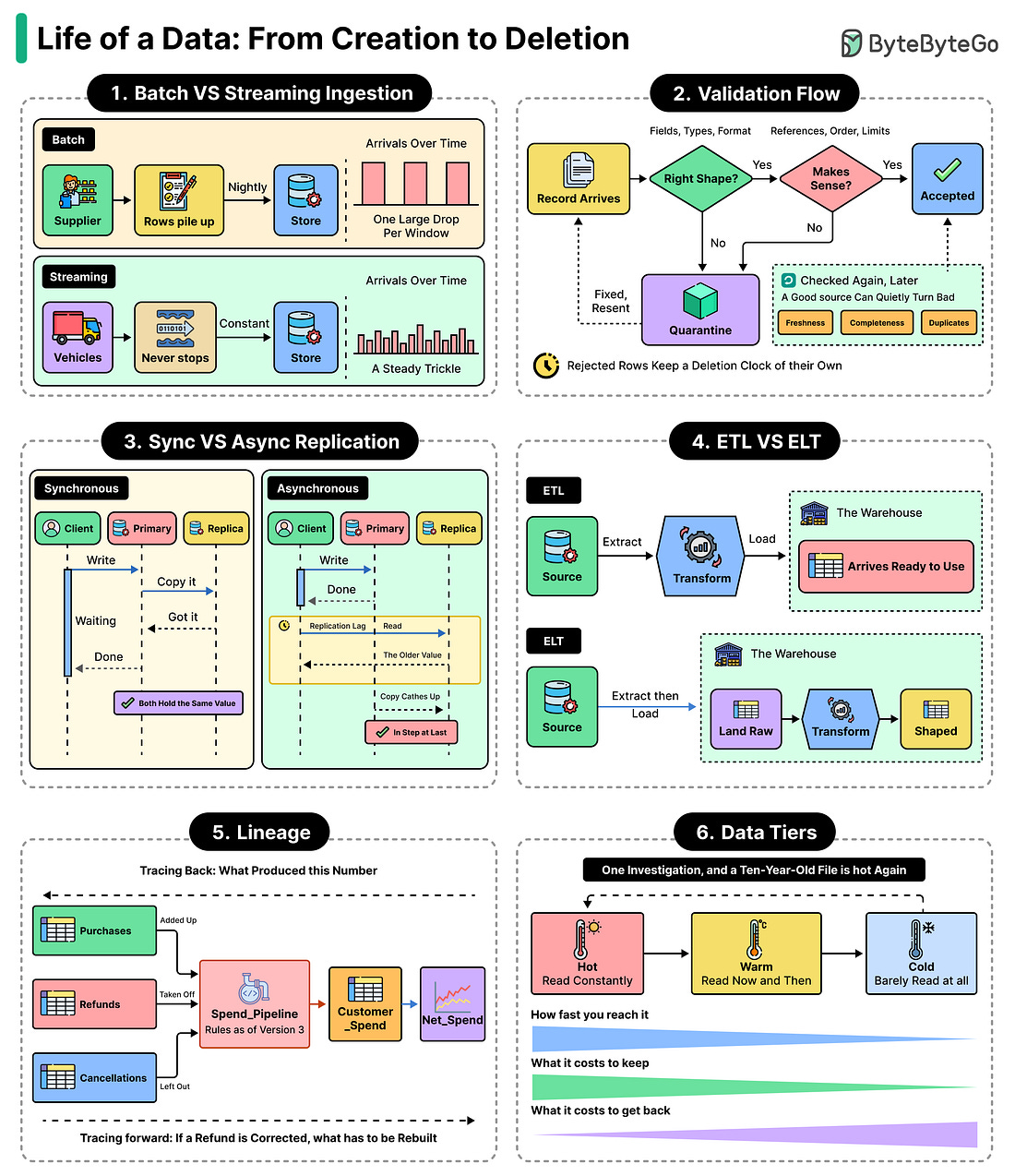
The lifecycle of data shows how information can enter a system, become useful, spread to other components, become old or stale, and eventually be deleted. Thinking about this lifecycle helps connect decisions that might otherwise seem separate, such as database design, performance, reporting, storage costs, recovery, and privacy.
In this article, we are going to look at the entire data lifecycle from creation to deletion and the decisions that need to be taken at each step.
 |
