
Hello,
Artificial intelligence is changing very quickly.
And I believe the
conversation has now reached an important turning point.
For the past several years, most of us have been asking questions like:
Can AI summarize a chart?
Can it help with research?
Can it write a clinical note?
Can it organize information?
But the question is beginning to change.
What happens when AI stops simply answering—and starts acting?
We Want You to Have Both
Dr. Robert
Conti and I have prepared two ways for you to explore this important issue:
READ THE NEW FMU WHITE PAPER
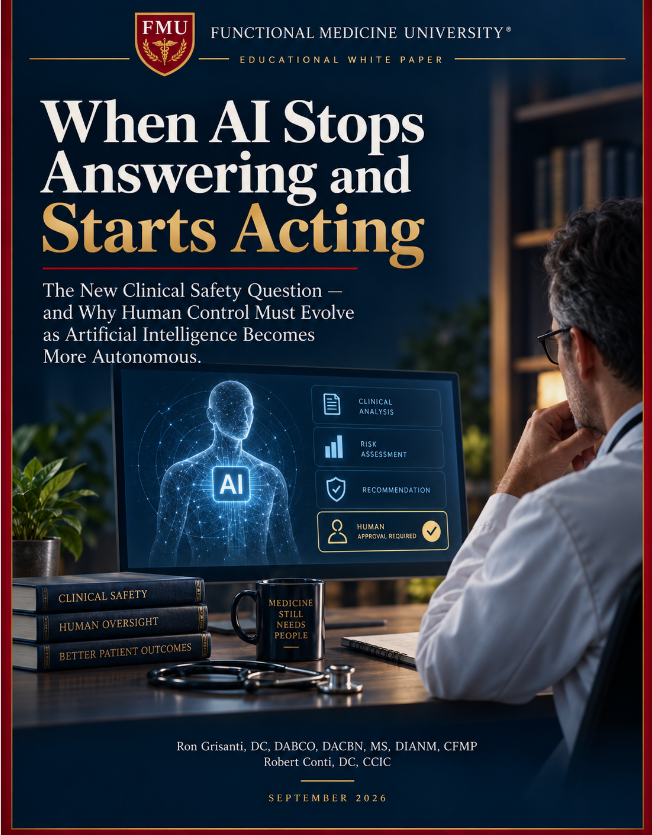
When AI Stops Answering and Starts Acting
The
New Clinical Safety Question — and Why Human Control Must Evolve as Artificial Intelligence Becomes More Autonomous
[DOWNLOAD THE WHITE PAPER]
PREFER TO LISTEN?
I also recorded a 13-minute personal audio commentary explaining what is happening
with AI right now, why clinicians should be paying attention, and what I believe we need to understand as AI moves from simply providing information toward increasingly autonomous action.
[WATCH / LISTEN TO THE 14-MINUTE COMMENTARY]
No registration is required for either one. I want you to have
them.
The paper examines the emerging shift from assistive AI toward increasingly agentic systems and, more importantly, what that means for clinicians.
It addresses questions such as:
- What is the difference between AI providing information and AI taking action?
- When should AI be allowed to proceed independently?
- Where should human approval remain
mandatory?
- Why is “human in the loop” not always enough?
- What happens when AI is factually reasonable but clinically wrong?
- Why are hallucinations only part of the problem?
- What
should happen when an AI system encounters uncertainty, conflicting information, or a potential safety issue?
One of the central ideas in the paper is what I call the Clinical Stop Rule:
AI should not continue simply
because it is capable of continuing.
The paper also introduces a practical Clinical AI Autonomy Model—from basic information support to actions that could materially affect patient care—and explains why the level of human oversight should increase as the consequences increase.
Another point I believe is especially important:
Capability is not permission. Performance is not authority.
AI can become increasingly powerful without becoming wiser, more accountable, or more clinically responsible.
I wrote this paper because I believe clinicians need something more useful than either hype or fear.
There are legitimate concerns surrounding AI.
There are also enormous opportunities.
The goal is not to panic.
The goal is to understand what is changing and prepare for it responsibly.
Download the White Paper Here
[INSERT WHITE PAPER DOWNLOAD LINK]
No registration is
required.
I want you to have it.
Want to Continue Following FMU's AI Work?
Over the next several weeks, I will be sharing additional white
papers, audio commentaries, practical clinical AI guidance, and updates on the development of FMU's new AI Certification.
If AI is an area you want to follow more closely, you can join our dedicated FMU AI Updates List below.
Joining that list simply lets me know you want to receive our
AI-specific educational updates rather than relying on the general FMU emails to catch them.
There is no obligation.
It is simply a way for those who are especially interested in AI and the
future of clinical practice to stay connected to what we are developing.
I believe this is going to be one of the most important conversations in healthcare over the next several years.
And one question may
eventually matter more than all the others:
Am I trained well enough to remain responsible while using increasingly capable AI?
I hope you find the paper useful.
To your growth and success,
Dr. Ron Grisanti
Founder, Functional Medicine University
Dr. Robert Conti
FMU Student Advocate
P.S. AI is becoming more capable very quickly. That does not mean clinicians should fear it—but it does mean we need to become more sophisticated in how we
supervise it. That is the conversation I want FMU to help lead.