
|
 |


A little before 8 p.m. ET this evening, the Supreme Court issued its decision in the cases out of Boston related to Trump’s executive order attempting to restrict mail-in voting—cases we’ve been tracking for weeks now. My cautious optimism paid off; the Court decided that states would continue to use the existing rules for the 2026 election, and that Trump’s EO would not go into effect. That’s an important decision to protect the midterm elections.
We’ve discussed the question what happens if we win? So you know I’ve been concerned that if the Supreme Court ruled against him, Trump would blame the courts, using a fake tale of fraud, to explain any losses his party suffers in the midterms, inevitably complaining the results are invalid. We know that is coming, and we’ll deal with it when we get there. For tonight, let’s celebrate the win—and use this decision to encourage friends to register and have a plan to vote no matter what, because massive turnout will be our strongest response to Trump’s lies about the election. We know he won’t stop just because of this one loss.
What of the Court’s decision? It was 7-2. No big surprises there. Justices Alito, joined by Justice Thomas, dissented. This was a shadow docket decision about whether an injunction could stay in place, not one following a full briefing on the merits, so the written order is just the few sentences below.
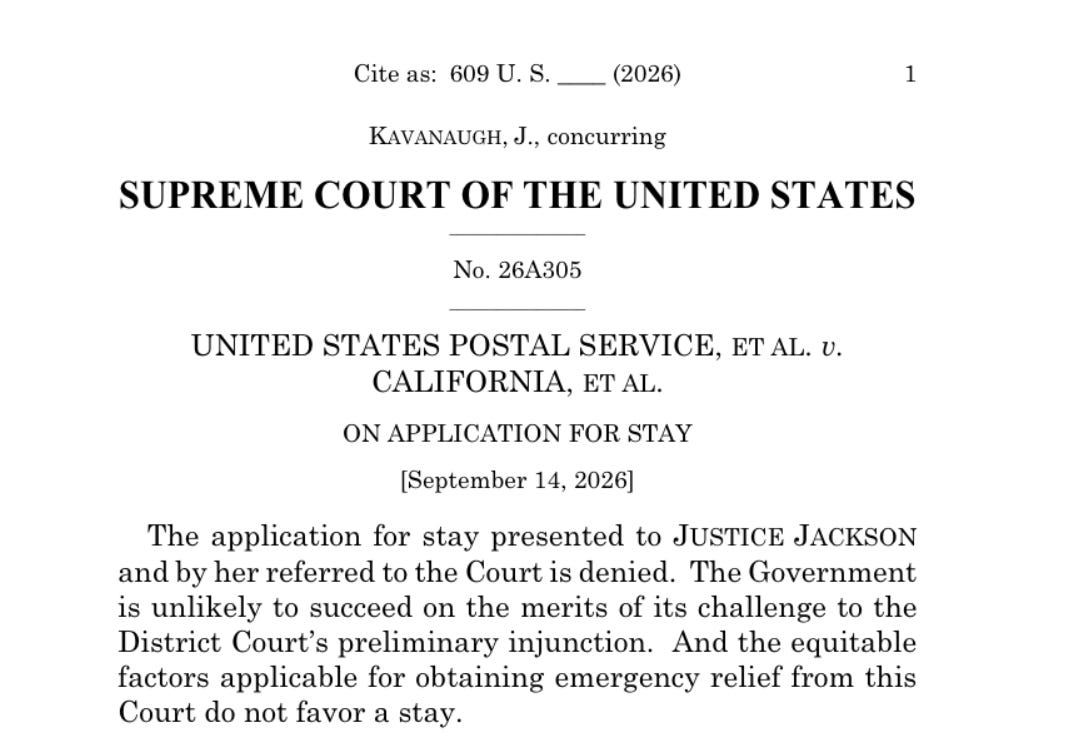 |
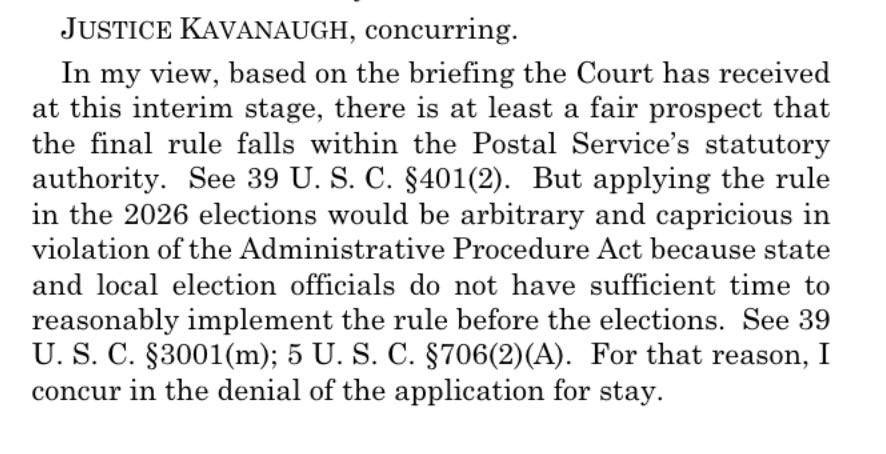
Justice Kavanaugh agreed with the order so far as the midterms go—“state and local election officials do not have sufficient time to reasonably implement the rule before the election”—but suggested he might side with the administration when it comes to future elections.
 |
That’s interesting in light of a decision issued by Judge Carl Nichols in the District of Columbia. We discussed that challenge to Trump’s EO back in May. He held a hearing on a request to enjoin the order and seemed inclined to accept the government’s “ripeness” argument, that in the absence of federal action to implement the EO, there wasn’t sufficient reason to enjoin the government. Then, after the hearing, crickets. Judge Nichols didn’t rule. Until now.
On Sunday night, he enjoined the EO from going into effect. Judge Nichols found that the EO was ultra vires, or beyond the power of the president to issue. He suggested that the Postal Service doesn’t have the power to administer elections. And his order goes beyond the scope of the injunction issued by Judge Talwani—it applies to the entire EO, it applies to all elections, not just 2026 (hence Justice Kavanaugh’s hedge), and it prohibits voluntary compliance by red states. (You can just hear all those red state secretaries of state breathing a sigh of relief, because they knew this plan was unworkable even if they weren’t willing to say it in public.)
Judge Nichols is a 2019 Trump appointee.
Justice Alito wrote in the dissent that “The Government will suffer irreparable harm absent relief. Because reversal of the District Court’s [injunction] would come too late for the 2026 midterms, the District Court’s errors deal a serious setback to the Executive’s goals while this litigation unfolds.” It’s almost as if voters, and their rights, don’t exist in Alito’s universe. He continued, “the Government has a strong interest in enforcing the rule, and implementing it will also ‘enhance the visibility of Federal Ballot Mail’ in order to better detect election fraud.”
There will, of course, be appeals. But the Supreme Court has spoken.
More good news: Judge Susan Illston of the Northern District of California ruled against a Trump plan to gut FEMA, cutting as many as 50% of its employees. The Judge held the plan was “pulled from thin air” and would impair FEMA’s ability to fulfill its statutory mission of responding to natural disasters. Judge Illston held that DHS violated the Post-Katrina Emergency Management Reform Act, which provides that the DHS Secretary “may not substantially or significantly reduce the authorities, responsibilities, or functions of the Agency.” Good job, Brownie.
And in the Southern District of Florida, Judge Kathleen Williams declined to stay her order imposing sanctions while Trump appeals her decision in Trump v. IRS, the case where he used a lawsuit in which he was effectively both the plaintiff and the defendant to create a slush fund he could use to reward his January 6 supporters and an immunity deal to protect himself, his family, and his business.
We discussed that case here and also here. A group of retired federal judges intervened to ask Judge Williams to reject Trump’s one-sided self-dealing, and she agreed, referring multiple Trump and DOJ lawyers to the state bars for disciplinary proceedings and preventing the Trump plaintiffs from claiming any of the benefits the faux settlement agreement between Trump and the IRS purported to confer on them. The case is currently on appeal to the Eleventh Circuit Court of Appeals, and Judge Williams’ order remains in place until the case is decided. She wrote that the public has “a significant interest in knowing that the judiciary is fair and that the same rules apply equally to all litigants,” and that if she lifted the sanctions order during the appeal, it would undermine public confidence.
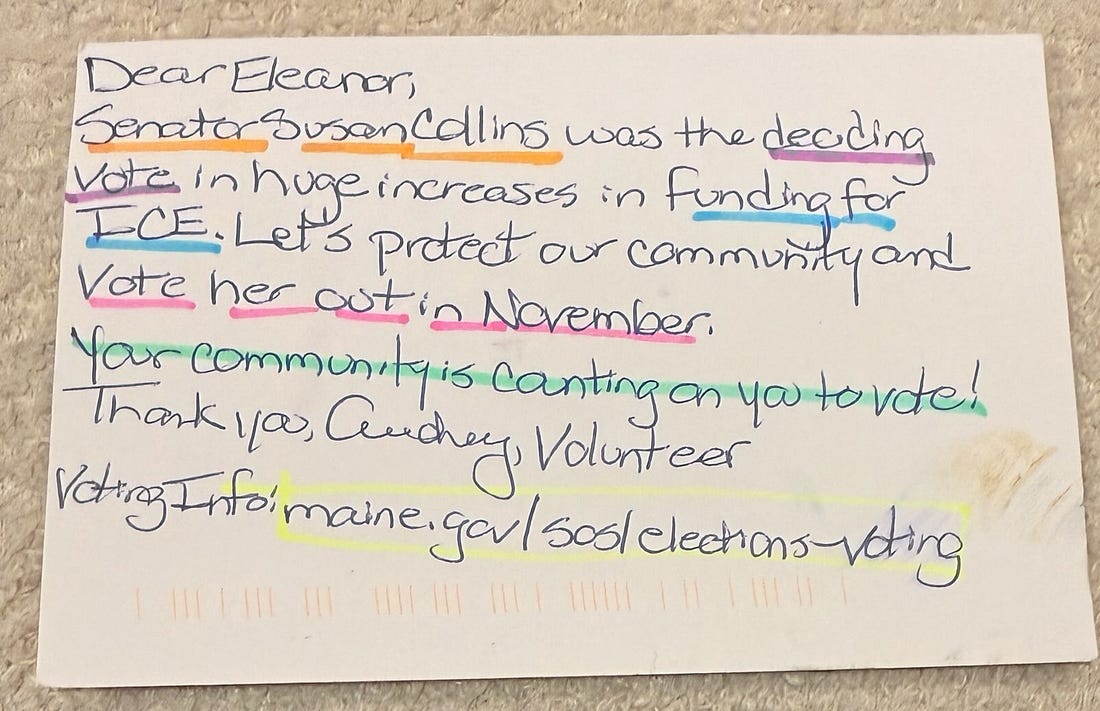
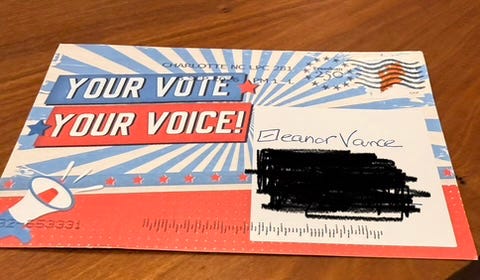
Finally, Americans seem to get it. Remember before the last election, and the one before it, we talked about postcards to voters—the practice of voters in one state sending postcards to voters in another state to encourage them to go out and vote? Today, my daughter, a Maine resident, got one of those postcards in the mail.
 |
 |
“Your community is counting on you to vote.”
Trump is not winning. Not in court. Not even in the Supreme Court. And certainly not with voters.
We are.