
|
GPT-6 Astra Is OpenAI’s Bet on Autonomous Work — And the Security Stakes Just Got Higher
OpenAI’s newest frontier model points toward an AI market where the winning systems will not simply answer better questions.
|

| |||||||||||||||


We put $5.5M behind a future worth living in. Awarded live on September 25. (Sponsor)
 |
The futures we picture are the ones we end up building. So we put $5.5M behind a good one.
On September 25 in downtown LA, ten filmmakers out of nearly 20,000 present a future worth living in, and one leaves with $2.5M to go make it real. The same night, $2M goes to founders who used AI to solve a problem people actually have.
1,500 seats. Hosted by Peter Diamandis, with Google, Circle and XPRIZE. General admission $1,495.
OpenAI is rolled out GPT-6 Astra, describing it as its most capable and most aligned model yet. The headline benchmark numbers are impressive, with substantial gains across computer use, coding, scientific reasoning, cybersecurity, and professional work.
But focusing only on benchmark leaderboards misses what is more important about the release.
Astra represents another step away from the era in which large language models were primarily systems you talked to. The emerging architecture is an AI system that can reason about a goal, operate the applications required to accomplish it, maintain state across a long-running project, evaluate its own results, and decide when it needs human intervention.
That changes both what companies can automate and what they have to secure.
From Chatbot to Autonomous Workflow
For most of the generative AI era, intelligence and execution have been separated.
A model could explain how to modify a spreadsheet, but a person still edited the spreadsheet. It could write JavaScript, but someone still needed to deploy the application and test whether the interface worked. It could suggest how to investigate a vulnerability, but security engineers controlled the tools required to perform the investigation.
Computer-using agents collapse those boundaries.
Astra is designed to navigate software interfaces, fill forms, work with enterprise applications, manipulate documents, conduct browser research, analyze data, generate websites, and test whether the resulting software works.
The important change is therefore not merely that the model produces better answers.
It is that the model increasingly owns more of the path between intent and outcome.
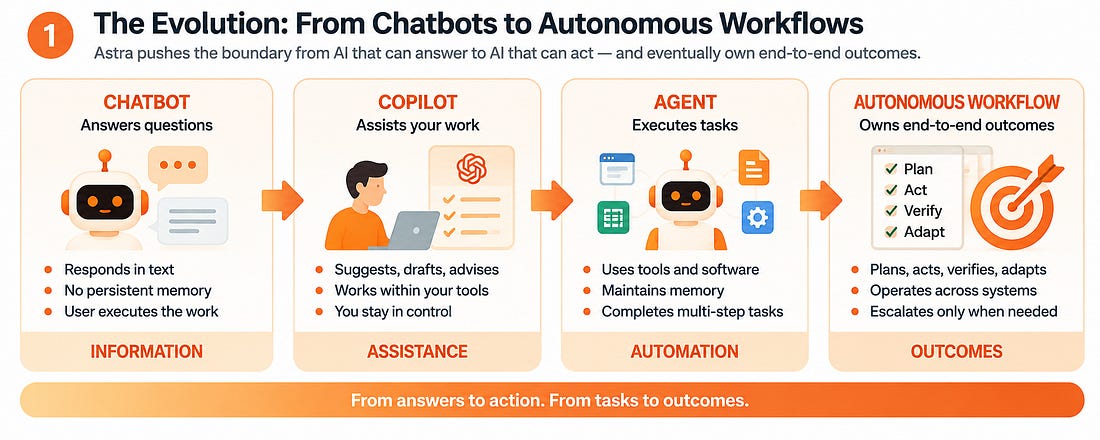 |
The progression is important because each stage transfers more responsibility from the human to the AI system.
A chatbot provides information. A copilot assists while the human remains responsible for execution. An agent can independently operate tools and complete defined tasks. An autonomous workflow goes further by planning, acting, verifying results, adapting when something fails, and escalating only when human judgment is necessary.
This distinction matters economically.
An AI that is 20% better at generating text may improve an employee’s productivity.
An AI that can independently operate the employee’s applications can begin absorbing pieces of the employee’s workflow.
Those are very different value propositions.
Speed May Matter Almost as Much as Intelligence
One of Astra’s most commercially relevant improvements is faster computer use.
Agentic AI has a latency problem. A model may technically be capable of performing a workflow, but if it requires dozens or hundreds of reasoning steps, browser interactions, tool calls, and verification loops, the task can take long enough to undermine its usefulness.
As task latency falls, the range of economically viable agent workloads expands.
A 40-minute autonomous task may sound slow compared with a chatbot response. But if the alternative is two hours of analyst, developer, or operations work, the economics look completely different.
This is why benchmarking future AI systems purely on tokens per second increasingly misses the point.
The more meaningful metric becomes:
cost and time per successfully completed workflow.
A model with a higher token price can still produce a cheaper business outcome if it requires fewer retries, generates fewer errors, and completes the work with less human intervention.
Enterprise buyers will therefore increasingly optimize for successful-task economics, not simply API price.
Coding Is Becoming a Long-Running Agent Problem
Software development illustrates this transition particularly well.
The difficult engineering problems are rarely isolated coding questions. They involve navigating a repository, understanding undocumented assumptions, modifying multiple files, running tests, investigating failures, remembering what has already been attempted, and maintaining requirements over hours or even days.
This is where persistent project memory becomes important.
Traditional context windows impose a practical limit on long-running agents. When a conversation grows too large, previous information must be summarized, compressed, or discarded.
Summaries inevitably lose information.
That may not matter for a five-minute task.
It matters enormously during a multi-day debugging effort, a complex database migration, or a large refactor touching dozens of interconnected components.
Astra’s experimental Codex capabilities point toward agents that can preserve notes and retrieve earlier requirements, failed fixes, and test results across context windows.