



 |
1. Epochal
Two shifts happened under the radar since Friday that are worth keeping your eyes on.
The first shift concerns the post-American world and it came on two fronts.
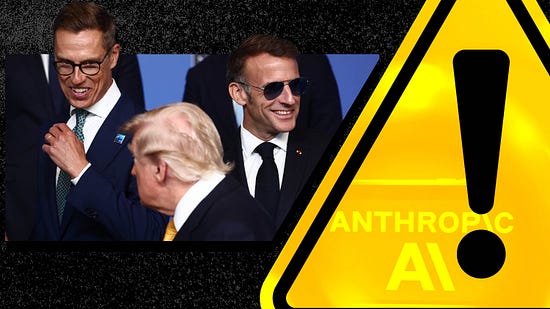
Finland announced today that it is joining the French nuclear deterrence initiative. You may recall that back in March France announced a change to its nuclear doctrine, stating that it would expand its nuke capabilities and partner with other allies to expand a nuclear deterrent independent of the United States.¹ Finland joins the nine other European countries—including Denmark—in joining France’s Forward Deterrence program.
This is the clearest sign possible that Europe is disengaging from America. Under Forward Deterrence, it will be possible for France to deploy nuclear-armed assets to allied countries, though command-and-control of those forces will still reside with the French president.²
As the Polish prime minister said back in March, “We are arming up together with our friends so that our enemies will never dare to attack us.”
Guess which group America now falls under?³
The second shift stalled out halfway. Oman was set to host talks between Iran and other Gulf states today in which the various parties were looking to strike bilateral agreements without involving the United States.
Those talks were cancelled after Houthi forces launched another successful attack on Saudi Arabia.
Here’s my sophisticated analysis: This is very bad.
It is bad that the war is widening.
Bad that our Gulf allies⁴ are willing to talk to Iran without the United States present to protect American interests.
Bad that Iran believes its position is so strong that it can strike (through its proxies) the Saudis just days before the meeting in order to assert dominance over the negotiations.
In both cases—the French nukes and the Arab–Iranian negotiations—the world is moving to a post-American order because of affirmative choices made by Donald Trump and the Republican party. None of this was caused by external events or dialectical forces.
Trump chose to alienate Europe, align with Russia, and demand territorial tribute from Denmark. Trump chose to launch the most foolish American war in (at least) a century because he was dazzled by an Israeli PowerPoint deck.
Decisions are being made by sovereign nations across the world; in every case they involve independence from American influence.
And there is no going back.
2. AI Panic
On Saturday Anthropic announced that it was unilaterally putting the breaks on frontier AI research. The company called on other businesses in the field to follow suit.
I want to set a baseline here for discussions about AI: No one knows how this shakes out.
It is possible that AI will turn out to be a massive bubble whose economic upside and disruptive downside was completely overblown.
It is possible that AI will be a revolutionary tool that causes great disruption, but also increases productivity, and, after a fashion, settles into a new status quo in the way that the industrial revolution and the internet revolutions did.
It is also possible that AI will cause a global catastrophe.
You should not trust the judgment of anyone who tells you that they know for certain which of these tracks AI is on.
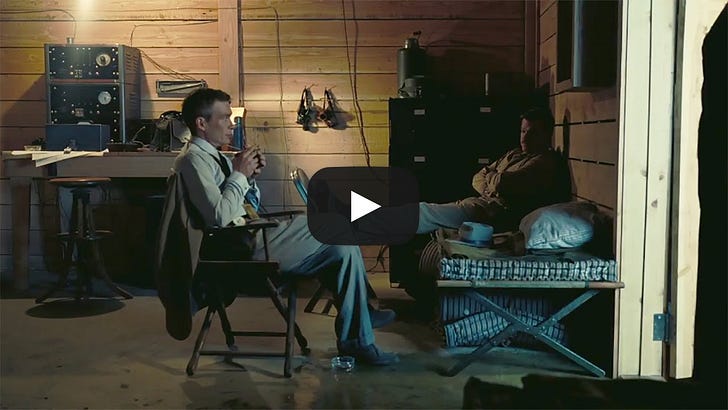
My intuition is that we are currently in a moment like the one from Oppenheimer when Gen. Leslie Groves is sitting with Bobby O. two hours before the Trinity test and asks, “What did Fermi mean by ‘atmospheric ignition’?”
Oppenheimer calmly explains that the engineers and physicists believe there’s a chance that detonating an atom bomb will cause an unstoppable chain reaction which turns the entire earth’s atmosphere into a fireball, killing everyone on the planet.
But, he says, that’s just the most remote possibility. “Chances are near zero,” Oppenheimer says.
Groves stops short and Oppenheimer says, “What do you want from theory alone?”
“Zero, would be nice,” Groves says.
The chances of AI causing a truly catastrophic event are probably near zero.
But zero would be nice.
What are the general dangers of AI