





 |
Detroit, Michigan
WHEN DONALD TRUMP SAYS HIS TRADE WAR with Canada will be good for American workers, Tanya Rincon is the type of person he has in mind.
Rincon is a recently retired autoworker who spent thirty years helping to build trucks and SUVs at the Ford assembly plant in Wayne, Michigan. That time span corresponds to a period when Ford and the rest of the “Detroit Three” frequently struggled with foreign competition, and when her union—the United Auto Workers—clamored for protection.
But when I ran into Rincon on Monday, just after she had marched with her union brothers and sisters in the annual Detroit Labor Day Parade, she gave me an earful about the tariffs Trump has applied to Canada.
“It’s just stupid,” she said.¹
Rincon made clear she wasn’t simply angry out of solidarity with her union counterparts in Canadian factories, or from a sense that Trump’s motivation is vanity rather than considered economic policy. Her big worry, she said, is what will happen to auto companies in Michigan—and her former coworkers on the line—as Trump disrupts an integrated trade relationship that has been in place for decades and has worked out well for both countries.
“We build parts for them, they build parts for us, we sell cars to them, they sell their products here,” Rincon told me. “We are always asking Americans to remember to buy American-made vehicles, and a lot of our American-assembled vehicles have some parts on them made in Canada, so that’s going to increase the price of American-made vehicles.”
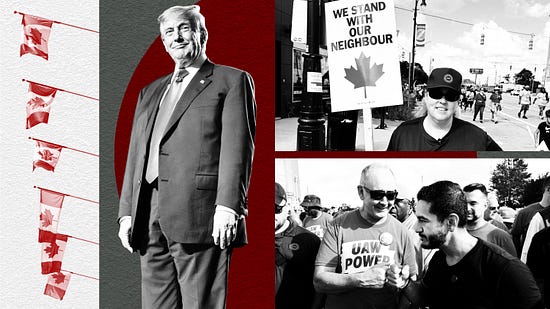
Rincon is hardly the only one thinking or saying such things. The UAW has come out strongly against Trump’s tariffs on Canada, even though it supports them for other countries, and during the parade another union supplied marchers with placards featuring a red maple leaf and the slogan “We Stand With Our Neighbour” (yes, the Canadian spelling).
The hostility Trump’s trade war has generated among the very people it’s supposed to benefit is not a good political sign for him or his party. And it’s not like the tariffs are playing better outside the union, as consumers brace for higher prices on everything from cosmetics to furniture to—yes—ice hockey equipment.
Michigan voters disapprove of Trump’s tariffs on Canada by more than a two-to-one margin, according to a new poll from the Detroit News and local station WDIV. That’s consistent with the findings of a June poll from EPIC-MRA, which asked about tariffs with Canada more generally and produced nearly the same two-to-one margin against.
All of this has turned the Canadian tariffs into a major issue in the midterm elections, especially in
The easiest decision you’ll make all year: Join the side you’re already on. Sign up for a Bulwark+ membership.
