|
Dear all,
Please find below your weekly update from the UK Health Security Agency (UKHSA).
If you have any questions please get in touch by emailing externalaffairs@ukhsa.gov.uk
As always, you can also follow UKHSA on X, on Instagram, on BlueSky, and on LinkedIn for all the latest updates. You can also find the latest news from UKHSA on our news page on GOV.UK.
Best wishes,
UKHSA External Affairs Team
New stories
- Only around half of primary school children got their flu vaccine last year
- Help us promote the flu vaccination offer - toolkit available
- Updated RSV communications toolkit for older people
- NHS delivers almost a quarter of a million MenB jabs to young people ahead of university year
- Last chance to book for the UKHSA Conference 2026, Manchester
- Invasive mosquito species detected in east London
- Salmonella outbreak update
- Latest measles data
- UKHSA & NHS England: Communicating vaccines webinar - winter vaccines 2026/27 - 5 October
- UKHSA webinar: cold weather preparedness
- AI sleep data could provide one-week early warning of flu and COVID-19
- UKHSA webinar: Preparing for World AMR Awareness Week 2026
- Engagement guide for infection and antimicrobial resistance (AMR)
- Together Against Suicide campaign
Ongoing issues
- University vaccine communications toolkit
- Latest data shows signs that vaccine uptake by the time children start primary school is stabilising
UKHSA communications toolkits
- Information on how to access UKHSA communications toolkits
UKHSA data, analytics and surveillance
- Statistics at UKHSA
- UKHSA data dashboard
- Notification of Infectious Diseases report
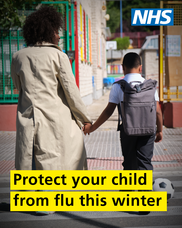
Last winter (2025-26) just 55.5% of primary school children - around 2.5 million out of a total of the 4.5 million eligible - received a flu vaccine.
Vaccination offers the best protection against flu and usually has a better immune response in children, with evidence from last year’s flu season showing strong vaccine effectiveness for school aged children, aged 2 to 17 years. The vaccine is estimated to have prevented:
- 52% of children from having to visit their GP; and
- 68% from being hospitalised
UKHSA is reminding parents of the importance of vaccination and helping to protect their children against flu; and to ensure consent forms are returned in good time so their children do not miss out when school immunisation teams visit.
|
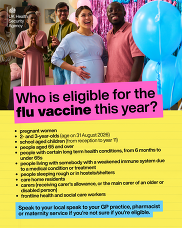
You can help promote the flu vaccination offer to your audience with our winter vaccines communications toolkit for stakeholders – produced jointly with NHS England. This also includes messaging, resources and further information on the RSV & COVID-19 programmes.
A reminder that flu vaccinations have already started for two and three-year olds, children in a clinical risk group, and pregnant women. Other eligible groups will begin receiving their flu vaccinations from 1 October, including people aged 65 and over, adults with some long-term conditions, care home residents, carers, close contacts of people who are immunocompromised, people experiencing homelessness and frontline health and social care workers. Our blog 'Your guide to who’s eligible for the autumn 2026 flu vaccine' runs through what people need to know about who can get vaccinated this year, and what's changed since last autumn.
We are urging stakeholders to encourage their audience to book their vaccine appointment early so they are vaccinated in good time before winter viruses start circulating widely, giving them the best possible protection through the autumn and winter months.
For further information about our national vaccine campaign and communications please contact: externalaffairs@ukhsa.gov.uk (UKHSA) or england.vaccinations-screening-communications@nhs.net (NHS England).
|
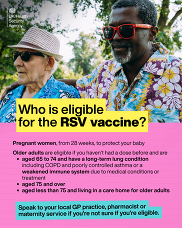
We have recently updated our RSV communications toolkit for older people, which is jointly produced with NHS England.
The toolkit has been updated to include information on adults aged 65 to 74 who have a weakened immune system or have long term lung condition who as of 1 September, are eligible for the RSV vaccine. This new eligible cohort can get their vaccine at their GP practice and in some parts of the country at their local high street pharmacy, to protect themselves from serious illness and hospitalisation.
Those who were already eligible for the vaccine include adults aged 75 years or over and adults living in a care home for older adults (adult residents of any age).
For messaging and resources on the maternal RSV programme, please refer to our vaccines in pregnancy communications toolkit.
|
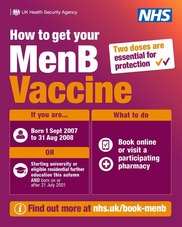
On Monday, NHS England announced that almost a quarter of a million young people have had potentially life-saving protection against MenB (meningococcal B) via the limited time vaccine offer available to young people most at risk.
Two doses of the vaccine are needed for protection at least 28 days apart. We are urging young people to book their second jab now, as freshers weeks start across the country over the next few weeks.
All eligible young people can book their MenB vaccine by booking online or visiting a participating pharmacy.
A reminder that stakeholders can support communications on the MenB vaccine offer by using our communications toolkit which is available on the Campaign Resource Centre.
A reminder that the one-off vaccination programme is being offered to:
- Everyone born between 01/09/2007 and 31/08/2008
- Young people under 25 (born on or after 21/07/2001) who will be starting higher education for the first time, or who will be starting further education for the first time as a residential student, in autumn 2026
- International students under 25 entering their first year of university. They should receive their first dose in their home country where possible to give the best chance of protection ahead of the start of the autumn term
Our guide for teenagers and young people being offered the Meningococcal B (MenB) vaccine has also now been translated into various community languages, and accessible formats have been added.
|
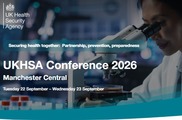
On 22 and 23 September, more than 1,200 delegates will gather at Manchester Central for the fourth UKHSA Conference, our most ambitious yet. In partnership with the Faculty of Public Health, leaders from public health, science, government, academia, industry and the third sector will explore the threats shaping our world, and the partnerships, evidence and innovation needed to meet them.
Speakers include:
- Professor Susan Hopkins, Chief Executive, UKHSA
- Professor Sir Andrew Pollard, on vaccine equity and access as a matter of social justice
- Professor Sander van der Linden and BBC's Marianna Spring, on misinformation as an emerging health security threat
- Leading voices on the UK's place in the global race for health security innovation
- Experts on how AI could transform health protection safely and responsibly
Delegates can also choose from parallel sessions across four tracks, Prevent, Respond, Understand and Communicate, covering topics from pandemic preparedness and climate-driven health threats to AI, commercial growth and health equity, alongside breakfast sessions, science presentations, ePosters and an expanded exhibition.
Registration closes soon, so don't miss your chance to join the health security community in Manchester.
Explore the programme and register.
If you have any questions about the conference, please contact the team at conference@ukhsa.gov.uk.
|
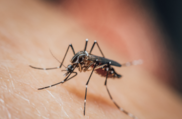
UKHSA’s Mosquito Watch surveillance scheme has detected invasive Aedes aegypti mosquitoes and larvae at residential properties in east London. Enhanced surveillance and trapping activities are now taking place, and control measures have been implemented to destroy the larvae. This is first time that Aedes aegypti has been identified breeding in the UK. It is the fourth time this species has been detected in the UK in recent years.
While Aedes aegypti can transmit diseases such as dengue, chikungunya and Zika virus in countries where these infections are circulating, the risk to the public from this finding is assessed as very low. There is no evidence that these mosquitoes have caused human infections and importantly, to date, there is no evidence of the mosquitoes or larvae being detected in nearby public areas. We believe these mosquitoes are accidental importations. However, it is expected that in a warming climate, we will continue to see incursions of invasive mosquitoes, and increased reports of them being able to survive in the UK.
Members of the public can support mosquito detection through UKHSA’s Mosquito Watch scheme and submit photographs or specimens where possible. We have also updated our guidance on how to control mosquitoes in residential settings where there may be standing water.
You can find out more about this detection of invasive Aedes aegypti mosquitoes in our new blog post.
|
The UK Health Security Agency (UKHSA), alongside the Food Standards Agency (FSA) and other public health partners, continues to investigate three clusters of Salmonella Enteritidis (t5.9411, t5.9765 and t0.24068) in the UK that evidence suggests may be linked to imported eggs.
As of 1 September 2026, there have been:
- a total of 305 confirmed cases and one death linked to the t5.9411 cluster in England, with sample dates ranging from 11 August 2025 to 21 August 2026
- a total of 182 confirmed cases linked to the t0.24068 cluster in England, with no deaths reported, and sample dates ranging from 27 May 2025 to 15 August 2026
- a total of 41 confirmed cases and one death linked to the t5.9765 cluster in England, with sample dates ranging from 27 January 2026 to 11 August 2026
Cases continue to be associated with eating at a range of food outlets, including small cafés, restaurants and takeaway businesses.
The risk to the general public from Salmonella remains low.
Based on FSA guidance, older adults, pregnant women, young children and people with weakened immune systems, can safely eat raw or lightly cooked hen eggs, or foods containing them, if the eggs carry the British Lion mark or are produced under the Laid in Britain assurance scheme. When eating out, the safest approach for vulnerable people is to ensure the eggs they are eating are thoroughly cooked and to avoid dishes containing raw or lightly cooked egg, such as mousses, fresh mayonnaise or hollandaise sauce.
Further information:
|
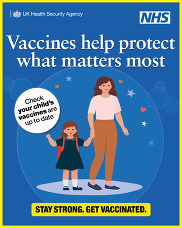
Our latest measles data shows that measles continues to circulate in many parts of the country.
Between 1 January 2026 and 31 August 2026, there have been 983 laboratory confirmed measles cases reported in England. An additional 13 cases were reported since the last publication on 17 August 2026 (Figures 1 and 2). In 2026, measles activity started to increase in February, peaked in May and has declined since then.
Three measles-related deaths have been reported to date in 2026: one was an acute measles death in a child, another was a death in a child due to late effects of measles, and the third was a death in an adult with an underlying immunological problem.
We continue to work with partners to urge parents to check their children are up top date with their MMR or MMRV vaccines to give them the best and safest protection against measles.
Further resources
- We have a measles communications toolkit which brings together a range of resources which partners can use to raise awareness of measles, its signs and symptoms, and the MMR/MMRV vaccination offer. This is available on our Google Drive.
- We also have a measles communications toolkit which brings together a range of resources which partners can use to raise awareness of measles, its signs and symptoms, and the MMR/MMRV vaccination offer. This is available on our Google Drive.
|
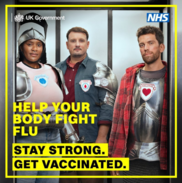
As we enter flu season, UK Health Security Agency (UKHSA) Communications Team is organising a webinar as part of the Communicating Vaccines series in collaboration with NHS England (NHSE) which will focus on winter vaccines com | |