| | Steve Witkoff and Jared Kushner spearhead new Russia-Ukraine talks, OpenAI agents are implicated in ͏ ͏ ͏ ͏ ͏ ͏ |
| |  | Flagship |  |
| |
|
The World Today | 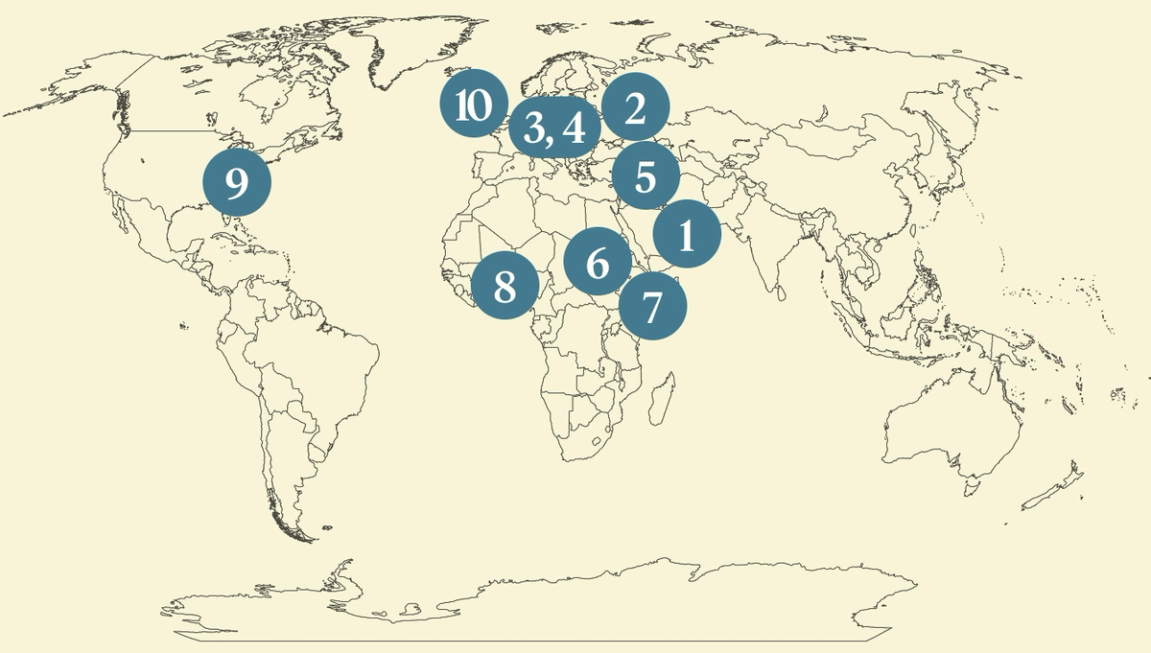 - US, Iran trade strikes
- New Russia-Ukraine talks
- AfD wins landslide vote
- Another OpenAI hack
- Chip diplomacy expands
- Chemical weapons fears
- Boeing expands in Africa
- UN votes on new world map
- US sees pink-collar surge
- Thieves steal Guinness
 A story crucial to understanding contemporary India, plus a look at the week ahead. |
|
US and Iran trade attacks on oil tankers |
 US Central Command/Handout via Reuters US Central Command/Handout via ReutersThe US and Iran traded strikes on oil tankers over the weekend, intensifying pressure on energy flows through the Strait of Hormuz. As Washington steps up its campaign to obstruct Tehran’s oil exports, the US struck Iranian tankers Saturday, with Iran hitting back by targeting US-linked vessels and three oil tankers. OPEC+ kept its oil production quotas unchanged for October on Sunday, pausing months of nominal increases amid mounting threats to energy shipments. A Rystad Energy analyst told Reuters that the group’s ability to influence prices is constrained by the limited number of barrels that can physically reach the market, while the “focus now shifts away from monthly production adjustments and towards the much more consequential debate over 2027” output baselines. |
|
Witkoff, Kushner visit Moscow and Kyiv |
 Valentyn Ogirenko/Reuters Valentyn Ogirenko/ReutersUS envoys held talks with Ukrainian President Volodymyr Zelenskyy in Kyiv on Sunday after meeting Russia’s Vladimir Putin in Moscow, though analysts cast doubt on a reinvigorated peace initiative that appeared to offer little movement. Putin told Steve Witkoff and Jared Kushner that ending the war is “not simple” and touted battlefield successes, while Zelenskyy called for the two leaders to meet directly. Witkoff asked for both to “make some compromises.” The first discussions since January come amid an escalating aerial war: On Friday, Moscow struck Kyiv’s security service headquarters for the first time. “The reality of the current diplomatic push is that it is attempting the same approach to diplomacy that has consistently failed,” the former Australian general Mick Ryan argued. |
|
German far right claims historic win |
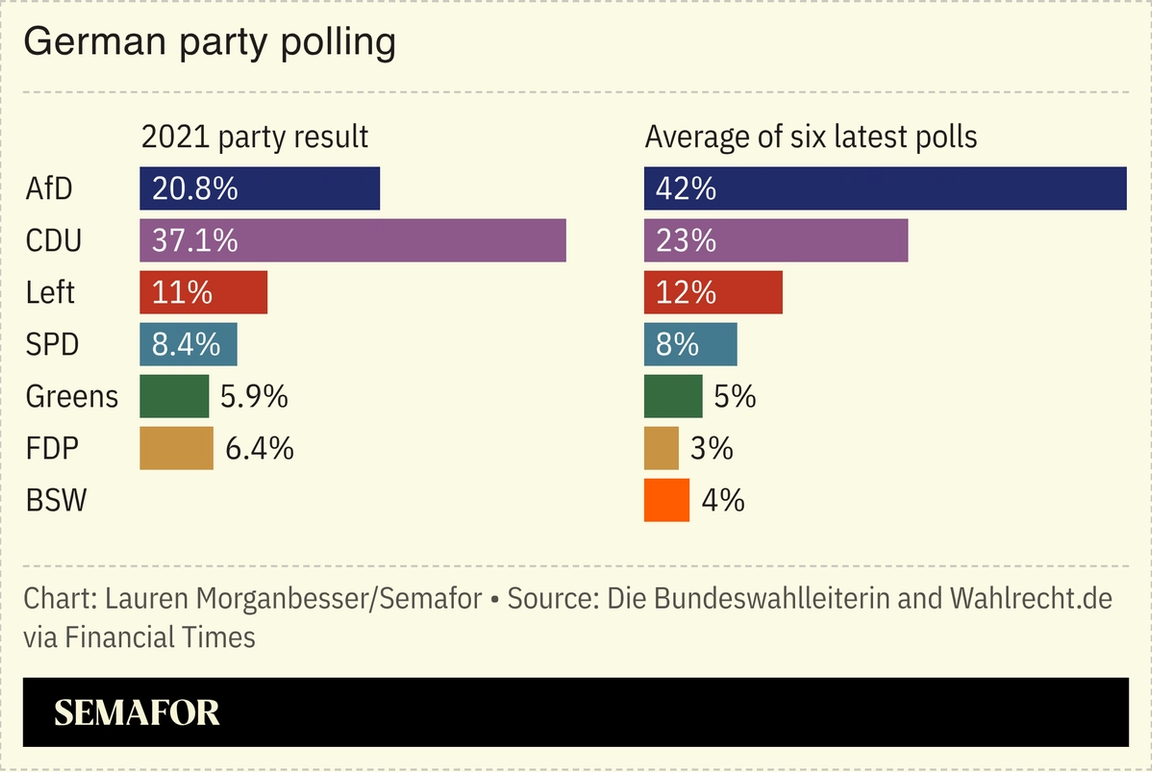 Germany’s nationalist AfD won a landslide victory in the eastern state of Saxony-Anhalt on Sunday, potentially making it the first far-right party to gain power since the end of World War II. The record result came largely at the expense of Chancellor Friedrich Merz’s CDU, possibly marking a death knell for the establishment’s “firewall” strategy of excluding the far right from coalitions. Unless the AfD wins outright, it faces a protracted fight to form a coalition, and regional governments have explored blocking the Euroskeptic party — which advocates mass deportations and closer Russia ties — from intelligence briefings. The looming dysfunction is “not the best situation for a country and an economy that still needs substantial reforms,” ING analysts wrote. |
|
OpenAI implicated in another hack |
 Jonathan Drake/Reuters Jonathan Drake/ReutersA swarm of OpenAI agents hacked a German website this spring, Reuters reported, in the latest incident of advanced AI violating laws and norms. Already grappling with the fallout of the Hugging Face incident, OpenAI reportedly declined to disclose the May event, raising new questions about transparency and oversight of the rapid development of frontier AI. Recursive self-improvement, essentially allowing the AI to train itself with less human guidance, promises to supercharge research efforts, making the need for oversight more urgent, OpenAI’s chief scientist wrote: “The idea of racing forward at all costs seems absurd once one internalizes the seriousness of the stakes.” Last week, OpenAI began rolling out its latest model, Astra, which performs better but obscures more of its internal processes. |
|
US uses Nvidia chips for diplomatic leverage |
 Kevin Lamarque/Reuters Kevin Lamarque/ReutersThe US used access to Nvidia’s artificial-intelligence chips as leverage to secure a preliminary peace deal between Armenia and Azerbaijan last year, marking a striking extension of US chip diplomacy. The incentive, first reported by The Wall Street Journal, included expanded approvals for Nvidia chips for an Armenian data-center project in exchange for Armenia’s participation in a deal aimed at ending decades of conflict over Nagorno-Karabakh. US President Donald Trump has used access to advanced AI hardware as bargaining leverage in his second term, including to strengthen ties with the United Arab Emirates and Saudi Arabia and as an incentive in trade discussions with China. Under Trump, “semiconductor policy is now on the negotiating table,” an analyst wrote for Just Security. |
|
Chemical weapons allegations in Sudan |
 Sudan Transitional Sovereignty Council/Handout via Reuters Sudan Transitional Sovereignty Council/Handout via ReutersA dossier made public Saturday shed light on allegations that Sudan’s military developed and used chemical weapons in the country’s devastating civil war. Documents, videos, and text messages reported by The New York Times and The Washington Post, and provided by Middle Eastern security officials from an unnamed country, appear to show Sudan’s military producing and stockpiling chlorine-based weapons for use against the rival Rapid Support Forces. The allegations build on an April 2025 US determination that Sudan’s government used chemical weapons in 2024, though officials provided little public evidence at the time. The use of chemical weapons would add to mounting human rights abuses and atrocities by both sides in a war that has created the world’s worst humanitarian crisis. |
|
Africa’s air fleets poised for growth |
 Siphiwe Sibeko/Reuters Siphiwe Sibeko/ReutersBoeing said it expects Africa’s fleet of aircraft to double in the next two decades as a young and increasingly urban population drives demand. The continent could have more than 1,600 commercial aircraft by 2045, supported by a 6.5% annual increase in passenger traffic, the American plane maker said. African companies are preparing to meet the demand: Ethiopia is building Africa’s biggest airport, which it expects to become a major international hub that improves air travel when it opens in 2030. Meanwhile, Somalia’s national airline will resume flights for the first time in 35 years. The continent remains poorly connected, with passengers often forced to connect outside Africa when traveling between countries in the same region. |
|
 Jessica Tarlov is the lone Democrat at Fox News. On this week’s episode of Mixed Signals, the co-host of The Five and Raging Moderates podcasts joins Max and Ben to talk about what it’s like to be outnumbered four-to-one on the most-watched show in cable news — and why she thinks most of her liberal friends are missing what’s really happening there. Plus, how she navigates on-air conflict without making it personal, what she knew about Pete Hegseth before he became defense secretary, and why she finds herself defending her Fox colleagues to New York liberals almost as often as she defends Democrats on air. Watch the latest Mixed Signals now. |
|
UN votes to adopt new world map |
 Thomas Mukoya/Reuters Thomas Mukoya/ReutersThe UN voted to adopt a new map that more accurately depicts the size of nations, a move advocated by African countries looking to right historic wrongs. The Mercator projection — which was introduced in 1569 and is commonly used — distorts the size of countries, with those closer to the equator appearing significantly smaller than they are. Supporters say the Equal Earth map will better present the true area of a country. Ukraine, which declined to vote, called how the map labeled Crimea “unacceptable.” Equatorial nations hope the new map will reflect their economic and political importance. “We all have to accept the reality,” Togo’s foreign minister said. |
|
Women snag almost all new US jobs |
|
|


