|
Nonprofit, investigative journalism on a mission to hold the powerful
to account.
|
Donate
|
|
|
|
|
|
|
|
|
In today’s Dispatches: Reporter Megan Rose spent years covering the case of Fred Steese, who was imprisoned for more than 20 years for a murder he didn’t commit. Megan reflects on Steese’s life in the wake of his recent death. |
|
|
|
I’d like to tell you about Fred Steese, who died this month of cancer at 62. When I first met Fred, he was living hand to mouth in a seedy motel on the outskirts of Las Vegas. He had been released from prison a couple of years earlier and struggled to find stable housing and a job, because — on paper, at least — Fred appeared to be a convicted murderer. |
|
| |
|
In 1995, Fred was wrongfully convicted of the murder of Gerard Soules — a former trapeze artist who had a dancing poodle show at a Las Vegas casino — even though prosecutors had evidence that he was hundreds of miles away at the time. He then spent 21 years in prison before a judge declared him innocent.
I wrote about Fred in a 2017 ProPublica and Vanity Fair story. It was part of a series that investigated how an obscure type of plea deal was shaping innocence cases and giving cover to district attorney offices that didn’t want to admit wrongdoing — or examine prosecutorial misconduct.
In Fred’s case, he told me he thought his ordeal was finally ending when the judge uttered the words “factually innocent” during a court hearing in 2012. Instead, Las Vegas prosecutors insisted he was guilty, that they had not made a mistake all those years ago and that they would retry him for Soules’ murder. But then they dangled a deal: Fred could walk away now, if only he would agree to plead guilty.
The offer was something I, and a lot of lawyers I talked to, had never heard of. It’s called an “Alford plea,” and it allows someone like Fred to assert for the record that they are innocent but agreed the state might be able to convict them anyway. Experts told me some prosecutors around the country were using the obscure plea as a tool to thwart exonerations.
Fred took the deal. He felt he couldn’t face the uncertainty of another trial and the additional time it would rob from him. Fred had only 13 years of freedom before he died.
In June, he went into the hospital for a hernia operation, and when he wasn’t healing like he should, the doctors discovered a large mass on his liver and another on his pancreas. It was stage 4 cancer. By August, he was in hospice, and he died on Aug. 8.
When I heard, it felt like the universe had dealt Fred yet another injustice. Fred did see a measure of accountability, and I can appreciate as an investigative reporter the rarity of that being the case at all. But I’m sobered that his death means he spent more time fighting to clear his name than he got to enjoy his freedom. He deserved 40 more years.
In late 2017, with the help of a tireless pro bono lawyer who worked his case for years, Fred was fully and unconditionally pardoned by the state of Nevada. His record was finally cleared after 22 years.
The pardon cleared the way for the state to pay Fred $1.4 million for his wrongful conviction. |
|
|
|
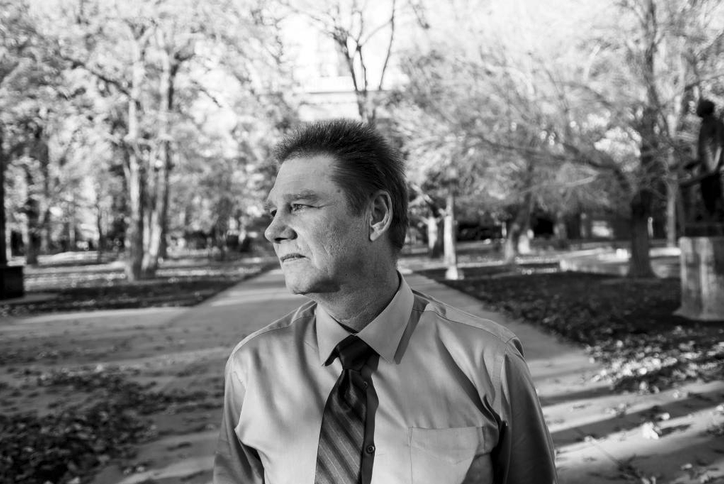
Fred Steese after his successful pardon hearing on Nov. 8, 2017. (David Calvert for ProPublica) |
|
|
|
Fred bought a pickup truck, a Mustang and his very own big rig; his lifelong dream was to be a long-haul trucker.
He didn’t manage to keep the money for long, though. Fred, who’d been in and out of foster homes as a child, spent much of his life outside prison without reliable structure, much less a budget. He was a drifter. He also struggled with drug use. At one point, Fred was swindled out of upward of $15,000 when someone pretended to be the owner of a house for sale that Fred wanted to buy.
Fred’s most marked characteristic was his cheerfulness. He was an easy laugh, and his good-humored resourcefulness quickly endeared him to those he met. “He’d give you the shirt off his back, even if he didn’t have another one,” his sister, Lynn Myers, told me.
Ryan Norwood, the federal public defender who proved Fred’s innocence, told me he wished Fred had had more time. “But he got to live his dream of being a truck driver and to live his life on his own terms for better or worse.”
Myers hadn’t seen Fred since childhood, but the two reunited after he was exonerated, and the relationship was a rare touchpoint in Fred’s otherwise transient life. Fred’s ashes will rest in a handmade wooden box at Myers’ home in California. “Maybe now,” she said, “he’s driving big rigs for God.” |
|
|
|
Read the Original Investigation |
Start reading Rose’s original story, which was published in 2017, below.
Fred Steese, Inmate No. 45595, often gazed at the 18-wheelers rumbling by the state prison on a desolate stretch of highway outside Las Vegas, yearning to be behind the wheel. Lying in his bunk in Cell Block A, Unit 7, he’d picture himself double-clutching down hills, filling out the logbook, expertly backing up as he made deliveries. Semis had been an obsession since he’d begun hitching rides with truckers between stints with foster families and in group homes. By 16 he’d stolen his first big rig. Now middle-aged, Steese treasured a commercial driver’s license manual, so well-used it was held together by tape.
As a lifer, however, he knew that even this modest ambition was out of reach. In 1992, a once famous trapeze artist who’d moved on to performing with a costumed poodle act on the Strip had been found murdered, stabbed dozens of times in his trailer on the outskirts of Las Vegas. Police found a prime suspect in Steese, a drifter with a record, who for a short time had been the victim’s lover and assistant, and who, after protesting that he was innocent, offered a confession.
But there was evidence Steese had been 670 miles away at the time — and prosecutors in Las Vegas didn’t share it. The prosecutors went on to win seats as state district court judges, where they still sit. Steese went to prison for life with no possibility of parole. That would have remained his fate except that, somehow, in a life with few breaks, Steese finally caught one. |
|
|
|
|