
|
Perplexity and Nvidia Are Betting on Local AI
Perplexity’s Portable Computer moves the model, agent runtime, files, tools, and much of the work onto local Nvidia hardware—a shift that could reshape enterprise AI costs, privacy, security, and the
|

| |||||||||||||||


The Network Layer Problem Most Privacy Stacks Don’t Address (Sponsor)
 |
Your carrier operates at a layer your privacy settings can’t reach.
Privacy engineering lives at the application layer — encryption in transit, zero-knowledge design, data minimization. The network layer gets less scrutiny.
Your carrier sits below all that. It sees your IMSI — a static identifier tied to your SIM that persists across every tower connection, regardless of VPN, DNS, or OS. It also sees your real number, call and text metadata, and location via tower triangulation. No application-layer config touches it.
Cape rotates the IMSI every 24 hours, resetting the trail at the only layer where the problem lives.
For most of the generative AI boom, using advanced AI has meant sending work somewhere else. A prompt leaves the laptop, travels to a remote data center, runs across expensive accelerators, and returns as an answer. That architecture made sense when frontier models were too large to run anywhere except hyperscale infrastructure.
But AI agents are creating a different computing problem. Instead of answering one question and stopping, an agent may inspect hundreds of files, call tools, write and execute code, retry failed steps, summarize intermediate results, verify its own output, and continue working for minutes or hours. Suddenly, the question is no longer simply where the smartest model lives. It is where all of that persistent AI work should happen.
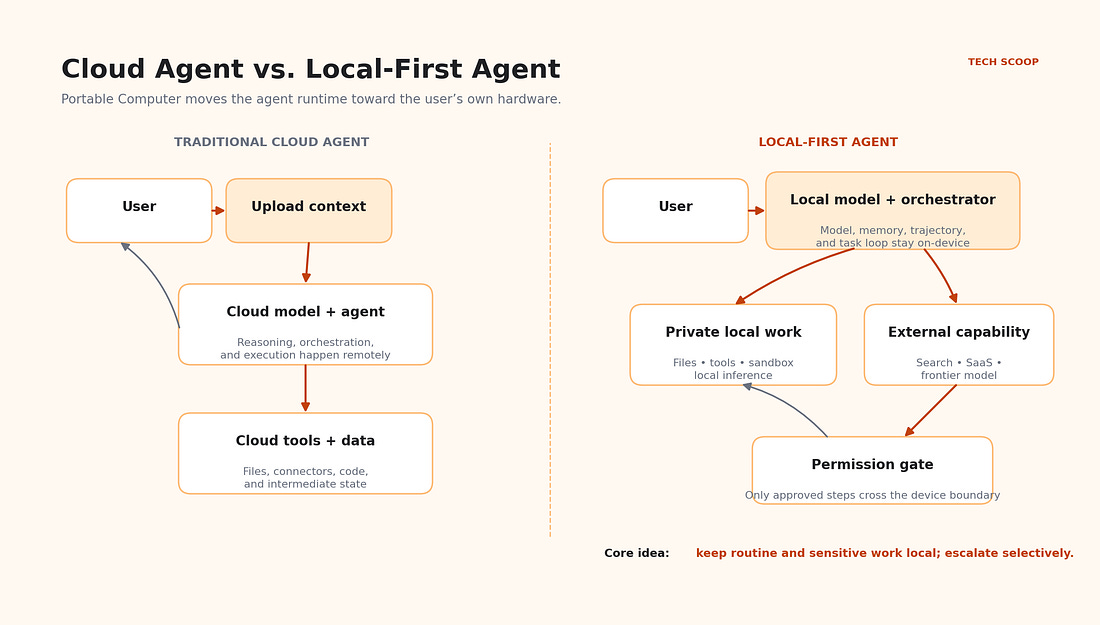
Perplexity is making a notable bet on the answer. On August 25, 2026, it launched Portable Computer, a local-first version of its Computer agent designed initially around Nvidia’s DGX Spark and, more broadly, Linux systems equipped with sufficiently powerful Nvidia GPUs. The important part is not that a 27-billion-parameter model can run locally. Developers have been running open models on workstations for years. What makes Portable Computer strategically interesting is that Perplexity is moving much more of the agent itself onto the device. The model, harness, conversation state, trajectory, local tools, file processing, and security sandbox can all operate on hardware controlled by the user. External capabilities such as web search, SaaS connectors, or a stronger frontier model are invoked only when needed and can be gated by user permission.
That turns local AI from a model-serving experiment into something closer to an operating environment for autonomous software.
Portable Computer Is More Than a Local LLM
A local chatbot only needs to accept a prompt and generate text. An agent needs an execution loop. It must decide what to do next, gather context, select tools, act on the environment, inspect the result, recover from mistakes, and eventually decide that the task is complete. Perplexity says its deterministic orchestrator manages that loop while the language model proposes actions. Approved commands execute inside an OS-level sandbox that controls process, filesystem, and network access. If the sandbox cannot run, the harness disables tool execution rather than silently falling back to the user’s full operating-system permissions.
 |
Why Agentic AI Changes the Economics of Inference
This architecture matters because agents change the economics of inference. A chatbot produces a visible stream of tokens and stops. An agent can consume enormous amounts of compute that the user never sees. Ask an agent to analyze a folder containing hundreds of contracts and it might read every file, extract text, inspect tables, compare clauses, run scripts, generate intermediate notes, revisit uncertain conclusions, and produce a final report. One human request can therefore become dozens or hundreds of machine actions.
Under a cloud-only architecture, nearly every one of those actions can translate into additional paid inference. The better agents become at doing useful work, the easier it becomes for organizations to generate large amounts of token consumption. Perplexity explicitly identifies rising token expenditure as one of the problems behind its local-first design. When inference runs on the user’s device, the economics shift from metered API consumption toward utilization of already-purchased hardware. Perplexity says local model work carries no inference fee within Portable Computer, while cloud services remain available for tasks that need them.
That does not mean local inference is free. Hardware has to be purchased, powered, cooled, maintained, and eventually replaced. Nvidia currently lists DGX Spark at $4,699. The system provides 128GB of coherent unified memory, up to 1 petaflop of FP4 AI performance, 273 GB/s of memory bandwidth, a 20-core Arm CPU, and support for models up to roughly 200 billion parameters. But those economics look very different from API pricing when the machine is heavily utilized. The more hours per day an agent works, the more attractive fixed-cost local infrastructure can become compared with paying for every intermediate model call.
The Shift From Paying Per Token to Owning the Compute
This is the same rent-versus-own calculation infrastructure teams have made for decades. Cloud compute is extremely attractive when demand is irregular, rapidly changing, or requires enormous scale. Owned infrastructure becomes more compelling when workloads are predictable and consistently utilized.
AI agents push inference toward the latter category because useful agents are not necessarily occasional. A coding agent can work throughout a developer’s day. A financial agent can continuously analyze local records. A research agent can build and update knowledge bases. A security agent can inspect artifacts in the background of existing workflows.
As AI shifts from something employees occasionally ask questions to something that performs persistent labor, compute utilization can rise dramatically.
The Emerging Model: Local Worker, Frontier Advisor
This is why the most important idea inside Portable Computer may be neither “local” nor “cloud,” but hybrid routing. Perplexity is not arguing that a 27-billion-parameter model running under a desk is suddenly as capable as the best frontier systems. Its own research acknowledges the opposite. Local models remain weaker on difficult reasoning tasks. The architecture instead assumes that much of the repetitive work can happen locally while stronger models are treated as an escalation layer.
A task can begin on the workstation. The local model can inspect private files, manipulate data, execute tools, and attempt the workflow. If it needs current public information, it can request web search. If it needs to send a finished result to a se