
|
 |
Thanks for signing up to be a free subscriber! This post in public so it’s free to access by all. If you want to, please heart-react this post, which improves its visibility to the platform, so this newsletter can continue to thrive and grow.
The Perspecticide of Coercive Control
How coercive control makes you doubt your own thoughts, memories, perceptions, and judgment.
|

| |||||||||||||||


Quick favor I want to ask before we start: This is the last week for filling in my survey on waiting in relationships. I’d love your input. You can fill it in here. Thank you!
How do you know which thoughts are yours when someone has spent years teaching you to distrust your own?
You see, people often equate the perspecticide of coercive control with gaslighting, but what perspecticide does to you can go on much deeper and much more destabilizing, even in the long term. Even long after you left or got away from your abuser somehow. This is how you end up not knowing which thoughts are your own and which are induced, or if you’re exaggerating.
There is a particular stage of an abusive relationship that I think is difficult to explain to anyone who has never experienced it. It’s the point at which you stop asking only whether your partner is treating you badly or why he’s doing it or how can you mitigate it, and begin asking whether you can trust yourself to know what is happening at all.
Did he actually say that?
Was it really that bad?
Am I remembering this correctly?
Maybe I misunderstood him.
Maybe I was too sensitive.
Maybe I provoked him.
Maybe this is what relationships are like.
Maybe I’m exaggerating.
Maybe I’m the problem.
These questions can be profoundly disorienting because they appear, on the surface, to be questions about an external reality. In truth, they are actually questions about your own capacity to perceive reality. A woman caught in coercive control may eventually find herself not just negotiating with a difficult partner but negotiating with her own interpretation of her life. She knows that something feels wrong, but she no longer trusts the part of herself that is telling her so.
This is one of the most devastating consequences of coercive control, and it has a name: perspecticide. It’s a ruthless murder of your perspective, in order to gradually replace it with his or something close to it.
The term comes from classic research on coercive control (especially the work of Evan Stark). Stark’s contribution was to argue that domestic abuse isn’t just a collection of violent incidents, but a pattern of domination that deprives a person of liberty and autonomy. Within that framework, perspecticide describes a more profound psychological consequence of coercive control: the erosion of a person’s ability to develop and maintain an independent perspective on their own life.
Research into coercive control shifts the question away from whether a woman was physically assaulted and toward whether her capacity to act, interpret, and understand herself as an autonomous person has been systematically undermined.
I think this concept of perspecticide deserves way more attention than it receives now. We’re all familiar with the idea of gaslighting. We know, broadly, what it means to manipulate someone into doubting their memory or perception. But perspecticide allows us to see something larger happening in coercive relationships. The problem isn’t just that an abusive partner convinces a woman of one particular falsehood. It’s that, over time, he can interfere with the very process of knowledge and internal cognitive processing, by which she decides what is true, what matters, what she wants, what she remembers, and whether her own interpretation deserves to be trusted.
The abuse begins to operate at the level of epistemology. He is no longer simply telling her what to do, but influencing how she understands what she does. And eventually, he may not have to tell her anything at all.
That’s why a lot of abusive relationships are so hard to parse from the outside: when coercive controllers are successful at breaking their victim’s will, they sometimes rarely need to do anything overt, to forbid, punish or criticize. The victim’s terror from previous overt behaviors (even ones perpetrated very long ago) does this controlling work for them.
When your own mind becomes an unreliable witness
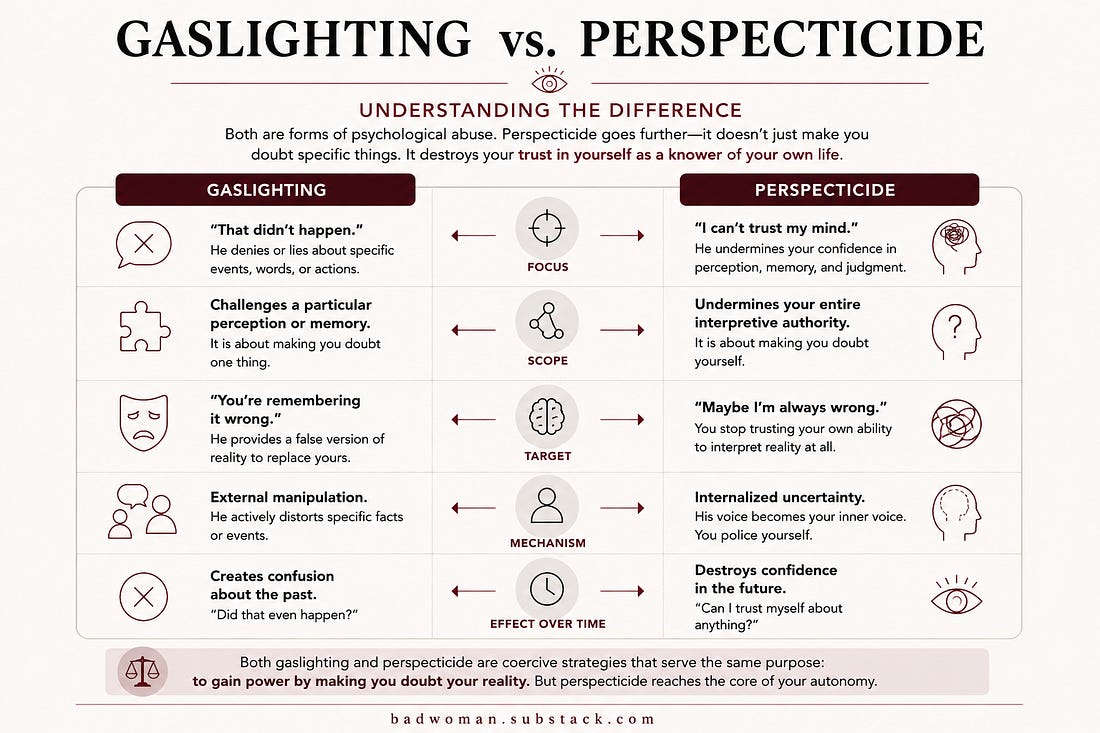 |
The popular understanding of gaslighting tends to focus on spectacular examples: someone denies an event that unquestionably happened, insists that a conversation never took place, hides an object and then tells their partner she imagined losing it. These examples are useful, but they can also give us an overly narrow picture of psychological manipulation.
Coercive control does not require a partner to spend every evening insisting that the sky is green. It can be much more mundane, subtle and insidious.