




Tales from the world’s stupidest trade war, per the president this morning: “The United States is giving serious consideration to changing the name of Lake Ontario to Lake America in that we don’t expect to be doing business with Ontario much longer.”
Trump might not have delivered his base lower prices, or an end to foreign wars, or even a Reflecting Pool that works. But at least he hasn’t gone back on his most central promise: A constant parade of countries to bully for their amusement. Happy Tuesday.
Join Bill Kristol and Andrew Egger for Morning Shots Live today at 10:00 a.m. EDT on Substack and YouTube.
 |
SCOTUS Could Still Do the Right Thing
by Andrew Egger
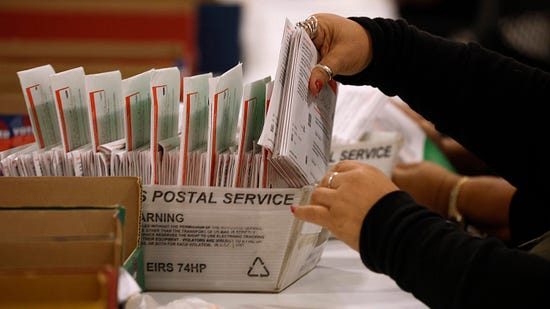
The first thing to note about yesterday’s Supreme Court party-line decision, which may, eventually, partially clear the way for Donald Trump to implement his cartoonishly unconstitutional executive order cracking down on mail-in ballots in blue states by abusing Post Office procedures, is that it’s probably not as bad as that description makes it sound.
I’ve written before about the complicated set of legal challenges against Trump’s mail-in ballot order,¹ but in the interest of time let me quickly crib from Steve Vladeck’s useful reaction post last night: Until yesterday, there were two different injunctions in effect blocking Trump’s executive order from going into effect; the Court’s order struck down one of them while leaving the other intact. Meanwhile, it’s a third forthcoming ruling from a lower judge—one examining the new USPS rules themselves rather than the Trump order directing their creation—that will probably end up providing the legal terrain on which this matter will ultimately be decided.
So the Court was explicit: In removing one of the stays against Trump’s order, they were not venturing any opinion about that order’s constitutionality. They were simply allowing—for now—the government to proceed with its fig leaf of legality intact. The order had commanded USPS to hatch new rules cracking down on mail-in voting “to the extent feasible and consistent with applicable law.” So until those USPS rules actually hit the books, states had no way of demonstrating they were harmed by the order—any legal violations would come through those rules, not through the order itself.²
Never mind that this language was transparently, laughably pretextual. Trump has never bothered to hide the purpose of his order: to keep states from running their elections via mail-in ballots by hook or by crook. He has said, repeatedly and explicitly, that his March executive order was an attempt to implement many of the same provisions as the Save America Act that Congress refuses to pass, including a ban on mail-in ballots. “If we can’t get it through Congress, there are Legal reasons why this SCAM is not permitted,” Trump posted in February. “I will be presenting them shortly, in the form of an Executive Order.”
It would have been nice if the Court had jumped at the first opportunity to put this nonsense to rest. Instead, they have kicked the can down the road.
Trump’s many, many illegal and unconstitutional acts as president have given us lots of cause to chew over the motivations and soundness of this Court. There have been, basically, two schools of thought.
The first interpretation is that they’re just occasionally useless procedureheads, so obsessed with the clockwork intricacies of the legal arguments before them that they’ve spent much of the Trump years routinely missing the bigger picture. For what it’s worth, this is basically my view, not to mention the view of Justice Ketanji Brown Jackson: Her dissent decries the majority’s “lack of situational awareness” in “taking its eye off the ball” by resolving the standing question without an eye toward Trump’s obvious “effort to foment chaos ahead of the November elections.”
The second interpretation is simpler: They’re just in the tank for Trump and his political project and tend to rule accordingly. I tend to think this view is too simple, and that it can’t reasonably account for any of the major losses the Court has handed Trump this term even on issues at the very heart of his project. But it’s the explanation of choice for many of the Court’s skeptics.
One small consolation of this moment, I guess, is we don’t have to waste a bunch of time arguing this point; we can just wait a bit and find out.
Having settled the standing matter to their satisfaction, the Court is expected now promptly to proceed to the actual merits of the case. This should be a straightforward matter. The Court could—and should—still steer us away from the constitutional crisis Trump’s order represents.
But there’s another imaginable path—the legal nightmare scenario. One could imagine a future where the Court, having ruled that all challenges to Trump’s order until now were out of order for one procedural reason, now turns around and blocks all challenges going forward according to a totally different procedural consideration. That would be the Court’s Purcell principle—its stated reluctance to meddle in election procedures close to an election for fear of causing chaos.
This isn’t a bad rule of thumb, but this Court has frequently faced criticism that its use of Purcell has been selective at best. Should it reach for Purcell here as an excuse to let Trump’s order go into effect, it will be the Court’s gravest sin since its 2024 invention of presidential immunity: an extraordinary abdication of oversight over a president’s extraordinarily unconstitutional attempt to seize personal control of elections.
But, you know—I think they won’t. I just wish they weren’t making us wait and see.
The Worst of the Worst?
by William Kristol
Another day, another indecency.
ABC News reported last night that “the wife of an Army sergeant and mother of a 6-year-old was deported on Monday.”
Cristy Maryori Villafranca-Trejo had fled violence in Honduras in 2016 and has lived in the United States for ten years. Her husband, Army Sgt. Hedar Leonel Turcios Juarez, became a U.S. citizen in 2024 after a nine-month deployment to the Middle East. Hoping his service would help expedite his wife’s naturalization process, Sgt. Turcios began pursuing citizenship for her.
But his wife was detained by ICE officers outside a Walmart in July as the couple’s young daughter watched. She was deported yesterday.
This was no bureaucratic mistake or oversight. The Department of Homeland Security confirmed her removal: “On August 24, Cristy Maryori Villafranca-Trejo, an illegal alien from Honduras, was removed from the United States in accordance with our laws.” Indeed, DHS confirmed she was targeted for removal: “On July 11, ICE conducted a targeted immigration enforcement operation to arrest Cristy Maryori Villafranca-Trejo.”
So DHS went hunting for an active-duty soldier’s wife, who’s been living here for ten years—no reported criminal history, no demerits whatsoever, trying to become a citizen—in order to deport her.
Why? Because it’s “in accordance with our laws.” Indeed, “having a family member in the military is not a free pass to violate our nation’s laws,” a DHS spokesperson said recently.
But the executive branch has discretion in the enforcement of laws. Earlier administrations of both parties have generally—and lawfully—chosen to shield the undocumented parents and spouses of service members from deportation.
But the Trump administration’s commitment to ethnic cleansing allows no such forbearance. And so, ABC