
|
 |
The People Have Spoken; They Want Their Power Back
The data-center backlash, like the affordability backlash, is often irrational. The underlying demand for agency is righteous.
|

| |||||||||||||||


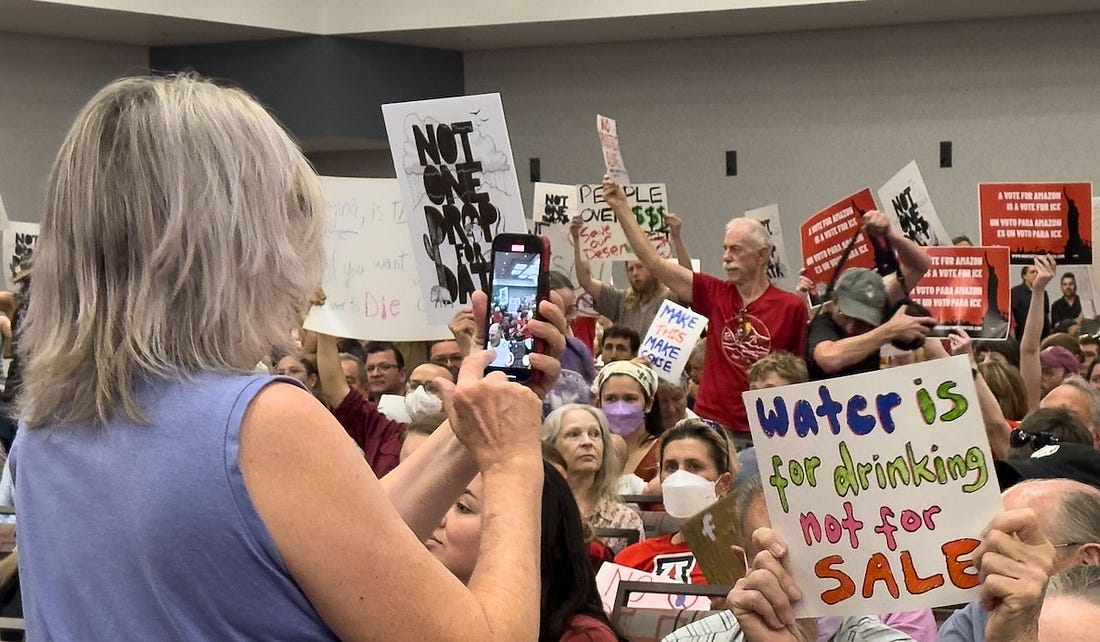 |
Public backlash to the relentless data-center buildout has upended politics just in time for the election.
This is, I would guess, mostly good news for Democrats. Donald Trump is president; Republicans are incumbent; the A.I. boom is driven by Trump-aligned tech oligarchs; and because of how badly he’s corrupted and mismanaged the economy, a dramatic slowdown in data-center construction could send the country into recession.
So Trump is trapped. He is faithless enough that under normal circumstances he’d simply reverse himself, claim the popular position as his own, pretend to have been a skeptic all along. But he has to support data centers, which means Republican candidates can’t credibly run too far.
But they are trying. And it’s forcing Democrats, once again, to confront the political tensions of our time—between populism and reason, poll chasing and authenticity, the short-term and the long-term.
In Wisconsin, the Republican gubernatorial nominee, Tom Tiffany, has taken to calling his Democratic opponent “Data Center David” Crowley, because Crowley’s position is that data centers should be allowed in the communities that want them—powered by clean energy, and built with union labor.
Tiffany, meanwhile, voted in Congress to federally preempt local data-center opposition. He is just a fraud. Every day brings a new reminder that Democrats simply have to make the Republican style of bad faith in politics a liability unto itself.
But the dilemma Crowley faces, over whether to hold his position or support a data-center moratorium, would be real even if he weren’t running against a liar.
The data-center backlash is extraordinary—an issue of high salience that unites about three-quarters of the country. But the Wisconsin case study reminds us that poll chasing and poll literalism can drive perverse politics.
The case for a moratorium is, essentially, that the public demands it—which it does! But when you burrow down to investigate what’s driving the opposition, you find a hodgepodge of real and imagined grievances.
Quite often, the things voters say they’re mad about aren’t really what’s bothering them.
Take me for instance: I know that for the most part (there are famous exceptions) data centers aren’t particularly hazardous to the environment, as industrial projects go. I know that—again, for the most part—they don’t cause acute, local public-health crises. I know that the communities that welcome them can reap huge (if perhaps temporary) financial windfalls. I know that they’re not only the bedrock of artificial intelligence, but of the whole internet, including its dwindling number of good parts. Generally speaking, I’m a YIMBY.
And yet, if I learned that Amazon or OpenAI or Meta planned to open a data center in my neighborhood, I’d NIMBY the fuck out of it. If I believed the modern internet and A.I. were healthier innovations for society—if their industries were regulated intelligently by a public-spirited government, and were helmed by civic-minded executives—it’d be different.
Instead, a passel of greedy robber barons and antisocial weirdos has decided we live in their world, which is in turn the dominion of the god machine, and whatever harms their creations inflict on society or humanity will simply be on us to deal with. (Not them, though, they own private islands.)
American citizens only have so many means of exerting political power, and this is one of them. And at bottom, I think that’s a big part of the draw for a lot of people. It’s a proof point that people still hold power in this country; the substance of the position is almost beside the point.
The data-center backlash is a reminder, like the “affordability” backlash that preceded it, that while politicians have to heed public opinion, they should not and cannot simply surf polls to the promised land. To succeed in the long run, they need articulable vision, and to understand the public psychologically, not just ideologically, as both individuals and groups of people.
What’s required beyond the ability to read polls is human touch, a feel for the human condition, which allows us to see past outrage spasms and irritable mental gestures to underlying sources of disaffection. It is insufficient to study up on what people claim to believe, and then promise to deliver it; it’s essential to ascertain why people feel the way that they feel.
We know this intuitively as we manage the politics of our private lives.
When your friends or colleagues or loved ones are irritable, what do you do? Do you always respond literally to whatever they say and do as they lash out? Or do you consider root causes? Whether they might be hungry, or tired, or dealing with some unrelated personal problem? Are they really having a meltdown over furniture layout or the number of red lights they hit on the drive to the supermarket? Or is something else at work?
Everyone who’s been in a relationship has had the experience of wondering whether the fight they’re having over which movie to watch is really about the movie or about whether it’s time to break up. Everyone who’s been through a breakup has then likely had to navigate awkward group dynamics. Who’s on whose side? Who’s the protagonist and the antagonist of this little microcosm?