
|
 |
The Supreme Court Weighs In
What the Court had to say about Trump’s executive order on elections and mail-in voting
|

| |||||||||||||||


Today, the Supreme Court ruled in the case brought by state attorneys general challenging Trump’s executive order on elections. In this case, the government wants an injunction to stop Judge Indira Talwani’s injunction, which stops the administration from implementing the EO—it gets a little confusing.
The Court did what the Trump administration asked. In an unsigned per curiam order, with dissents from Justice Sotomayor (joined by Justice Kagan) and Justice Jackson, the Court told the government it could go ahead and execute the EO.
It’s important to issue two caveats before we go any further:
This is not a decision that Trump’s EO is lawful. And as Steve Vladeck and I discussed tonight (link forthcoming), the Court would have to defy the Constitution, which gives control of elections to the states, to reach that result. That doesn’t mean we’re out of the woods here; this is a Court that, as Steve aptly puts it, is at its worst when it’s deciding voting cases, and its thumb will be on the scales for Trump. But today’s decision is limited to the injunction in the AG’s case.
Judge Talwani also issued a separate, nationwide injunction in the League of Women Voters case. That injunction stays in place, at least for now. As we’ve been discussing, the government owes her a response to the plaintiffs’ motion asking her to enforce it, after the Postal Service indicated it was ready to issue a final rule putting procedures in place to execute its role in the EO. Judge Talwani has indicated she’s prepared to rule quickly, likely tomorrow, so this case will be before the Court before long.
In its decision today, the Court held that Judge Talwani incorrectly entered the injunction and that it believes the government will prevail on the factors necessary to get an injunction of its own to put an end to hers. The Court ruled the Judge was wrong on two doctrines we’ve been discussing a lot lately: ripeness and standing. The Court wrote that while “the District Court rejected the Government’s argument that it lacked jurisdiction over the States’ claims because the States lack standing to bring them,” the Supreme Court believed the government was likely to succeed on those jurisdictional arguments. That means the Court believes, not necessarily that the EO is lawful, but that these are the wrong plaintiffs to bring the case, that they lack standing and that they sued too early. The Court also wrote that it believed the government would prevail on two other factors necessary for its injunction to succeed: that the injunction is causing it irreparable harm and that the equities do not favor leaving the injunction in place while the Government’s appeal is pending.
That’s what tonight’s decision is about. It doesn’t say the EO and what Trump wants to do are lawful. It doesn’t even let the administration move forward because the second injunction is still in place. Is it disturbing? Yes. I dislike the Court’s framing, which characterizes the EO like this: “President Trump issued an Executive Order designed to maintain public confidence in federal elections.” But the political value signaling isn’t a substantive decision. This is about where we are procedurally.
That leaves us with some questions:
Will the same analysis apply to the LWV case, or are the plaintiffs situated differently?
Why is the court willing to change election rules so close to the start of elections? What about the Purcell principle?
Does this decision mean the government will win on the merits, i.e., the legality of the EO?
Steve Vladeck joined me tonight to discuss those issues, and that video will be available shortly, in a separate post. I encourage you to watch it; in 20 minutes, we cover the key issues that will dominate the conversation about these cases for at least the next week, with a nuanced analysis of where the Supreme Court is and where it’s likely headed.
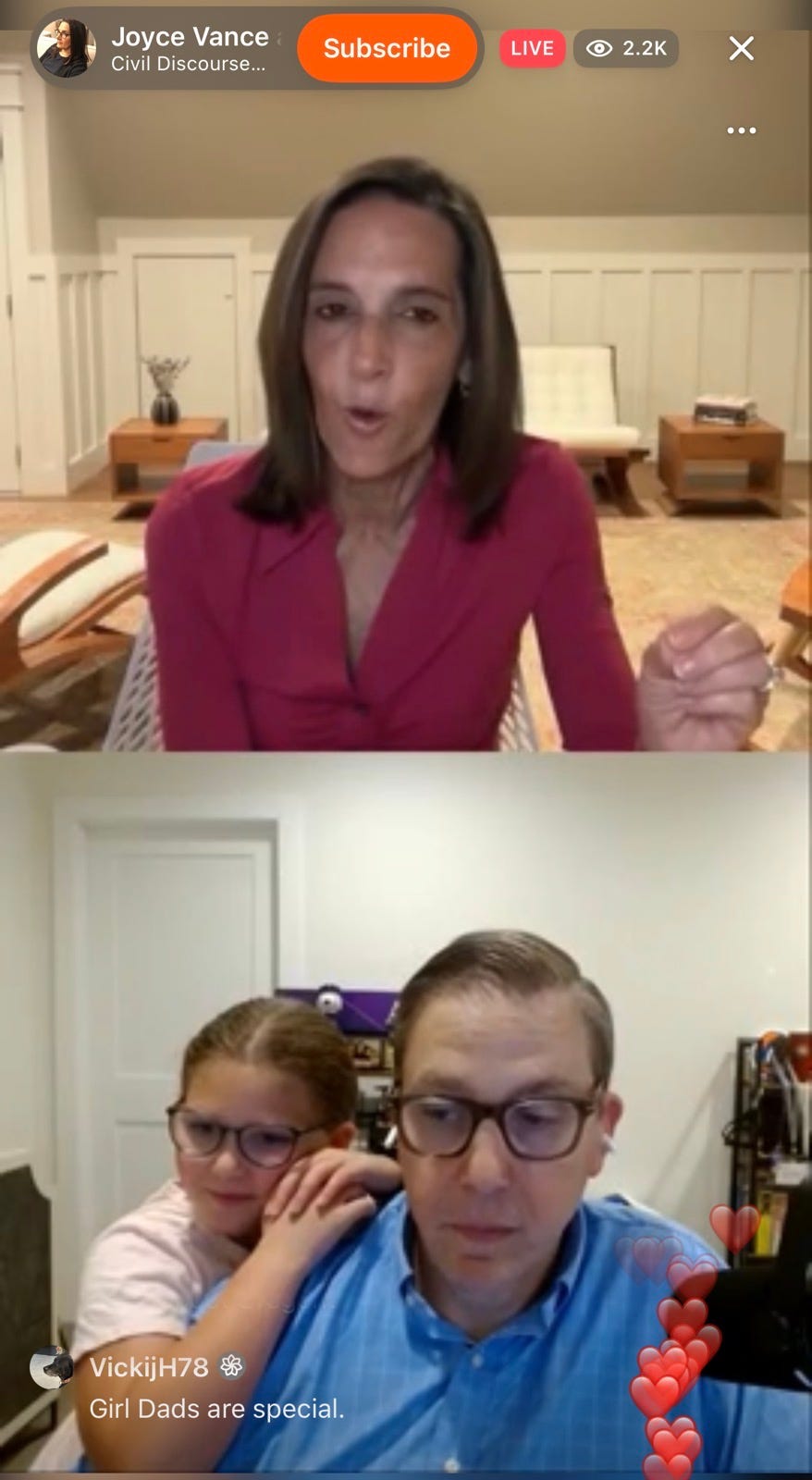
But for all of the legal substance, this was my favorite part of Steve’s and my conversation. If you missed us live, yes, you should watch for the analysis of this situation, and also, for his adorable daughter sneaking in to say goodnight to her Dad.
 |
The video is coming later tonight, but for now, remember this. Even if Donald Trump makes it impossible to vote by mail (which I don’t think will happen), he can’t make it impossible for us to vote. We can still vote in person. It’s up to us.
Make a plan, and include your friends. Plan an election party now, and encourage people to vote and celebrate come November. Help people who aren’t registered to vote, and help people who are check their status and make sure they’re on the voter rolls in active status. What Trump is doing is outrageous. Let’s put that outrage to good use and turn out the vote.
We’re in this together,
Joyce
You're currently a free subscriber to Civil Discourse with Joyce Vance . For the full experience, upgrade your subscription.