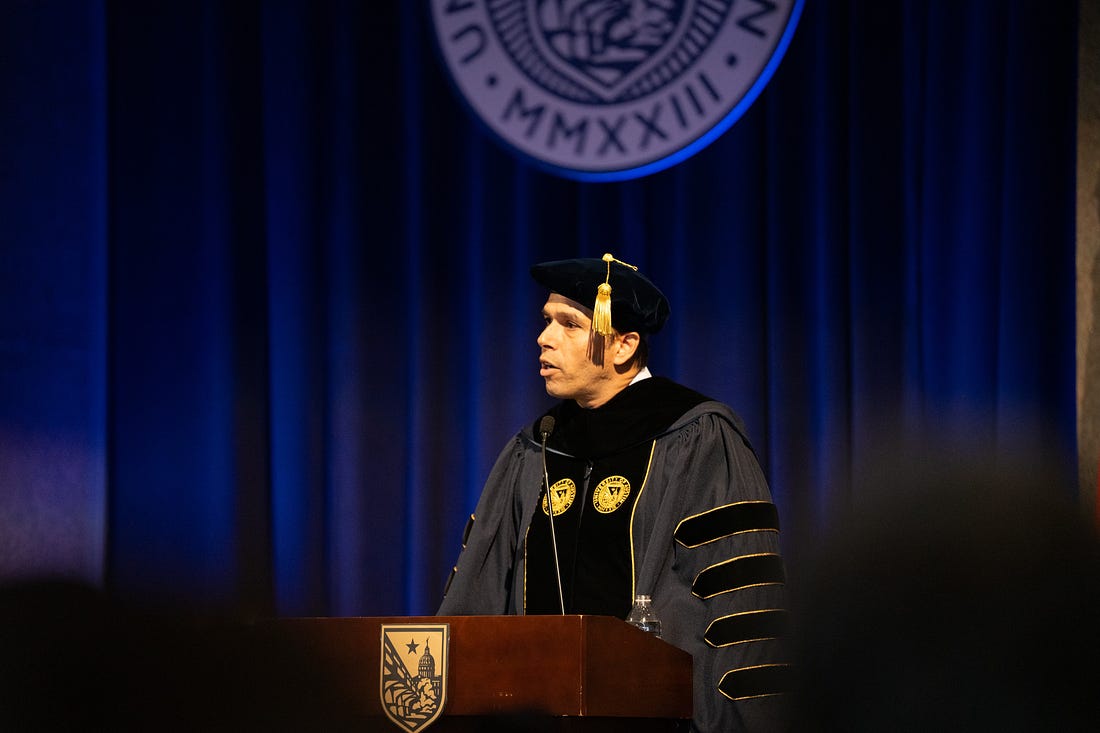
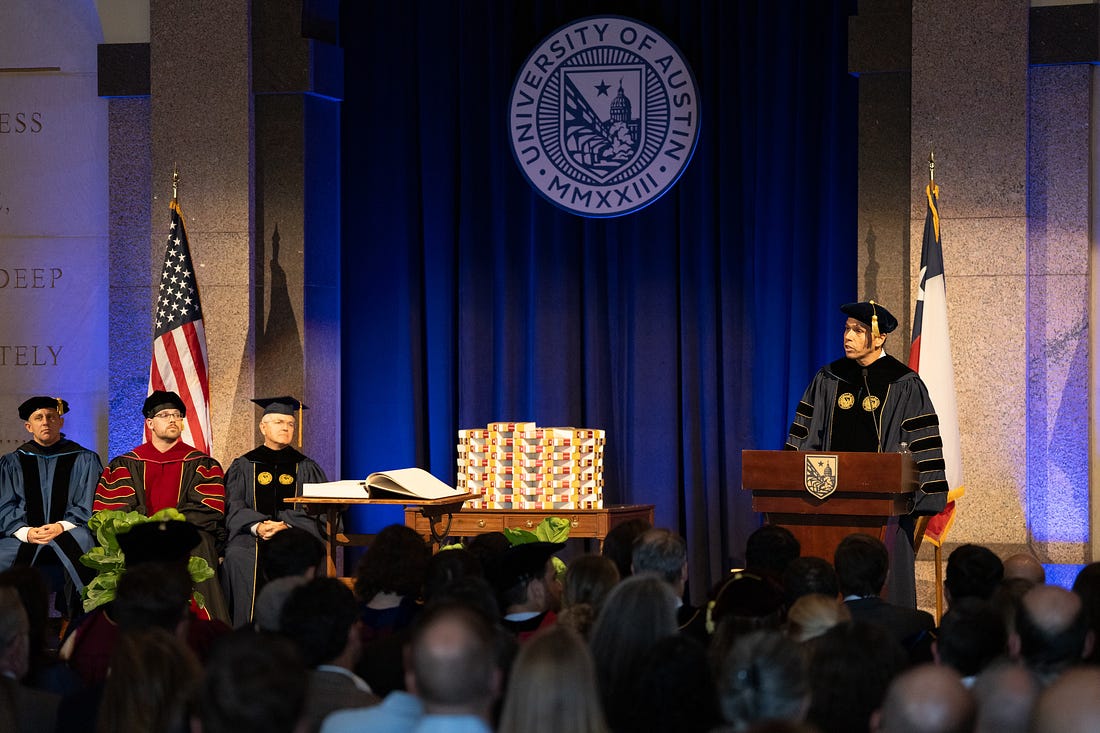
It's an honor to stand here and welcome the third class at UATX, the most exciting university in America.
To the freshman: thank you for choosing us. I know you had options, and you picked our ambitious experiment. In return, we can promise you that we will stop at nothing to help you become worthy of great things.
***
In the 1830s, the French aristocrat Alexis de Tocqueville traveled across America and admired much of what he saw. But he observed a dangerous paradox in the American love of equality. As the old ties of class, tradition, and community dissolved, he predicted, each citizen would retreat into a small world of narrow concerns — until every American would end up "thrown back forever upon himself alone," confined at last "in the solitude of his own heart." A man with nothing above or beyond him has nothing important to strive for and becomes focused on himself alone.
Tocqueville called this danger individualism. Paradoxically, he worried that the more independent the citizen feels, the weaker and less independent he actually becomes. And weak men are more susceptible to being governed by others. They are dominated by the ideas and fashions of the majority and look to a government bureaucracy to take care of them. Tocqueville saw this individualism as a path to comfort in servitude.
America's version of individualism led to something quite different.
The pilgrims and pioneers were the most self-reliant people on earth. They persisted against nature and starvation to set up the colonies; they headed West on wagon trains even as they buried their children on the Oregon Trail. They formed volunteer fire brigades before any government services existed. They ran their own towns without deferring to a distant capital. They carved farms and opened shops and built railroads. They turned wilderness into civilization. Their grandchildren stormed the beaches at Normandy, and their great-grandsons walked on the moon.
That kind of relentless pursuit of greatness was self-uninvolved. It was strong and persistent, and the opposite of introspective. America's self-reliance and rugged individualism produced achievements that were only possible because we escaped the old aristocratic order and its unmeritocratic privileges of birth.
These great achievements begin, however, with the recognition that there's something greater beyond us, that much of life's meaning comes from duties imposed on us and loyalties we did not choose. To strive beyond ourselves we first need to understand ourselves, and that means fully understanding our inheritances before we presume to improve or criticize them.
Greatness starts with recognizing that we incurred a debt to the past, to the family that raised us, to the founders of our country, to the dead who built everything around us and fought our enemies so that we can live in freedom and prosperity. Greatness starts with the recognition of virtue.
For most of Western history, the highest compliment you could pay someone was to call them virtuous. A virtuous father was devoted to his children. A virtuous friend was loyal even when it was costly. But over the last century, virtue gave way to authenticity — being true to whatever feels right.
Today's young people are the most self-aware, validated and as Tocqueville warned us, individualistic. A free and enterprising America became the richest society in human history. And yet, your generation is the most anxious, fragile, and lonely.
American capitalism succeeded in producing unprecedented wealth and opportunity not by rewarding self-obsession. But instead, rewarding the founder obsessed with a product, the engineer obsessed with a problem, a doctor obsessed with getting his patient healthy. It's two bicycle mechanics from Dayton, Ohio taking their shop profits and betting on a wind tunnel in the back of the store. It's an immigrant entrepreneur taking his profits from an internet company and betting it on a rocket to take us to Mars.
Short of the military, our universities are the institutions best positioned to cultivate a free and virtuous citizen. Instead, they've become sanctuaries for the authentic self. Having lost the confidence to distinguish between good and bad, universities pretend that all ideas are equal and promise a curriculum to "reflect" your interests. They've traded the question of "what is true and good?" for the question "how does this make you feel?" Universities keep offering a self-affirming mirror when what you need is a window.
But not at UATX. You are here because you are the tiny minority in our country that wants something different. A place that hands you books chosen for you, where you will sit next to people not selected for "fit" but for raw intellect, a place that asks you to defend your opinions, and holds everyone to the highest standards. You are here because you want a real education that humbles you without humiliating you, that challenges you without flattering you.
You are going to live together, eat together, argue together. And, as you share the labor of maintaining a community, we trust you'll pass down to the class behind you what the class ahead passed on to you.
Freshman, look around. You are sitting near a classmate you don't yet know who will argue with you until late at night. They will be the friends standing by you at your wedding. In this room is a professor who will pour red ink on the margins of your essay. That professor will be the mentor you call when deciding what new job offer to take a decade from now.
So, to the class of 2030, the whole world will keep telling you to find yourself. We're hoping for something better: that you forget yourself and discover the durable joy of being absorbed in something greater than you.
Years from now, you'll be in a room where something serious is on the line. Maybe a dinner table where a troubling question gets asked, or a courthouse where a big decision is made, or a board meeting where a serious mistake is about to be made. Those rooms will need at least one person who knows how to think through hard things. We want you to be the person the rest of the room quietly turns to.
But today, we turn to you and ask you to forget yourself. We want you to read books that have no interest in your identity, and to wrestle with facts that don't care how they make you feel. We want you to help your classmate at an inconvenient hour, to listen and learn from the professors, and to find ways to contribute to this young university without demanding that it conforms to you. Forget yourself and find something greater than you.
Forget yourself today, then wake up tomorrow and forget yourself again. Spend four years doing that, and you will cross this stage in 2030 strong, free, surrounded by friends who will help you build a good, virtuous and successful life.
Welcome to the University of Austin.
Apply for fall 2027