
|



How to give an agent a task instead of a token (Sponsored)
 |
Give an agent an access token and it spreads: into the context window, into tool call logs, into notes it keeps between steps. Each copy works from anywhere, long after the fact.
Relay keeps the credential at WorkOS. Your agent names the user, WorkOS attaches that token, refreshes it, and releases it only to allowlisted hosts. A hijacked agent session is a live process you can kill.
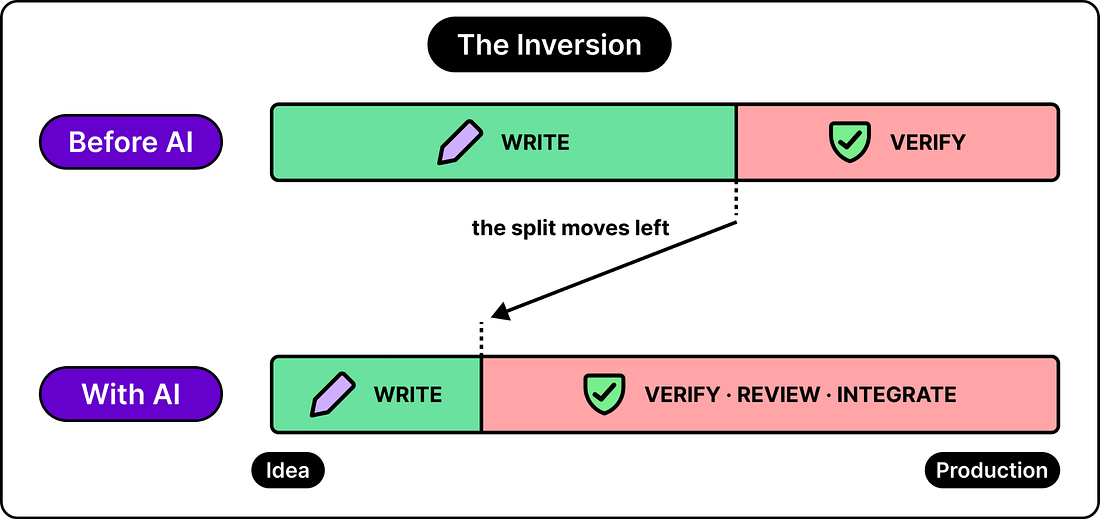
The gap between code that executes fine and code that is actually safe to trust is growing wider pretty fast. For many years, writing code was the slow, expensive step, whereas reviewing it was a smaller task at the end. With the rise of AI-assisted coding, this balance is shifting.
AI tools can now create a working function in seconds and a full feature in minutes. Teams are able to write more machine-generated code every month. In other words, producing code is now fast and relatively easy, whereas code verification is the harder part. A reviewer still has to read the change, understand it, and decide whether it belongs in production. In fact, more code written simply means more code that should be verified.
We recently got a chance to speak with Andrea Malagodi, the CTO of Sonar (the company that has built some of the most used code verification software). He provided deep insights into code verification, especially in the context of AI and how Sonar is adapting to the recent changes.
In this article, we will look at how code verification works, why the rise of AI-generated code puts more pressure on it, along with the extremely useful insights from Andrea on what the future may look like.
 |
The Shift
The shift with regard to code generation and verification is quite visible when we look at the data. One of the clearest signals comes from Google’s DORA research, a long-running study of how thousands of teams build and ship software. Their recent work found that as teams adopt more AI, delivery stability dipped. Trust in AI-generated code stayed low, with well over a third of developers reporting little confidence in what these tools produced [2]. In other words, more speed in writing code brought more pressure further down the line.
A controlled trial from the research group METR gives a similar indication. Its participants were experienced open-source developers working on their own mature projects, and each task was randomly assigned to allow or disallow AI tools. The developers expected AI to speed them up by roughly a quarter.
However, the result showed a totally different picture. AI-assisted tasks took about 19 percent longer [3]. Moreover, this happened after the developers internally believed that the AI helped them be more productive. Turns out, a lot of extra time went into prompting, waiting, reading the output, and correcting it. To be fair, the same team later reported a more confusing follow-up signal. This was partly because developers preferred to keep their AI tools [4].
Nevertheless, if we consider these results together, it is evident that while AI definitely increases the amount of code written, it also leads to more verification work down the line.
So let us first understand what code verification actually means.
Earning Trust
Code verification is the umbrella term for every check that ensures whether a piece of code is correct, safe, and maintainable enough to ship to production. In other words, it is the work of earning enough trust to put a change in front of real users. The key term to note here is “earning”. This is because trust arrives in degrees. It is built up one check at a time, rather than granted in a single stroke.
Think of a task of drafting a contract. Writing the words is one part of this task. However, the review, the legal checks, and the signatures are what transform those words into something people can actually rely on. Writing code works in a similar way. The moment a piece of code leaves an editor and is committed to a code repository, it carries an implicit claim about the functionality. Code verification is the process through which that claim gets tested until a team feels safe to use that code in a real production environment.
Some domains push this stage to its limit through rigorous formal verification. In such domains, engineers have to mathematically prove that the code being deployed matches a precise specification. Such a process is standard for critical stuff like flight-control systems and kernels, where a single defect can risk lives. However, for most software, having a similar approach can cost far more than it returns. Therefore, teams opt for lighter checks that are arranged in layers.
The Filter Stack
Taking the layered analogy further, we can imagine code verification as a stack of filters. As you can see, each filter catches a certain type of problem.
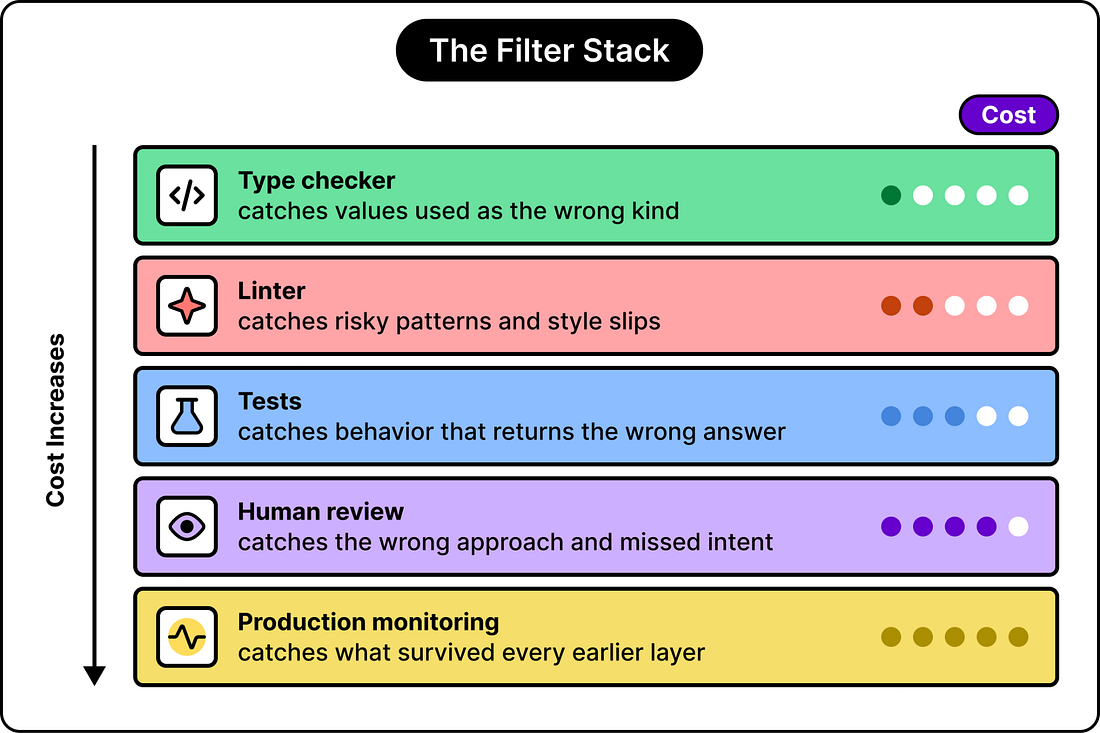 |
At the top of the stack, we have the cheapest checks. For example:
Type Checker: It confirms whether the values moving through your code are the exact type each operation expects. This way it can catch a whole class of mistakes before the code even runs.