





 |
ICE’S NEW INVESTMENT—a purchase of thousands of electric-shock gloves—sounds like something out of a dystopian movie. And it turns out that the likely logic behind the purchase is disturbing.
According to an acquisition-planning form published by the Department of Homeland Security last week, ICE is purchasing what it calls “a Conductive Distraction and De-escalation Device.” In reality, they’re wearable tasers.
While immigration czar Tom Homan emphasizes that the gloves—cartoonishly called “Generated Low Output Voltage Emitters” or “G.L.O.V.E.s”—will reduce the need for ICE agents to use lethal violence, critics already suggest the move is actually more about optics and what agents can get away with.
More discreet than a taser or a gun, the gloves are ideal weapons for the age of social media video. There’s no swing, no jab—just the laying on of hands. Agents will be able to use the devices to shock whomever they deem “disorderly” with less risk of being the subject of the type of video that goes viral or results in messy lawsuits.
The weapon’s manufacturer calls it an “invisible partner.”
Monitoring Trump’s deportation agenda requires constant vigilance and deep cultural knowledge. Join Bulwark+ for both.
Compliant Technologies, the company that makes the gloves, pitches itself as an alternative to lethal violence. “By providing non-lethal alternatives, we aim to create a safer world for everyone involved,” the company’s website reads. “We believe this technology can lower liability, lessen risk, and create a more amiable atmosphere for the general population and those who protect and serve us.”
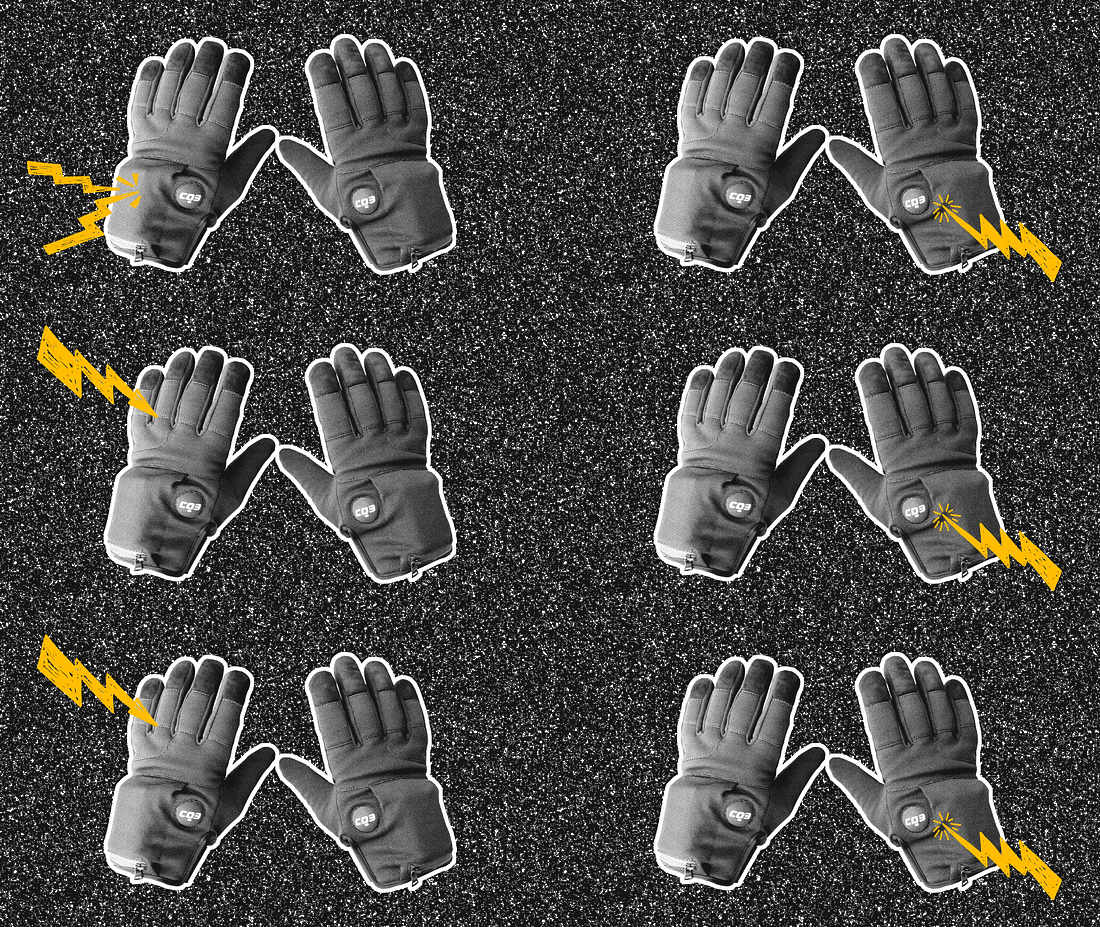
This peaceful image is undercut by the site’s visual of a powerful electric current flowing behind the gloves, looking like the aftereffect of Thor charging up in an Avengers movie.
Homan seems to agree with their de-escalatory claims. “It’s another device to help someone get compliant when they are not,” Homan told Fox & Friends last week. “You can’t just go from zero to one hundred, right, and the first thing you go for is lethal force.”
ICE’s planned purchase is between $10 million and $20 million, which, at the rate the Omaha Police Department¹ was quoted by Compliant Technologies for the same model last year, could put well over 12,000 gloves in and on the hands of ICE agents.²
Jason Houser, who served as ICE chief of staff in the Biden administration and still maintains connections within DHS, told me he believes the gloves will be in use on the street before the end of the year, and agents will be using them in field training. A senior DHS official told NBC News they expect ICE to have the gloves in a little over a month.
“All this buying capability when officers aren’t trained to use these tools is very dangerous for the officers and the public,” Houser told me. “I know these tools from . . . when they were pitching them to us, and if you put your hands directly on their chest or certain body parts, in a situation where you’re putting your hands on an individual, they can be extremely dangerous.”
LET’S SORT OUT some of ICE’s claims here, starting with the idea that the gloves are de-escalatory. What does that mean in the context of how ICE operates?
Compliant Technologies promises conductive distraction and de-escalation devices “within the Force Continuum to supplement existing tools” of clients such as ICE. A force continuum is a framework that describes an “escalating series of actions an officer may take to resolve a situation.” Strictly speaking, according to ICE’s “Firearms and Use of Force” directive, issued in late May, the glove should be used at the fourth stage of their continuum, “Hard Techniques,” to prevent the confrontation from reaching the fifth, “Deadly Force.”
ICE’s use-of-force guideline states:
Authorized Officers may use force, including intermediate force, only when no reasonably effective, safe, and feasible alternative appears to exist and use only the level of force that is objectively reasonable in light of the totality of facts and circumstances confronting the Authorized Officer at the time force is applied.
And they are allowed to use weapons like these only when empty-handed techniques are not enough to “bring a disorderly or violent subject under control.”
So much for ICE’s rules as written. But the obvious question here, given ICE’s track record over the last year and a half, is: Can an agency that deploys undervetted, overly aggressive agents and lies about its involvement in the deaths of both immigrants and U.S. citizens be trusted to deploy a weapon that leaves no physical trace? After watching David Brouillette, a violent ICE agent who never should have had a gun, kill Johan Sebastián Durán Guerrero in Maine, does anyone believe the best of the best will be receiving and using these devices?
In ugly and sometimes deadly incidents, ICE agents and other DHS personnel have repeatedly failed to demonstrate the type of training and judgment that the G.L.O.V.E. user manual is clear the devices require:
 |
The red “warning” label, the manual explains, means the instructions “May result in injury or death if not followed or observed.”
Some of these instructions, straight from the manual, include:
The G.L.O.V.E. SHALL NOT be deployed for any of the following:
Verbal defiance or belligerence
Punishment
Torture. . . .
Avoid using the G.L.O.V.E. against certain po