
|
 |


Hi Partner,
Last week you were able to read Part I of our interview with Kris.
Kris is the best growth investor I know.
He even made a bet with me that Nvidia was undervalued… 3 years ago.
Everybody was already convinced that Nvidia was overvalued. Kris wasn’t.
Nvidia is up almost +400% since then.
Let’s dive into Part II of this interview right away!
 |
Kris just announced his 5 favorite stocks right now.
Curious? Download them for free:
 |
What are the most important metrics or ratios to take into account for growth investors?
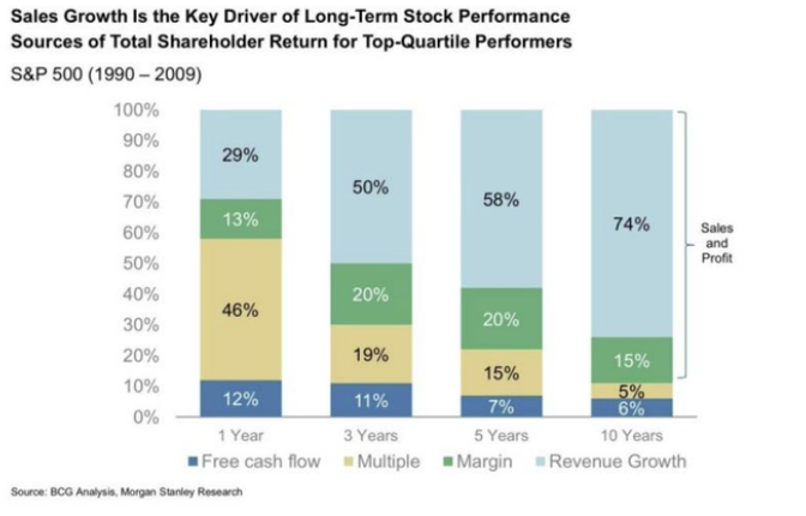
Kris: It’s pretty simple: revenue growth. Look at the long-term statistics and you will see that revenue growth is by far the most important driver of stock returns over the long term. Over a year, it’s valuation. But that only counts for 5% over a decade.
 |
Of course, growth alone is not enough. It’s easy to grow revenue fast if you sell $1 for 90 cents. So you want profitability moving in the right direction. But that doesn’t mean I shy away from unprofitable companies. There are tests to see if an unprofitable company is a good company or not.
My favorite is the rule of 40, which comes from the venture capital world: revenue growth plus free cash flow margin should be above 40. Suppose a company grows revenue by 60% with a free cash flow margin of minus 10%. That’s a rule of 50 and that’s really strong. I would definitely be interested in that company, even if it still loses money.
What would be a reason to sell a position?
Kris: The most important reason is simple: the company doesn’t execute as I want it to execute. That doesn’t mean I sell for every mistake. Every company makes them. You have to be a bit tolerant. But blind tolerance is just hoping, and hope is not a strategy, as we all know.
That’s why I have my self-developed Selling Rules that are very company-specific. I determine beforehand when I will trim or sell. Of course, I don’t follow them blindly, as there are always situations in which you should divert from the rules. Suppose a selling rule is at least 15% revenue growth and the company only grows its revenue by 8% but guides for 25% revenue growth in the next quarter, selling would be stupid.
Next to the Selling Rules, I have also developed a Quality Score. Every quarter, I go through the earnings in an earnings deep dive, and then I score the company on 17 criteria, from quality of management and revenue growth to metrics I’ve developed myself, like sales efficiency scores. This catches slow deterioration in companies, which you don’t always see if you don’t score. If the Quality Score is dropping and too low, or the Selling Rules are broken, I consider selling. But I try to hold companies for a long time, not selling too early. It can cost you much more to sell a Multibagger to early then to hold a loser too long.
Who is the investor you admire the most?
Kris: Potential Multibaggers is highly influenced by three investors.
The first, and the biggest influence, is Phil Fisher. You may know him from Common Stocks and Uncommon Profits, a fantastic book that heavily influenced my views on investing.
The second is David Gardner, one of the co-founders of The Motley Fool and almost as important as Phil Fisher in the development of Potential Multibaggers. He has picked at least seven 100-baggers: Amazon, Nvidia, Tesla, Intuitive Surgical, Netflix, and others. And he does what I also emphasize: hold your stocks for the long term.
Every single one of those fantastic stocks had crushing drops along the way, 80%, 85%, 90%, Amazon almost 95% but David Gardner held the stocks all the way through. If you ever needed proof that holding longer beats selling too early, this is it.
The third influence is Peter Lynch. His level-headedness, his contrarian eye, and in general, he’s simply a very wise man. His influence is more about his mindset than his investing method.