A recent analysis is challenging the idea that Chinese-made AI is cheaper than offerings from OpenAI and Anthropic. AlphaSense, a software firm that sells AI-powered search and market-research tools, released a study that found proprietary models from OpenAI and Anthropic are actually cheaper for performing some tasks, compared to open-weight models from leading Chinese developers. (AlphaSense used the models through cloud providers Amazon, Google and Microsoft as well as Cerebras.) Testing a range of models to search through and analyze its trove of financial data, AlphaSense found that GPT-5.6 Sol, the most advanced OpenAI model, and Opus 4.8, one of Anthropic’s most advanced models, generated better answers at a lower cost than models from two of China’s top AI labs: Moonshot’s Kimi K3 and Z.ai’s GLM-5.2.
Join The Information for AI Agenda Live on Wednesday, September 23, at SFMOMA. We’re bringing together the industry’s most influential researchers, founders, and investors to preview the next wave of innovation—from breakthroughs in continual learning models to the latest bleeding-edge applications. Learn more here.
Welcome back! Laura here.
A recent analysis is challenging the idea that Chinese-made AI is cheaper than offerings from OpenAI and Anthropic.
AlphaSense, a software firm that sells AI-powered search and market-research tools, released a study that found proprietary models from OpenAI and Anthropic are actually cheaper for performing some tasks, compared to open-weight models from leading Chinese developers. (AlphaSense used the models through cloud providers Amazon, Google and Microsoft as well as Cerebras.)
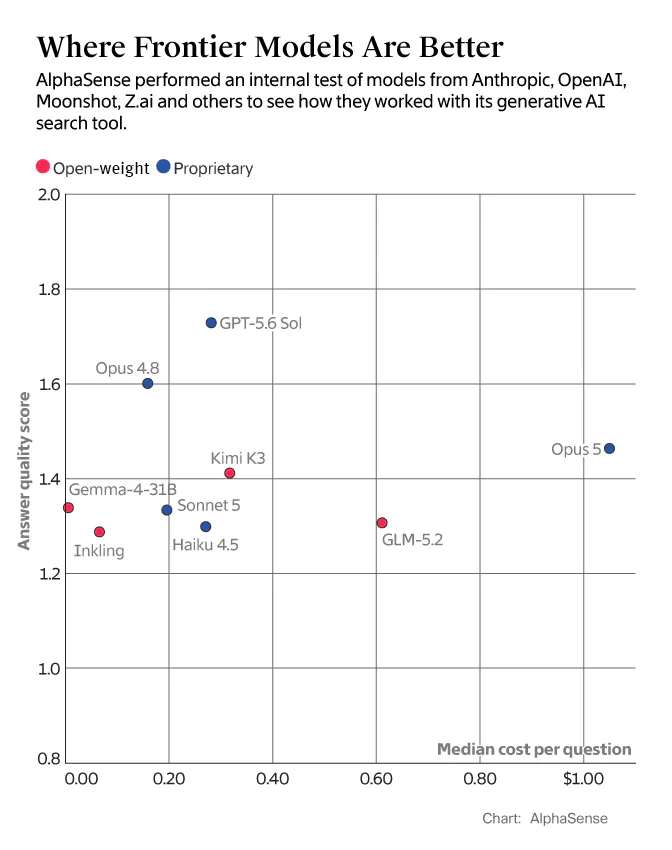
Testing a range of models to search through and analyze its trove of financial data, AlphaSense found that GPT-5.6 Sol, the most advanced OpenAI model, and Opus 4.8, one of Anthropic’s most advanced models, generated better answers at a lower cost than models from two of China’s top AI labs: Moonshot’s Kimi K3 and Z.ai’s GLM-5.2.
Comparing the cost effectiveness of different models can be tricky. Looking just at the price of the tokens—the units of text or images that AI ingests and generates—can give the misleading impression that open-source or open-weight models are always cheaper. Moonshot charges $15 per 1 million tokens of output from Kimi K3, while the comparable charge is $25 for Anthropic’s Opus 4.8 and $30 for OpenAI’s Sol. Some research indicates that can lead to real savings: AI benchmarking firm Artificial Analysis ranks Kimi K3 and GLM 5.2 as significantly cheaper than the two U.S. models for accomplishing the same set of tasks, for example.
But the AlphaSense study, released earlier this month, echoes contentions from some American AI executives, who argue that greater intelligence can make the U.S. models more cost-effective despite their higher prices per token.
Bret Taylor, chairman of OpenAI’s board and co-founder of AI customer-service startup Sierra, said in a CNBC interview late last month that frontier models are cheaper and more efficient than open source ones because they use fewer tokens to answer a question or accomplish a task.
The comment came after the release of Kimi K3, which performed comparably to leading U.S. models on some benchmarks, spurred worries that open models could erode the competitive positions of OpenAI and Anthropic, whose pricey models and coding tools have been pushing up enterprises’ AI bills. (Already, I’ve reported, companies are beginning to turn to open models for coding to bring down their AI costs).
AlphaSense asked each model 246 financial analysis questions that involved reviewing its mass of data, including earnings reports, investor call transcripts, SEC filings, news articles and more. The test questions included asking models to analyze commentary from pharmaceutical companies, to generate rundowns of major acquisitions by waste management giant Clean Harbors, and to analyze sales growth estimates by Wall Street analysts for luxury retailer Burberry. AlphaSense’s team scored the models based on the quality of their answers, such as whether any numbers used were from the correct time frame and whether they referenced multiple analysts’ perspectives.
AlphaSense found that the median cost of using GPT 5.6 Sol was about 13% lower than Kimi K3, while its quality score was around 20% higher. Similarly, Opus 4.8 was about half the cost of Kimi K3 but notched a quality score that was 13% higher. The difference was even starker with GLM 5.2, which was about twice the cost of Kimi K3 but ranked worse in terms of quality.
“Some of the more expensive models, the ones that look more expensive based on just their price per token, actually ended up being less costly because they were more efficient in using tokens,” AlphaSense CEO Jack Kokko told me.
Still, Kokko said, the ideal approach could involve a mixture of models. AlphaSense gets the best performance overall with its generative AI search tool by using its own “harness” software, which includes a router that can pick the best AI model for different parts of queries. For example, the router might select a smarter, more expensive model to plan how a question should be answered, and a smaller, cheaper model to carry out that plan. That lowers the cost per question significantly, he said.
To be sure, open models still have advantages. Because anyone can download them, a company can theoretically run them on its own server chips—if the company has enough of them—freeing it from paying per-token prices to other companies altogether. And while financial analysis is a domain that benefits from more intelligent models, weaker open models could be sufficient for handling simple tasks, such as summarizing emails.
Join us to explore the real-world shifts, new architectures, and enterprise strategies defining the next era of AI. Secure your spot today to hear directly from top minds at Google DeepMind, OpenAI, Atlassian, and more.
Tickets on sale now: The Information returns to Napa Valley October 27–28 to convene senior women across tech, media, and finance. Join us for two days of intimate, candid conversations with the leaders navigating today’s global shifts.