
|



GLM-5.2 - Fine-tune and deploy your own instance (Sponsored)
 |
GLM-5.2 is Z.ai’s flagship long-horizon coding model, featuring a usable 1M-token context window that reliably maintains API contracts and engineering intent where others fail. Stop managing GPU clusters. With Crusoe Serverless Fine-Tuning, you customize GLM-5.2 on your proprietary data in a tenant-isolated environment—no data sharing, no infrastructure overhead. When your job finishes, deploy to Self-Serve Deployments in one click or download raw .safetensors weights for full portability. Every run is reproducible, auditable, and fully yours. No lock-in. No guesswork. Experience production-grade, customized performance without the DevOps burden.
AI models have solved the writing code part of software development to a great extent. Today, a capable model can produce a working function, a full component, or a small application from a plain-language description. It can do so in seconds for a fraction of the cost.
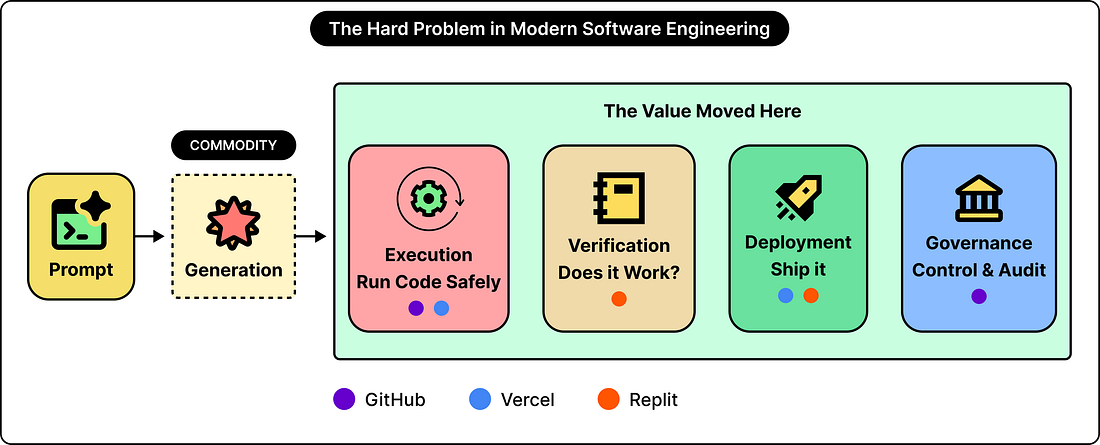
This change has shifted the economics of every developer platform. As the generation of new code becomes cheaper and widely available, it stops being the differentiating factor for a platform. This is the reason GitHub, Vercel, and Replit are trying to rebuild themselves around solving other hard problems in the software development process.
 |
To understand what the three companies are doing, we trace one unit of work through every platform while asking the same questions:
Where does the AI actually run the code it writes?
How does each platform verify that the code works?
How does the finished product reach production, and who is permitted to ship it?
Here’s what we will cover:
Why does cheap code generation move the hard engineering problem to another place, and how does that impact the platform’s overall value?
GitHub’s orchestration bet, built on ephemeral cloud environments and a control layer that routes work across competing agents.
Vercel’s production bet, built on isolated microVM sandboxes and a billing model matched to how agents actually run
Replit’s verification angle, built on a self-testing loop that drives a real browser to catch code that only looks like it works
How the MCP standard lets any agent reach any tool, and why all three companies now support it
How Stripe turned payments into something an agent can set up from inside a coding tool, and the credential design that keeps it safe
Disclaimer: This post is based on publicly shared details from various sources. References at the end. Please comment if you notice any inaccuracies.
Commoditization
A language model can now turn a description into working code. This means a developer can write a sentence and receive a function, a page, or a small application that actually runs right out of the gate.
This capability used to be the scarce and valuable part of a developer tool. Today it is widely available and close to free, which leaves a platform that offers only generation with little to charge for.
So what matters now is not raw code generation, but aspects of software development that come up after the code is available. Three questions carry most of the weight now:
Where does the agent run the code it produces, and how is that environment kept safe?
How does the platform confirm that the generated code actually works?
How does the result reach production, and who is allowed to ship it?
GitHub, Vercel, and Replit answer these questions in different ways.
GitHub puts its effort into coordination
Vercel into the path to production
Replit into verification
GitHub gives us the clearest place to start, because it deals with the pull request workflow most developers already use.
[Webinar] Can you prove AI is working? (Sponsored)
 |