
|
CAPTCHAs and Bot Detection Are Failing in the Age of AI Agents
AI agents are blurring the line between humans and bots. Learn why static bot detection, CAPTCHAs, and binary allow/block rules are giving way to continuous trust, agent identity, behavioral signals,
|

| |||||||||||||||


Cut code review time—and bugs—in half.
 |
CodeRabbit gives fast-moving engineering teams AI-powered code reviews that catch bugs, suggest fixes, and learn your team’s coding preferences directly inside your workflow.
Trusted by 15,000+ teams and used across 6M repositories, CodeRabbit helps developers ship faster without sacrificing code quality.
2-click install. Available in PRs, CLI, and IDE.
The web security industry has spent decades asking a deceptively simple question:
Is this visitor a human or a bot?
That question is rapidly becoming obsolete.
AI agents can now navigate websites, interpret interfaces, fill forms, compare products, authenticate to services, call tools, complete transactions and react to what happens next. More importantly, the person and the agent do not necessarily exist in separate sessions anymore. A user might manually browse an ecommerce site, ask an AI assistant to compare products, hand the checkout process to the agent, intervene to approve payment and then resume control afterward.
The same session can therefore move between human behavior and machine behavior several times. Recent observations of agentic traffic point toward exactly this kind of transition, making point-in-time classification increasingly inadequate.
The security problem has changed.
The challenge is no longer simply identifying automation. It is determining whether the current actor, action and intent should be trusted.
That distinction could reshape bot management, fraud prevention, application security and identity architecture across the web.
The Web Is Moving From Bots to Agents
Traditional bots were comparatively predictable.
A scraper downloaded pages. A credential-stuffing bot attempted logins. A ticket scalper hammered an inventory endpoint. Search crawlers fetched URLs according to relatively recognizable patterns.
Modern AI agents operate differently.
An LLM-powered browser agent can inspect a page, decide which element to click, observe the result, change its plan and continue working toward an objective. Research published in July 2026 found that modern browser agents can combine normal browser execution, adaptive reasoning, automated interaction and external CAPTCHA-solving capabilities rather than relying on the brittle scripts associated with earlier generations of automation.
This matters because many security systems implicitly depend on automation being less capable than the interface it is attacking.
That assumption is weakening.
OWASP already distinguishes automated abuse from conventional vulnerability exploitation because many automation attacks simply misuse legitimate application functionality: scraping content, creating accounts, scalping inventory, stuffing credentials or manipulating application workflows.
Agentic automation increases the sophistication of that problem.
Instead of scripting:
click button → submit form → repeatan attacker can increasingly specify:
Find the available inventory, determine how the purchase flow works, recover from errors, and keep trying until successful.
The agent figures out much of the workflow itself.
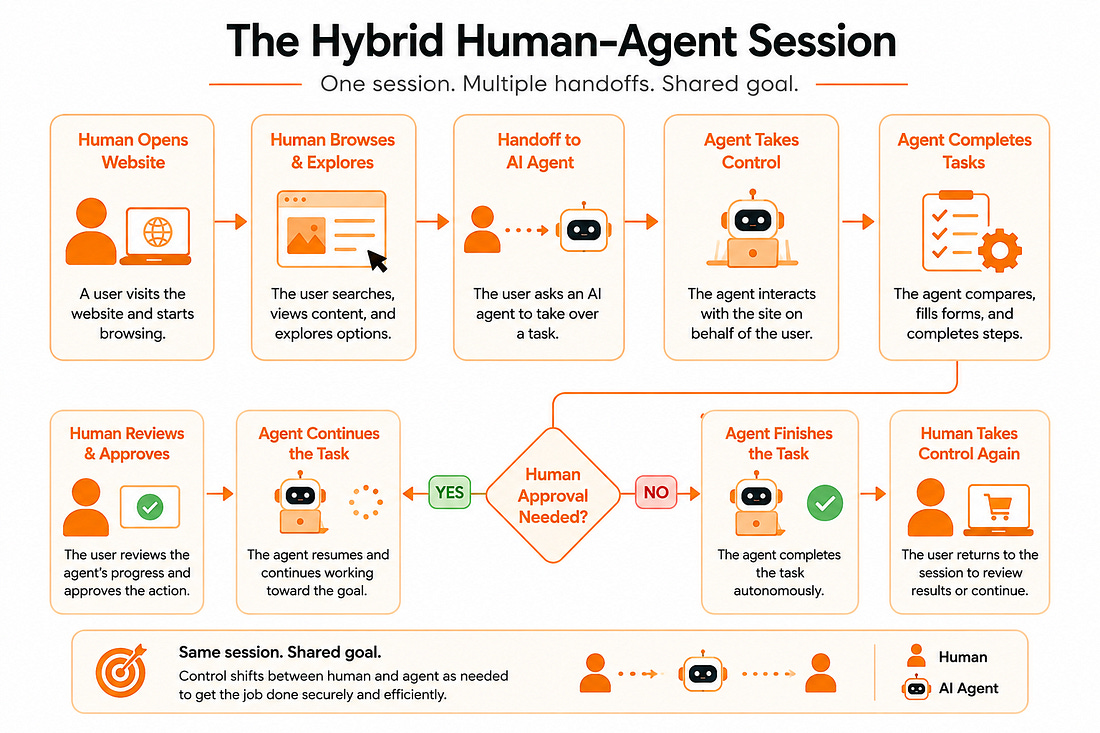 |
This is why simply labeling an entire session BOT or HUMAN becomes increasingly meaningless.
The identity of the actor may change while the session persists.
The More Useful Question Is: Can This Action Be Trusted?
There is an important conceptual separation security teams need to make between risk and trust.
Risk asks:
How dangerous does this particular action appear?
Trust asks:
What accumulated evidence do we have that this actor should be allowed to perform it?
They are related, but they are not opposites.
Imagine a well-established customer suddenly refreshing an order-status page unusually quickly. The behavior might produce an elevated automation signal, but years of account history, a known device, successful authentication and a low-risk action could justify allowing it.
Now reverse the situation.
A completely unknown browser arrives from a fresh environment, immediately creates accounts, rapidly cycles inventory queries and initiates high-value transactions.
Even if every individual interaction superficially resembles legitimate browser activity, the session deserves much less trust.
The important shift is therefore:
Bot detection → trust evaluation
And trust should not be a single score calculated when the visitor arrives. It needs to evolve throughout the interaction.