
|
 |
Thanks for signing up to be a free subscriber! This post in public so it’s free to access by all. If you want to, please heart-react this post, which improves its visibility to the platform, so this newsletter can continue to thrive and grow.
The Crazy Cat Lady Insult Is No Longer the Flex Misogynists Think It Is
The history of the “crazy cat lady” stereotype, and why unmarried women have always been treated as a social problem.
|
| |||||||||||||||


Quick note before we begin: Did you already fill in my new survey on waiting in relationships? I’d love your input, if you have 5 minutes. You can fill it in here. Thank you!
Yesterday, the 8th of August, was the international day of cats and orgasms. I find the coincidence to be a very good fit :) So it was time to finally write about the crazy cat ladies.
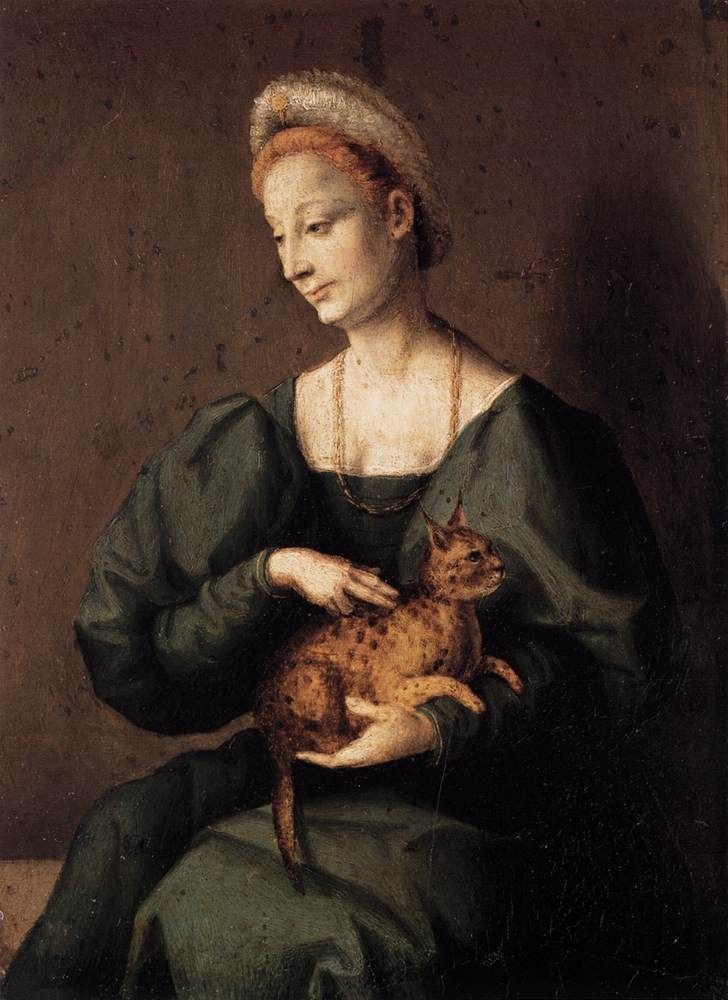
There is something wonderful and hilarious about the fact that one of patriarchy’s most enduring threats to women who don’t conform to its prescribed script is, apparently, a house full of cats. The crazy cat lady is supposed to be the cautionary tale at the end of the road for women who fail to secure a husband. She is old, unmarried, vaguely eccentric, presumably lonely, and surrounded by an alarming number of animals, felines in particular. Perhaps she talks to them. Perhaps she feeds them too much. Perhaps she has stopped caring what men think. The horror.
This is supposed to be an insult, of course. The message is that if a woman remains single for too long, she will eventually become the crazy cat lady: socially undesirable, emotionally damaged, sexually irrelevant and surrounded by substitute relationships (with pets etc.) because no man wanted her. It is an extraordinarily old idea wearing a very modern costume. And I think the funniest thing about the contemporary version is that it has begun to lose its power.
More and more women are looking at the supposedly terrifying fate of living alone with cats and thinking: ‘Wait. You mean I get a house, my own money, nobody snoring beside me, and several creatures who don’t expect me to perform unpaid domestic labor for them?’
 |
The crazy cat lady stereotype is therefore worth taking seriously precisely because it looks so unserious. The cat is not really the point; the joke has never fundamentally been about cats. (It’s the kind of joke that isn’t just a joke.)
It is about a woman who has failed, refused, or simply chosen not to make a man the organizing principle of her life. And once you understand that, the history of the crazy cat lady starts looking considerably less like a quirky story about women and pets and considerably more like a long history of what happens to women who exist outside heterosexual domesticity.
Before There Was a Crazy Cat Lady, There Was a Spinster
The crazy cat lady is not an invention of the internet. She is the latest descendant of a much older family of misogynistic stereotypes: the spinster, the old maid, the eccentric maiden aunt, the witch, the bitter unmarried woman and the supposedly pathetic woman who has reached old age without being chosen by a man.
The details changed, but the basic social message remained remarkably stable. A woman’s expected trajectory was marriage, children and domestic usefulness. A woman who deviated from that trajectory therefore required an explanation. Why wasn’t she married, what was wrong with her? Was she unattractive or difficult? Perhaps frigid? Bitter? Too masculine or too independent? Maybe she was just a little crazy.
That last explanation was the one that stuck because it was the most convenient, politically speaking.
Historically, of course, unmarried women were not all tragic figures desperately waiting for husbands to rescue them from their miserable existence. Some never married because they could not afford it, some because the available marriage market offered them little, some because they entered religious life, some because they remained economically useful within extended families, and some presumably because they simply did not want to marry (although this resistance to the imperative came with some personal cost). Women have never been a homogeneous population obediently following one reproductive timetable.
But societies organized around marriage had an interest in making unmarried women seem abnormal.
But the stereotype did not need every unmarried woman to be miserable. It only needed marriage to remain the culturally approved destination. The woman who stayed outside it could then be represented as an unfortunate exception, someone who had somehow missed out on the ‘proper’ female life.
The ‘old maid’ stereotype performed precisely this function. The unmarried woman was therefore imagined as bitter, sexually frustrated, socially awkward, unattractive or eccentric, and perhaps many of these at once. She was the woman who had somehow failed the most important test of feminine adulthood: being desirable enough for a man to choose her.
And there is a rather obvious cruelty buried inside this narrative. A man’s unmarried status has historically been much less likely to be treated as evidence that something is fundamentally wrong with him. A bachelor might be a confirmed bachelor, an eligible bachelor, a lifelong bachelor, a free spirit, a ladies’ man or simply a man who ‘never settled down’.
Women get the spinster label. Men get options.
The terminology itself tells us who is supposed to experience singleness as a personal failure.