| | In this edition: DR Congo imposes fresh mineral export bans, South Africa’s crypto policy shift, and͏ ͏ ͏ ͏ ͏ ͏ |
| |  | Africa |  |
| |
|
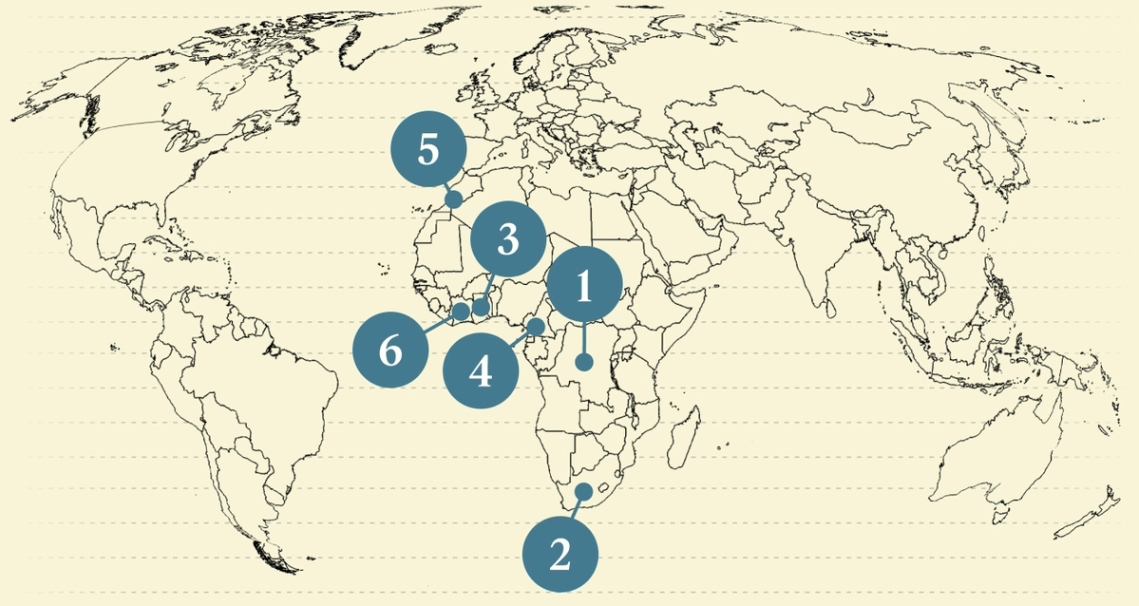 - DRC’s new export curbs
- Pretoria mulls crypto pivot
- Migration anxieties revealed
- Concerns over Biya’s absence
- FIFA chief needs Africa
- Weekend Reads
 Why the continent’s glaciers are shrinking. |
|
DR Congo imposes copper, cobalt curbs |
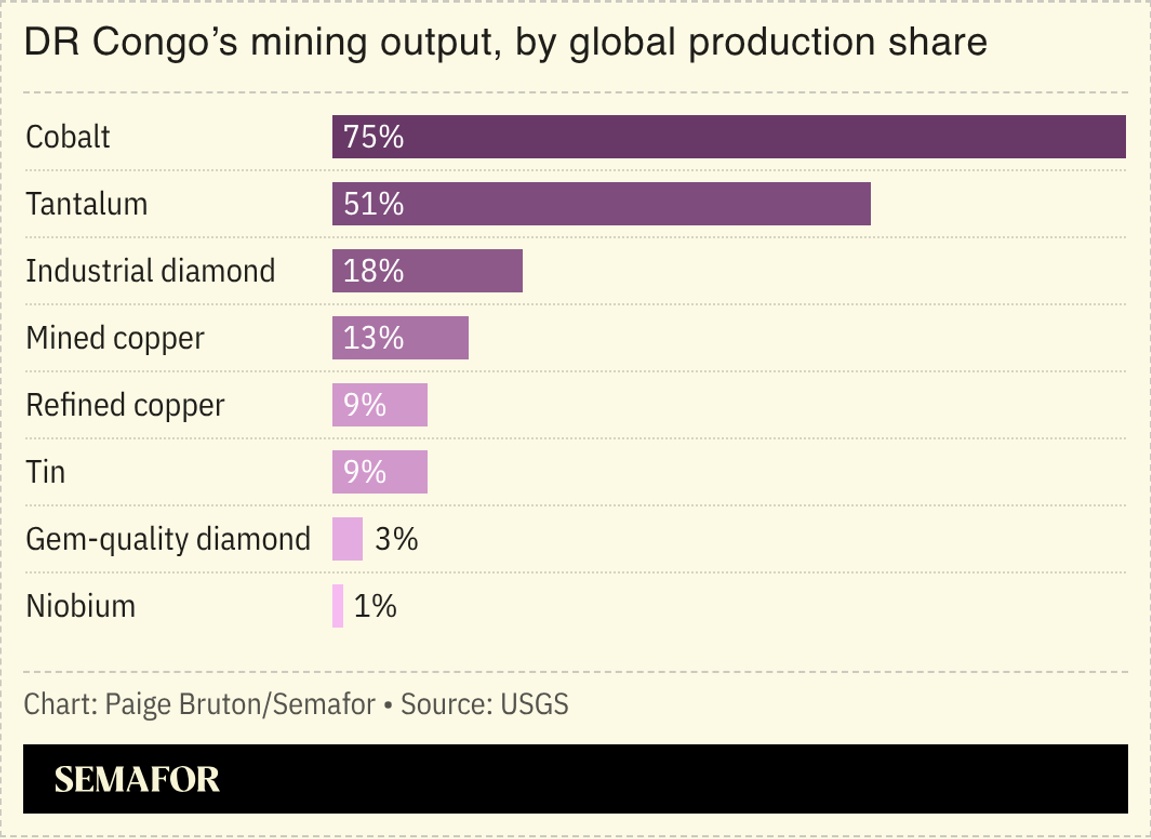 DR Congo has banned exports of copper and cobalt concentrates, escalating its push to increase domestic processing and retain more value from its mineral resources. The country, which accounts for more than 70% of the world’s cobalt supply, is seeking to leverage its position as a major source of minerals needed for the global battery industry, as well as the cables and transformers that underpin data centers. Reuters reported that a government order showed the ban would take immediate effect, although one-year export waivers may be granted under “strategic circumstances.” The order reportedly said the ban was motivated by “the need to encourage mining operators to market or export commercial mineral products with high added value.” The restrictions are the latest imposed by Kinshasa, which recently added lithium to a list of strategic minerals that are subject to increased royalties. Other African countries are also leveraging demand for their natural resources to boost mining revenues: This year alone, Zimbabwe suspended its raw lithium exports and Ghana’s gold regulators introduced a new sliding‑scale royalty rate that rises in line with bullion prices. |
|
S. Africa mulls cross-border crypto ban |
| |  | Tiisetso Motsoeneng |
| |
 Phill Magakoe/Pool via Reuters Phill Magakoe/Pool via ReutersSouth Africa proposed a ban on corporate cross-border stablecoin transactions, setting up a clash with a generation of tech entrepreneurs who say the restrictions will hurt trade, push volumes into unregulated channels, and isolate the country from global capital pools. The draft rules, released jointly by the South African Reserve Bank and National Treasury, mark one of the most aggressive attempts by an emerging economy to force borderless crypto to abide by decades-old foreign exchange controls. The proposed rules also block incoming payments from private wallets, and count outgoing transfers as an offshore capital move that triggers exchange control limits. The pushback comes as importers across the continent and other emerging markets turn to digital currencies to pay overseas vendors on the spot, circumventing tight bank supplies of hard currency and costly transfer delays. |
|
Immigration raises anxiety — survey |
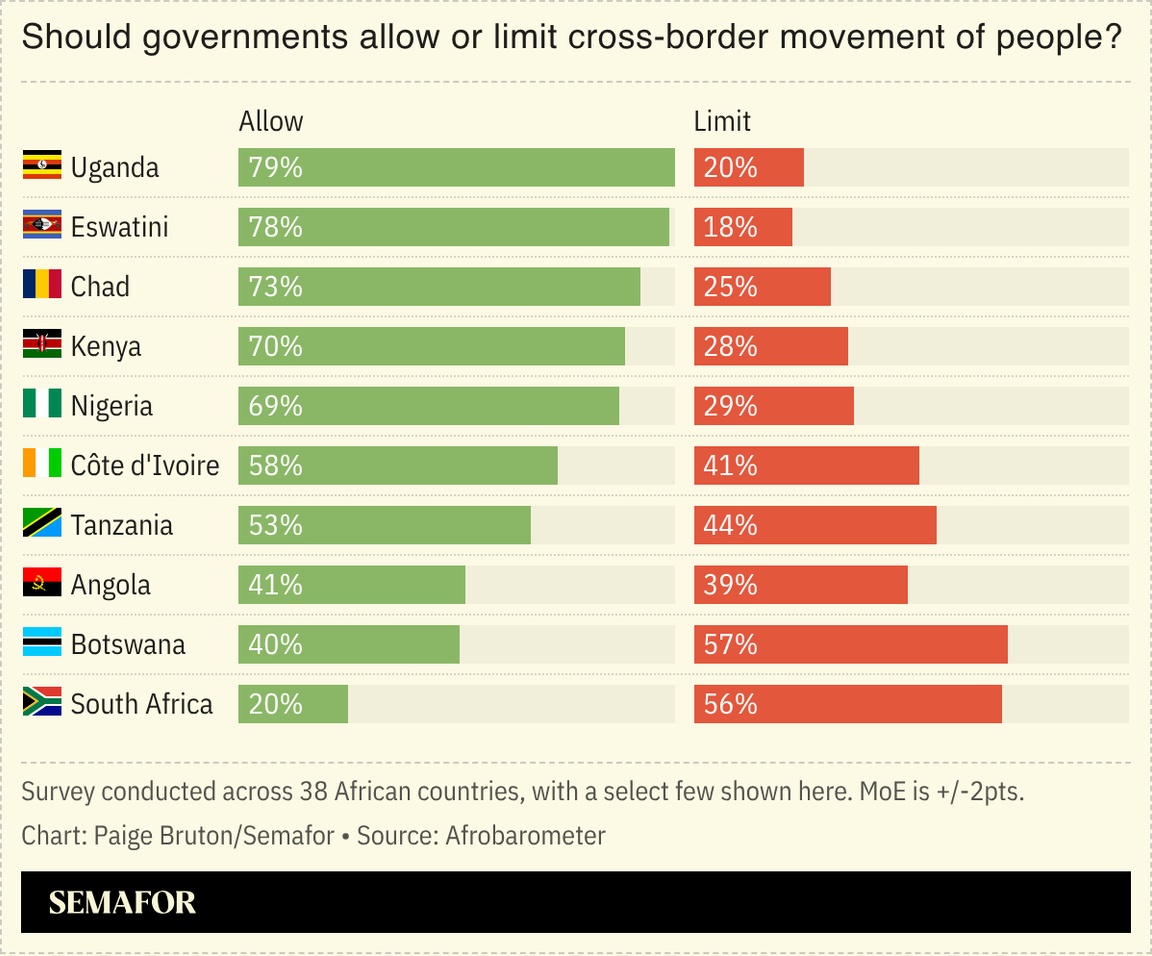 The prospect of allowing Africans to move freely across the continent’s borders is a common source of economic anxiety, a survey by Afrobarometer found. Nearly two-thirds of respondents preferred to see fewer or no job seekers admitted into their country, the Ghana-based polling company found. Xenophobic unrest in South Africa, where violent mobs have forced thousands of African foreigners to flee the country, has thrust migration into the spotlight. Events in the continent’s most advanced economy appear to support one of Afrobarometer’s findings that the most educated, skilled, and wealthiest Africans tend to be most resistant to immigration, especially if they are from relatively rich countries. These views exist alongside an increased desire for mobility on the continent: Nearly half of those who took part in the survey of 38 countries said they had considered emigrating. — Alexander Onukwue |
|
Biya’s absence stirs speculation |
 Cameroonian President Paul Biya in April. Guglielmo Mangiapane/File Photo/Reuters. Cameroonian President Paul Biya in April. Guglielmo Mangiapane/File Photo/Reuters.President Paul Biya’s shuffle of key army positions during a two-month absence from Cameroon has stoked fresh speculation about political stability in the cocoa and oil-producing nation. The absence of Biya, who at 93 is the world’s oldest president, has prompted renewed questions about his health. Opposition figures in Cameroon have called for the presidency to be declared vacant because he has not been in the country since June 7 — he is thought to be in Switzerland. Biya’s aides have pushed back, asserting that he can govern from abroad. “I cannot tell you exactly when President Paul Biya is returning,” Communication Minister René Emmanuel Sadi told RFI. “And even if I knew, it is not my place to announce it here. I can at least tell you that he is coming back very soon.” Biya has led Cameroon since 1982 and could remain in office until the age of 100 after securing an eighth term last October. He has maintained a firm grip over Cameroon even as a coup toppled another long-standing regime in Gabon to its south, and militant insurgencies trouble other neighbors, Chad, and the Central African Republic. — Alexander Onukwue |
|
| |  | Adrian Elimian |
| |
 Royal Moroccan Football Federation President Fouzi Lekjaa and FIFA President Gianni Infantino. Eloisa Sanchez/Reuters. Royal Moroccan Football Federation President Fouzi Lekjaa and FIFA President Gianni Infantino. Eloisa Sanchez/Reuters.FIFA President Gianni Infantino is leaning on Africa’s 54-member voting bloc to survive the fallout from his failed $20 billion World Cup commercial rights plan, with staunch ally Morocco leading the charge. The Confederation of African Football (CAF), led by South African billionaire Patrice Motsepe, said on Thursday its executive committee “unanimously reconfirmed its support” for Infantino, thanking him “for his support for African Football.” After reports of the proposal to sell off stakes in the World Cup broke last month, three confederations — Asia, Europe, and North America — pushed Infantino to back down. There was also anger from senior FIFA insiders and some world leaders. Now, a pressure campaign challenging Infantino’s leadership is gathering steam, with the continued threat of a European boycott looming. |
|
 - Three decades after apartheid, South Africa’s market-based land reform program has redistributed only 12-20% of a promised 30% of white-owned land. Black and white farmers in the Free State and KwaZulu-Natal interviewed by researchers revealed landowners often sold specific pieces of land to buffer against theft or separate their herds from labor tenants’ livestock, leaving Black beneficiaries on small, unsupported plots.
- Africa’s longtime development finance model is unraveling as Western aid retreats and Chinese state lending gives way to private equity investments. In response to these shifts, Rabah Arezki proposes in Foreign Policy that the African Development Bank reinvent itself as the continent’s financial architect by using loans to draw in commercial lenders, channeling credit through local banks toward SMEs. It should condition support on progress on banking reforms, he argues, with the aim of positioning the bank as Africa’s own institution for self-financed transformation.
- Having pressured more than 160,000 migrants to flee in recent months, South Africa’s Afrophobic “March and March” movement is continuing to escalate ahead of local elections in November. Reporting by Obi Anyadike and Oscar Nkala in The New Humanitarian traces the campaign’s toll on immigrant-run shops, Soweto’s informal economy, and cross-border trade worth billions, with economists warning that the movement obscures migrants’ economic contributions and ignores diplomatic costs.
- Nigeria’s brutal kidnap-for-ransom crisis has grown into one of the country’s most lucrative industries. In The New Yorker, Alexis Okeowo traces its roots from Niger Delta militancy through Boko Haram to armed militia groups now operating across the north. Following the five-month captivity of a twice-kidnapped university lecturer, Okeowo documents ransoms paid by families with zero government support, ineffective security spending, and the politicization of the crisis by American conservatives.
|
|
 Business & Macro |
|
|


