| | Trump and Warsh keep the lines open, Ukraine ‘weeds out’ Colombian narcos, and India’s electronics p͏ ͏ ͏ ͏ ͏ ͏ |
| |  | Flagship |  |
| |
|
The World Today | 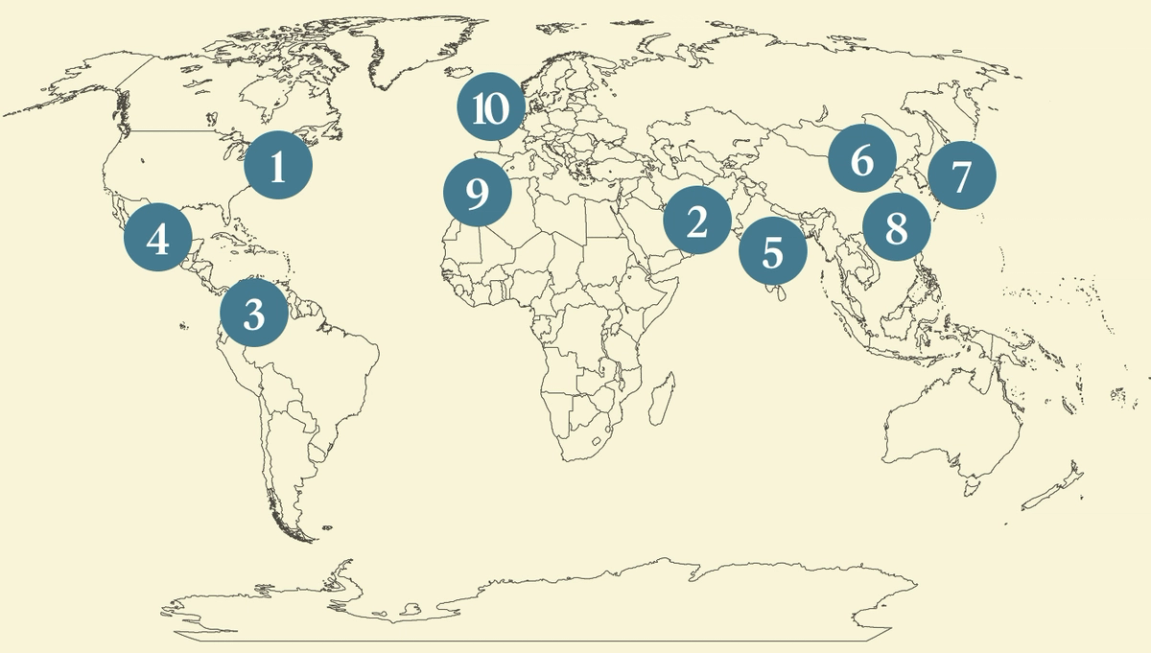 - The Warsh-Trump relationship
- US-Iran sanctions barrier
- Ukraine kicks out narcos
- Sheinbaum curbs fracking
- India deepens electronics push
- ByteDance forbids distillation
- SoftBank increases AI bet
- Freighters go nuclear
- France bans scam calls
- Mental health fixation
 A dog’s Odyssey. |
|
Warsh balances political, market pressure |
 Evelyn Hockstein/Reuters Evelyn Hockstein/ReutersUS Federal Reserve chair Kevin Warsh has kept the lines of communication open with President Donald Trump since taking the role, underscoring the central banker’s balancing act between markets and the White House. Trump reportedly hasn’t pressured Warsh to lower interest rates, but sought his advice on the Iran war and AI, suggesting Warsh is “engaging Trump directly to head off the sense that the Fed is his adversary,” The Wall Street Journal wrote. Warsh is also under pressure for pulling back on forward guidance, which drew bond market blowback at the Fed’s last meeting. Trump has made clear his preference for lower rates, but his repeated praise of Warsh suggests he could be comfortable with an independent central bank helmed by “his guy.” |
|
US sanctions could stymie Hormuz route |
 Joey Pfeifer/Semafor Joey Pfeifer/SemaforEven if Iran and Oman are successful in forging a deal to reopen a commercial corridor in the Strait of Hormuz, preexisting US sanctions could render the route unworkable, experts said. The US Treasury has prohibited US companies from receiving “guarantee of safe passage” from Iran’s government, which the proposed route would necessarily entail, possibly resulting in asset freezes for those who comply. Iran will be able to weaponize Hormuz indefinitely, The Economist predicted, through which a fifth of the world’s oil and LNG transited, and efforts to reroute energy flows underestimate the ability of Iran to retain strategic leverage. “The oil price roller coaster is in for many more climbs and drops in the weeks ahead,” Semafor’s climate and energy editor wrote. |
|
Ukraine ‘weeds out’ Colombian narcos |
 Anatolii Stepanov/Reuters Anatolii Stepanov/ReutersUkraine’s armed forces have weeded out and “sent home” a number of Colombian volunteers sent by Medellín’s armed groups to glean drone warfare expertise. Such incidents are not isolated, the Financial Times reported: “What worries me most is the level of specialization they’re acquiring,” a Colombian aid worker in Ukraine said. Latin American armed groups have pioneered low-cost drone usage, allowing Colombia’s guerrillas to challenge state air supremacy for the first time in their decades-long conflict; cartels have also designed new mini-subs emulated by the US military. Washington remains unprepared for widespread drone warfare, marking the first time since the start of World War II “that the US military finds itself a major step behind,” an expert argued in The National Interest. |
|
Sheinbaum rules out fracking expansion |
 Henry Romero/Reuters Henry Romero/ReutersMexican President Claudia Sheinbaum ruled out fracking in a key basin, citing danger to nearby water tables and indigenous communities, highlighting her political balancing act as the country strives to wean off US energy. A former engineer, Sheinbaum has backtracked on her opposition to fracking, touting “new extraction technologies” that differ from “traditional fracking,” and reframing it as essential for reducing Mexico’s reliance on US imports; she’s also fallen back on price caps. As the White House pushes to enlist Mexico in its aggressive pursuit of cartel leaders, Sheinbaum has alternatingly defied and placated Washington: After killing a cartel leader with US intelligence assistance in February, Mexico’s government last month filed US criminal complaints regarding the deaths of Mexican nationals in immigration custody. |
|
iPhones boost India’s electronics ambition |
 B Mathur/Reuters B Mathur/ReutersThe success of Apple’s production facilities in Chennai, including the company’s first major iPhone factory in India, is boosting Prime Minister Narendra Modi’s ambition of transforming the country into an electronics powerhouse. Washington’s intensifying efforts to wall off its tech industry from Chinese software and components are also helping make the case for India, which has been trying to show it’s less costly and more reliable than China. The Chennai hub “is physical proof that the country is on its way to proving the doubters wrong,” Bloomberg wrote. Microsoft opened its largest India data center in Hyderabad Thursday, betting on a “market of more than 1 billion internet users” and deep tech talent, Reuters reported. New Delhi is also eyeing semiconductor production. |
|
ByteDance forbids distillation |
 Aly Song/Reuters Aly Song/ReutersChinese tech giant ByteDance’s founder reportedly forbade AI researchers from distilling rival models, as scrutiny of the practice causes friction between Washington and Beijing. The policy reportedly dates to 2023, predating the period when “avoiding US retaliation” became a potential commercial priority, the Pekingnology newsletter wrote. Notably, ByteDance is not one of the firms American AI lab Anthropic has accused of distilling — charges that prompted US sanction threats. The guidelines sparked intense debate at ByteDance, whose best models have been surpassed by smaller Chinese labs, highlighting the competitive pressures facing the industry as Beijing presses for better AI built with less compute. US models currently offer better value, The Economist wrote, but the “convergence is likely to continue.” |
|
SoftBank doubles down on AI bet |
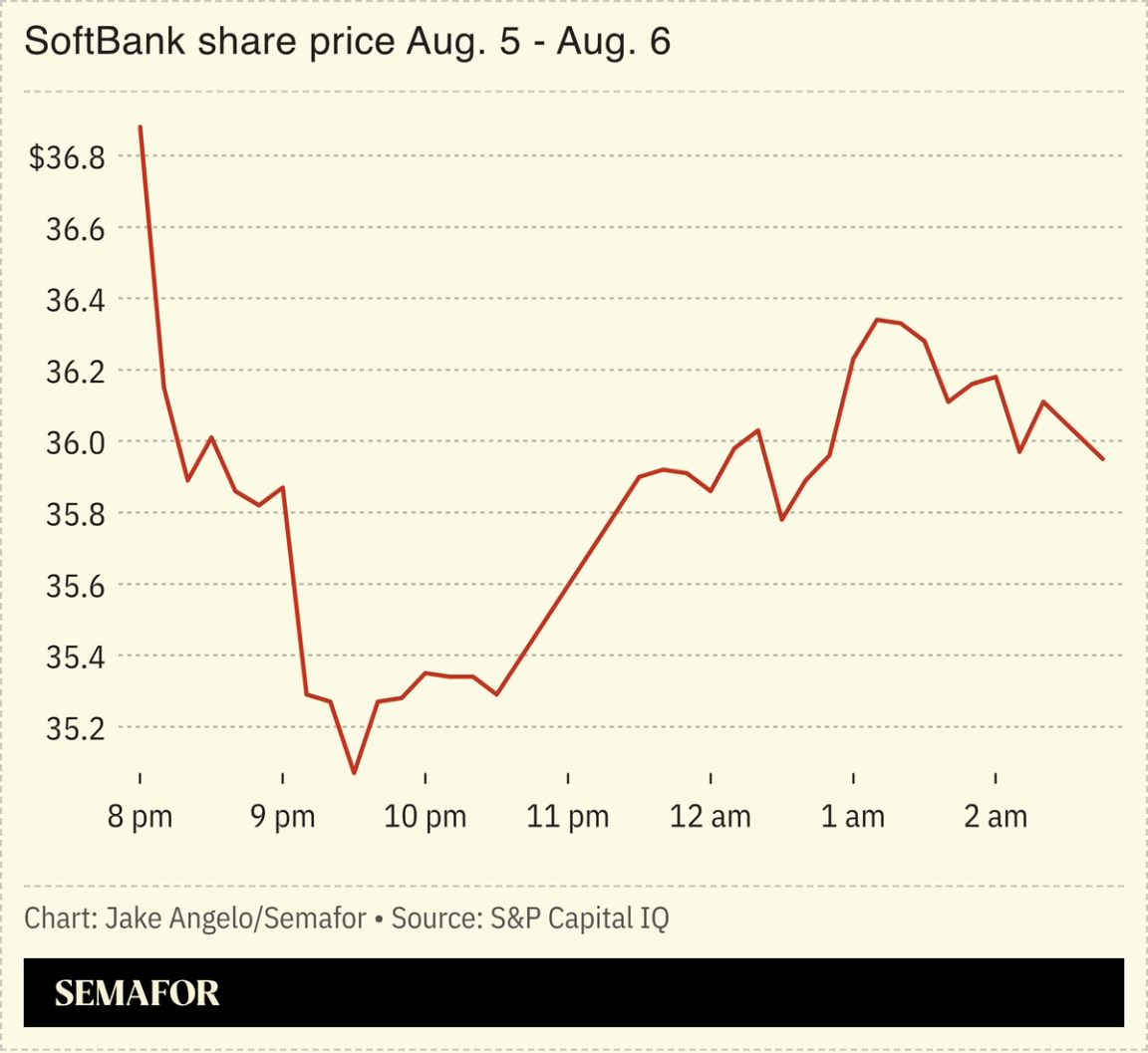 SoftBank’s profit got a lift from its investment in US chipmaker Intel, which has been on a record turnaround over the past year thanks to the AI buildout. Besides investments in Intel and OpenAI, CEO Masayoshi Son’s sharp pivot into AI has included a string of multibillion-dollar AI projects for which the company has yet to provide a clear timeline on when the revenue from those deals will surface. SoftBank is also “using borrowed money and financial sleight-of-hand” to reorient the Japanese giant around AI, as Semafor’s Liz Hoffman put it, not unlike how Son turned the Japanese telecom into a venture force in the 2010s. |
|
 The Gulf now reaches far beyond the region, shaping energy markets, supply chains, and the global economy. Semafor Gulf is here to help you make sense of it. Five days a week, editor Mohammed Sergie and our team across Abu Dhabi, Dubai, and Riyadh will connect you with what’s happening on the ground, and how it affects business, energy, and diplomacy — bringing clarity to the most consequential story in the world. |
|
Nuclear cargo ships on the rise |
 Carlos Barria/Reuters Carlos Barria/ReutersNuclear-powered cargo ships could be on the rise, bringing reduced carbon emissions but new security risks. The shipping industry needs low-carbon fuels to meet net-zero targets, and nuclear is a growing option. Industry and governments are unveiling plans, and forecasts suggest there could be hundreds of reactor-powered commercial vessels by 2050. Nuclear-powered military vessels, notably submarines and aircraft carriers, have been in service since 1955. But they have advantages: They are usually a single-country venture, while commercial ships are often designed in one, built in another, operated by a third. Military vessels are also able to defend themselves against attack. “Engineers, regulators, ports and shipping companies must make these vessels safe and controllable,” two academics wrote in Nature. |
|
France bans telemarketing calls |
 Christian Hartmann/Reuters Christian Hartmann/ReutersA French ban on nuisance telemarketing calls could cost 50,000 jobs in Morocco. From Aug. 11, firms making unsolicited phone calls to French consumers could pay fines of up to €75,000 a call. But Morocco’s outsourced call-center industry historically makes 80% of its revenue phoning French customers and the country’s employment minister warned that tens of thousands of jobs are at risk. The sector, built on cheap, Francophone labor with relatively weak unions, is simultaneously being hollowed out by AI. India and the Philippines have both seen customer service layoffs in their huge outsourcing industries. An industry site noted that the characteristics which make call-center work easy to offshore — repetition, predictability, and scale — also make it suitable for automation. |
|
|


