



 |
1. Michigan
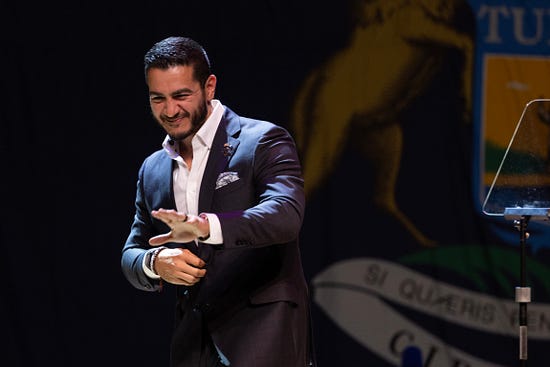
The Associated Press this morning called the Michigan Senate Democratic primary: Abdul El-Sayed won a much closer than expected victory over Haley Stevens.
Let’s get under the hood on the numbers to understand if Democrats are taking a big risk on the youngblood.
Start with this: El-Sayed should beat Mike Rogers, the former longtime congressman who is the Republican nominee, because Michigan is a fairly Democratic state.
The current governor of Michigan is a Democrat and Democrats have held the governorship for 16 of the last 24 years.¹
Since 1979, Democrats have held both of Michigan’s Senate seats for the entire period, with the exception of a single Senate term when Spencer Abraham was elected in the 1994 Republican wave.
That’s an incredible run.
Here are the ten Senate elections since Abraham broke the streak:
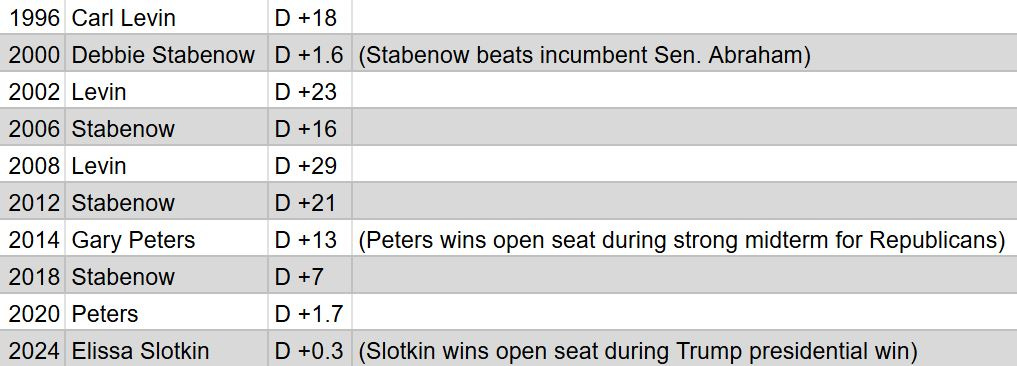 |
You can see a clear pattern of Republicans gaining ground since 2014—but Democrats have still performed well. They’ve won open seats; they’ve won in midterm elections when Republicans are surging nationally. They’ve won in presidential years when Republicans captured the White House.
They’ve even won an open seat while Trump was carrying the state at the presidential level.
What this tells us is that Michigan is a Democratic state. With an open seat, in a good environment for Democrats, without Trump at the top of the ticket, any replacement-level D should win this Senate seat.²
Probably by > 1.5 percent.
Translation: El-Sayed would have to be worse than a generic Democrat—by at least 1.5 points—in order to lose.
Is he?
2. Results
Start with El-Sayed’s positives.
He’s an excellent speaker and a real political talent.
He ran an insurgent campaign, going from near the rear of the pack to the front.
He beat the entire state Democratic establishment that came out to oppose him.
He was outspent by close to 11 to 1.
That’s a lot of positives. And here’s another one: El-Sayed turned out a lot of voters.
The last time Michigan Democrats had a semi-competitive primary was in 2024. Elissa Slotkin romped with 76 percent of 934,000 votes.
More than 1.5 million people voted in yesterday’s primary. In a primary race in a state where the total number of eligible voters—of both parties—is around 8 million, that’s a lot of excitement; a lot of energy. You have to give El-Sayed credit for a lot of it.
And yet . . .
El-Sayed dramatically underperformed his polls. The last batch of polls had El-Sayed ahead by +13 on average. His worst poll in the final days had him at +8.
As of this writing, he’s ahead by just about 1 percent.
Not the end of the world, maybe. But concerning.
Also concerning is the voting pattern. This race had become a referendum on El-Sayed. He was the main character. He was so far ahead and had so much energy behind his campaign that the question for Democrats wasn’t so much Stevens vs. El-Sayed, but, “Are you sure you want to roll with this guy?”
When Slotkin beat Mike Rogers in 2024, she won by a total of 19,000 votes out of 5.6 million votes cast.
How did she do it? She rolled up huge margins in Wayne, Washtenaw, and Ingham Counties where she won with Saddam numbers. She dominated 8 of the 11 most populous counties.
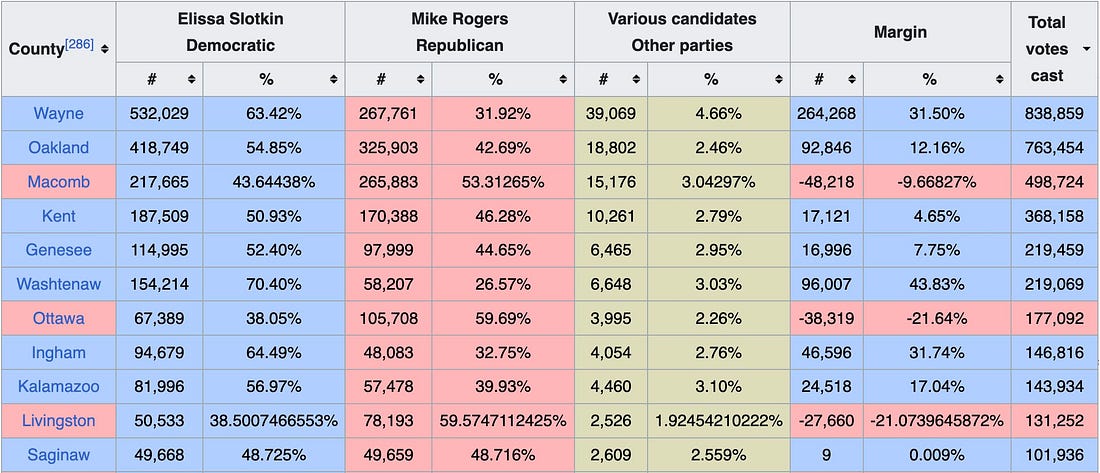 |
But she also hung on in the rural counties. Slotkin only dropped below 30 percent in a handful of rural outposts. The difference between hitting 30 percent, or falling to 20 percent, in a county with 5,000 voters isn’t much—500 votes.
But again: She won by 19,000 votes, total. And there are a lot of those small, rural counties.