





Now that Todd Blanche’s nomination for attorney general has made it out of committee, the race is on to figure out which Republican senators get to take a show vote against him without imperiling his nomination. It’s a tricky thing, given that Blanche can only afford to lose two. The first, unsurprisingly, is Susan Collins, who said yesterday that Blanche “has taken several actions that have further eroded” the Justice Department’s independence. She’s not kidding! Who the lucky second abstainer will be remains to be seen: Lisa Murkowski has said she is still weighing her decision. Bill Cassidy has been mum. But it can only be one. Happy Wednesday.
 |
About Last Night
by William Kristol
It would be nice to be able to draw some novel, surprising, or dramatic conclusions from last night’s election results. But sometimes the truth is messy and prosaic. The fact is that the results were a mixed bag. And they don’t seem to me to change anything much about what’s likely to happen in November.
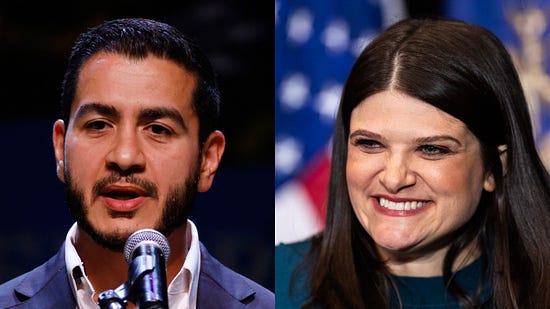
The highest profile race was the Michigan Democratic Senate primary. The polls suggested that the leftist insurgent, Abdul El-Sayed, would easily defeat the establishment candidate, Haley Stevens, perhaps by double digits. It looks early this morning that El-Sayed will likely eke out a victory by a percentage point or two.
It’s a good reminder that polling in primaries can be unreliable. More importantly, it probably means Republican Mike Rogers, who almost won his senate race against Elissa Slotkin in 2024, has better odds than he otherwise would have had this November. But the national environment will still help the Democratic nominee, and it’s also the case that some swing voters may be more attracted to the change El-Sayed represents than put off by some of his left-of-the-mainstream views. So while this is a chance—very likely the only one—for a Republican Senate pickup, it’s by no means guaranteed.
On the other hand, the continuing cascade of news about Rep. Max Miller’s horrifying personal behavior, combined with his determination to stay in the race for his Ohio congressional seat, makes me more convinced than ever that Democrats will have a better-than-expected cycle in that state—and that Sherrod Brown could very well win the Senate race there.
Put that together with likely Democratic pickups in North Carolina and Maine, and decent opportunities for victory in Alaska, Iowa, and Texas, and I think Democrats have a pretty good chance—I’d say slightly better than 50-50—of controlling the Senate.
And there are other states that aren’t being much discussed that could well be in play. Last night, Kansas Democrats nominated a strong moderate, Alan Hamilton, to take on a weak Republican incumbent, Roger Marshall. At the same time, voters in that state soundly defeated a Republican-backed measure to change the way Kansas Supreme Court’s judges are selected—a measure that was really a referendum over the court’s more liberal decisions, especially on abortion rights. By the way, that topic could return more centrally to the electoral conversation this year after the recent emergence of a recording by Todd Blanche assuring faith leaders that he’d work to extend anti-abortion measures nationally.
I’d also note that the Democratic nominees have withdrawn from Senate races in South Dakota and Idaho, clearing the field for moderate and attractive independent candidates to stand as the alternative to the Republican nominees. The same thing may well happen soon in Montana. One or more of those races might become competitive. In these cases, Democratic parties are behaving responsibly, putting their pride and narrow self-interest aside, and trying to rise to the moment by making it easier for voters to elect candidates not burdened by the Democratic brand but who, as senators, would help check Donald Trump.
Meanwhile, nothing that happened in House primaries last night—a mixed bag of progressive and moderate victories—changes the broader electoral landscape. We are today where we were a few days ago when Ron Brownstein said on our Bulwark on Sunday podcast that “like Bogart, I believe the fundamental things apply.”
One fundamental thing that applies is that the party of the incumbent president hasn’t maintained control of the House in an off-year election since 2002. Voters like their checks and balances! Another fundamental is that special elections have produced consistent and marked Democratic overperformances over the past year and a half.
And the most significant fundamental is that Donald Trump’s approval is so far underwater. He’s far worse off than George W. Bush in 2006, or Barack Obama in 2010, or Joe Biden in 2022, or than he himself was in 2018. In all those instances, the House flipped. Trump’s not going to escape the same fate.
The task for Democrats isn’t complicated. They need to focus on the fundamentals and keep on fighting Trump. They also need to prepare for a desperate Trump administration and Republican party to do whatever they can to tilt the playing field. But on this front, Democrats seem to be getting better prepared, and courts and voters seem increasingly alert to the danger. Yesterday, for example, public outrage forced Republicans in important Tarrant County, Texas to back down from a scheme to drastically reduce the number of voting locations, including cutting early voting locations on college campuses.
It’s no time to relax, and it’s no time to panic. Ron Brownstein’s Casablanca reference made me think of World War II, which in turn reminded me of the famous British World War II poster: “Keep Calm and Carry On.” Good advice then, good advice now.
Psycho Congressman, Qu’est-ce Que c’est?
by Andrew Egger
Things are quickly going from terrible to unsustainable for Max Miller. The congressman, who has long faced serious, troubling allegations of domestic abuse, became a national spectacle this week after he tried to refute the allegations in a bizarre livestream. Incomprehensibly, he decided to take another bite of the apple yesterday afternoon, going on CNN for a lengthy interview with Jake Tapper.
It couldn’t have gone worse. Tapper began the interview by asking about a new allegation from Miller’s former father-in-law, Sen. Bernie Moreno (R-Ohio), who said Miller had recently refused to return a treasured stuffed animal—a blue bunny—to his daughter, who can’t sleep without it.¹ Tapper wanted to know: Was that true? Miller responded:
Jake, I would agree that if that were true that would be incredibly disturbing and that the senator would be right. However, he has taken two years to publicly acknowledge for me to resign from my seat. Why is that, Jake? If he truly believed—look, I’m a father to a two and a half year old daughter. I believe that you’re also a father to children. And I don’t know if you’re also a father to