
|
 |



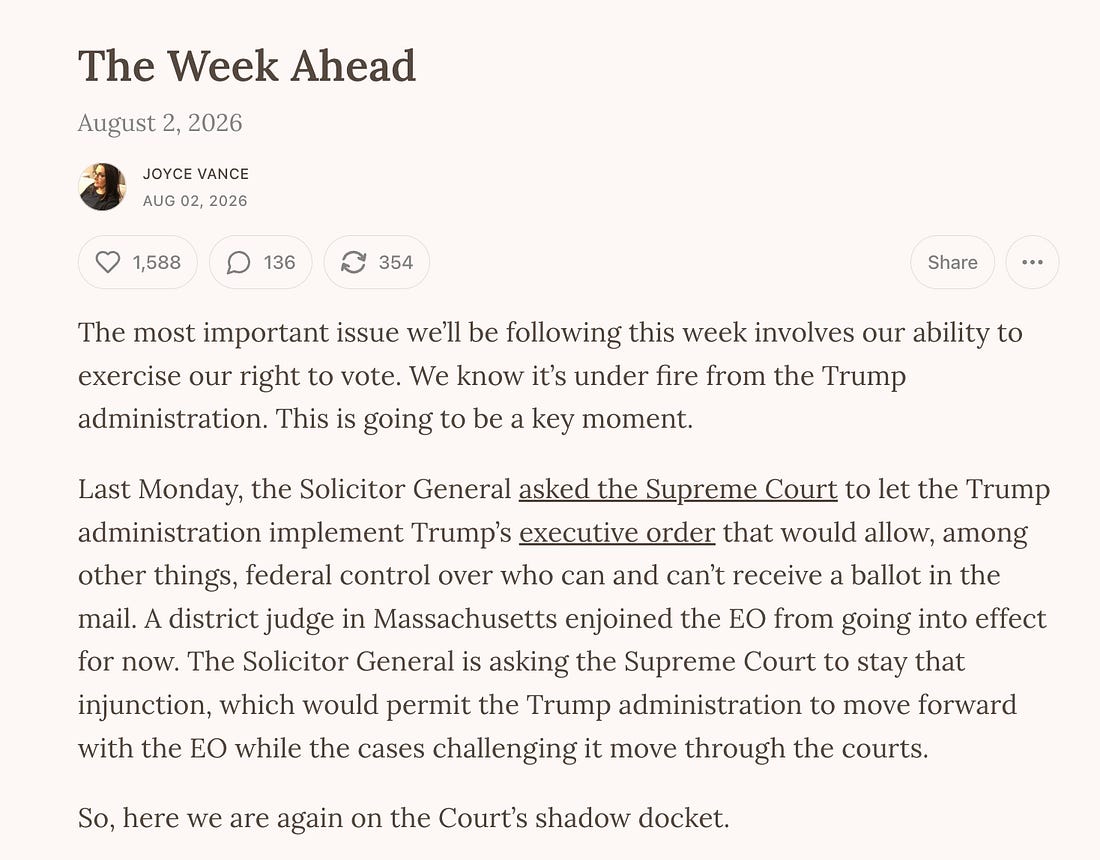
Sunday night in The Week Ahead post, we discussed the Trump administration’s effort to push ahead with implementation of an executive order that would give the federal government greater control over who can—and can’t—vote, despite the Constitution reserving that right to the states. The Solicitor General is trying to get the Supreme Court to override a lower court’s decision preventing implementation of three key parts of the order in advance of the midterm elections. The Trump administration is joined by red states in its request to the Court.
 |
On Monday, blue states’ attorneys general who are challenging Donald Trump filed their brief.
As we discussed at the time she issued her partial injunction, District Judge Indira Talwani in Boston concluded that the challenges the blue state AGs raised were not yet “ripe”—that means ready for a court to review—for federal elections after the midterms. But she agreed to proceed with claims that applied to the midterm elections because the executive order “created a ‘direct and immediate dilemma’” in that regard. The Judge enjoined the administration from proceeding in the District of Columbia and the states challenging the provisions.
The biggest areas of concern are the administration’s push to create lists of voting-eligible citizens for each state, investigate (i.e., intimidate) local election officials who issue ballots to anyone the feds don’t approve of, and use the Postal Service to prevent ballots from reaching anyone the federal government decides isn’t eligible to vote.
The blue states’ brief can be found here. They begin by reminding the Supreme Court that it “has repeatedly warned about the dangers of altering election rules on the eve of an election,” before pointing out that is exactly what they would be doing if they rule in the Trump administration’s favor. They explain what that would look like:
“It would allow the federal government to rush out an unprecedented, legally indefensible voter-verification and ballot-interception program that would, among other things, give the U.S. Postal Service farreaching new powers and responsibilities.”
“Under this new program, USPS—a budget-strapped agency that has struggled to administer a variety of programs in recent years—would require state governments to assemble (and then upload to an untested online USPS ‘portal’) lists of voters registered to cast mail ballots.”
“States would also be forced to redesign their ballot mail to adopt barcodes that USPS would scan to make voter-eligibility determinations.”
“USPS would refuse to deliver ballots for voters not identified in its database.”
“The federal government wants to roll out this program ‘as soon as early to midAugust,’ … mere weeks before States begin sending out mail and absentee ballots, and less than three months before the midterms.”
This would result in a “high risk of errors and the limited window for correcting mistakes,” which means that the millions of people who vote by mail, including voters with disabilities and in rural areas “would likely be denied mail ballots and, as a result, disenfranchised.” Voters could be confused by the process and less likely to engage. And election officials would have to expend time on sorting out the new procedures, taking valuable time away from administering the election.
The blue state AGs point out that Judge Talwani entered a very limited injunction to protect only the next election from late-occurring changes. The Trump administration is now seeking an injunction of its own, to keep her injunction from going into effect. But the AGs argue the administration’s position is flawed: “Neither the federal defendants nor intervenors make any effort to defend the legality of the executive order (EO) that adopted the sweeping changes enjoined by the district court. Nor could they. The Framers entrusted the States and Congress—not the President— with the responsibility to set rules for federal elections. And Congress has not authorized the EO’s unprecedented directives.”
As for the argument that the EO isn’t far enough along toward being implemented to be “ripe” enough for the district court to have considered it, the challengers argue that “It is not credible for defendants to assert that the scope of any final implementation actions is ‘entirely speculative.’ … The EO imposes highly ‘specific directives,’ … and defendants’ own papers have detailed the steps they are taking to finalize those directives in the coming weeks—steps that do not materially differ from the EO.” In other words, the administration is moving to put the president’s demands into effect, and because those demands are illegal, the courts have to move now, to avoid infringement on the right to vote.
Forcing the blue states to wait until closer to the election would allow Trump to impose the EO on the states, even if it was ultimately found to be illegal—it would be too late. The AG’s brief explains that “If litigation challenging final implementation of the EO does not even begin for several more weeks, it would be extremely difficult—if not impossible—to obtain a definitive judicial resolution with enough time remaining for States to redesign and reorder their ballot mail, train elections officials, and adequately educate the public before the November midterms.” The decision that they are relying on in the quoted section is Justice Kavanaugh’s concurrence in the 2020 election case in Wisconsin, which forces the Court to decide whether it will again impose different rules when the interests of Democratic voters are at stake than it does when Republicans are asking the Court for assistance. And they point out that any state that wants to give up its right to run its own elections and use the federal government as a gatekeeper is free to do so, but the states that have challenged the EO don’t want to see their constitutional authority diminished.
The EO conflicts with provisions in the Constitution that give states the power to determine voter eligibility and to set the “Times, Places, and Manner” of holding congressional elections. We no longer rely on this Court to protect people’s rights when they interfere with the conservative majority’s culture wars agenda. The question here is whether they will try to sidestep clear rules the Court has created, and this majority itself has enforced, in this situation to aid President Trump.
A bipartisan group of 56 former judges is siding with the blue states, urging the Supreme Court to keep the injunction that prevents the administration from moving forward in place. It’s an unusual coalition, pointing at the importance of the issue before the Court. The judges argue that the EO is anti-voter and unconstitutional, and permitting Trump to move forward would allow him to seize power he does not have.
This morning, my Insider podcast cohost Preet Bharara and I spoke with Republican election lawyer Ben Ginsberg. He told us, “There is no substantive evidence to back up the charges that our elections aren't accurate and certainly not that they're fraudulent.” You can listen to our conversation here. But it’s a remarkable moment in our history when the president is living in a fantasy world where he sees election fraud, albeit only when he loses, and is willing to sacrifice the voting rights of people he took an oath to serve on the altar of his personal needs.
That’s the throughline—Trump doesn’t serve; he expects to be the one on the receiving end, whether it’s decking out the Oval Office in trashy gold decor, accepting a plane from Qatar and expecting taxpayers to foot the bill for retrofitting it, or any of the other myriad ways he’s extracted benefit from the presidency. That’s what we have to make sure people understand heading into the elections, in which the president doesn’t want people who oppose him, people who see him for what he is, to be able to vote.
The Supreme Court could act at any time. When it does, the consequences won’t be confined to a legal opinion. They’ll affect how millions of Americans cast their ballots this November, and they’ll tell us something important about whether this Court is willing to apply its own rules consistently when the stakes involve Donald Trump. That’s why we’ll keep following this case. It’s one of the most important examples of how Trump is trying to seize power the Constitution doesn’t assign to the presidency, in ways people don’t always have time to track for themselves. We’ll keep track here at Civil Discourse.
We’re in this together,
Joyce