
|
Your High-Yield Savings Account Is Quietly Losing to a 4-Week T-Bill
If you live in a high-tax state, the math on cash savings hasn't favored a bank in a long time.
|

| |||||||||||||||


Real question: if you live in New York, California, or any state with a real income tax — why is your emergency fund in a high-yield savings account?
Most personal-finance advice treats high-yield savings as the obvious answer for cash. It used to be. In a 2026 rate environment, with state income tax in the picture, the math has quietly flipped. The Treasury is paying more than your bank on an after-tax basis — for a product the IRS literally exempts from state and local tax.
It’s called a Treasury bill. Specifically, a 4-week T-bill. And in high-tax states, it has become the highest-yielding place to park cash, full stop.
How T-Bills actually work
A T-bill is a short-term loan to the U.S. Treasury. You buy it at a discount; it matures in 4, 8, 13, 17, 26, or 52 weeks at face value. The difference is your interest.
Buy a $10,000 4-week T-bill at $9,972. Four weeks later, the Treasury wires you $10,000. You earned $28 of interest, which annualizes to roughly 3.61% — the current 4-week yield as of June 2026.
Three things are unique compared to your savings account:
Backed directly by the U.S. government. Not FDIC insurance — actual U.S. Treasury obligations. The strongest guarantee in financial markets.
Interest is exempt from state and local income tax. Federal tax only. This is the line that changes the math.
You can auto-roll them. Set up your brokerage or TreasuryDirect to automatically reinvest into a new 4-week bill every time one matures. Cash on a 28-day treadmill, indefinitely.
Why state-tax exemption matters more than people realize
This is the piece nearly every article on T-bills glosses over. Let’s run the after-tax math at the same income level.
Assume you’re in a 24% federal bracket and pay 9% combined state and local (close to NYC, NJ, CA, MD). Your savings account interest gets hit by BOTH layers. Your T-bill interest only gets hit by federal.
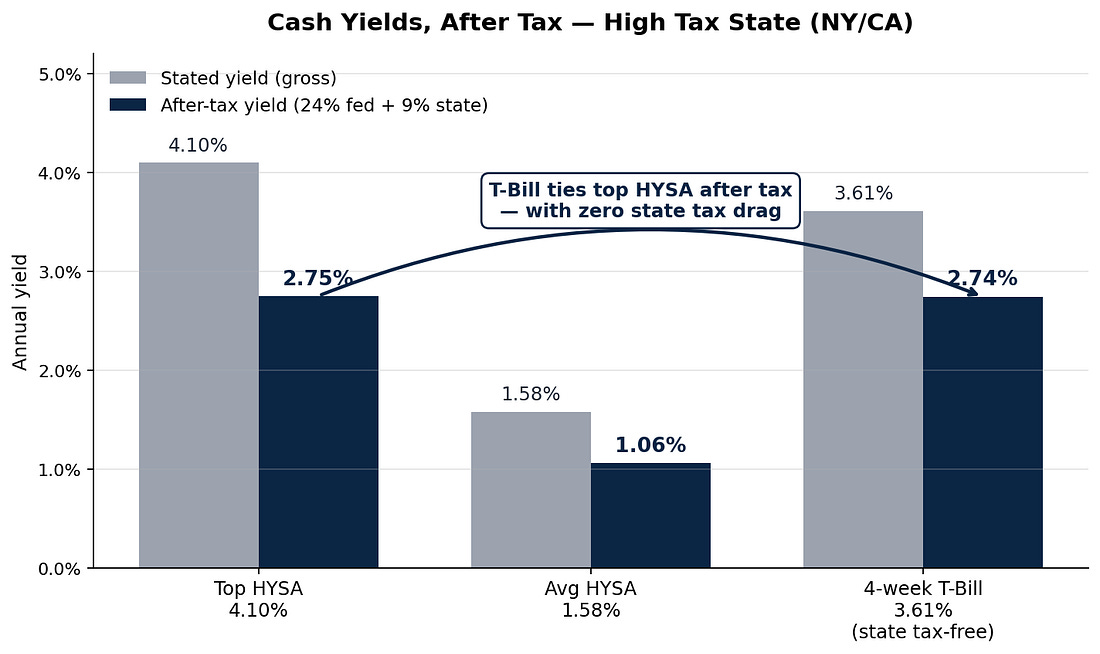 |
Top high-yield savings on the market: 4.10% gross. After 24% federal + 9% state = 2.75% after tax.
Average high-yield savings: 1.58% gross. After tax: 1.06%.
4-week T-bill: 3.61% gross. After 24% federal only (no state) = 2.74% after tax.
The 4-week T-bill effectively ties the top HYSA on after-tax yield, while crushing the national average. And it does it with zero promotional-rate games and the strongest credit backing on earth.
How to actually buy one
Two paths.
Path 1: Through your existing brokerage. Fidelity, Schwab, and Vanguard all let you buy T-bills directly. Auto-roll is built into the platform. Free to trade — no commissions on Treasury purchases. This is what most people should do. It lives next to your other accounts. The cash sweep + auto-roll feels exactly like a savings account.
Path 2: Through TreasuryDirect.gov. Same product, different interface. The advantage is direct relationship with the Treasury and no possibility of broker errors. The disadvantage is the website is from 1998 and recovering a locked account is a nightmare. For most people, doing it through Fidelity or Schwab is simpler.
Action this week: Open the bond/fixed-income screen at Fidelity, Schwab, or Vanguard. Look for ‘Treasury auction’ or ‘New issue treasuries.’ Buy a 4-week T-bill in any amount you’d otherwise keep in a savings account. Check the box for auto-roll. That cash is now earning state-tax-exempt yield, government-backed, with no bank promotional rate to babysit. Takes 10 minutes once you find the screen.
When HYSA still wins
Two scenarios where I’d keep money in a high-yield savings account.
If you might need the cash mid-month. T-bills mature in 4-week blocks. If you have to liquidate before maturity, you sell on the secondary market — usually painless, but you’re at the mercy of where rates have moved that week. A HYSA gives you instant access, full stop.
If you live in a no-income-tax state. Texas, Florida, Tennessee, Washington, etc. The state-tax exemption doesn’t help you, and HYSA top rates (4.10% gross) edge out the 4-week T-bill (3.61%). In those states, the math swings back to favor a top HYSA.
The one-line version
Cash management hasn’t gotten easier in 2026. It’s gotten more rewarding for people who know the rules. T-bills aren’t exotic. They’re not risky. They’re the Treasury paying you not to leave your money at a bank — and in any state with income tax, that’s a deal worth taking.
Sources
Federal Reserve H.15 — Daily Treasury rates (June 2026) — https://www.federalreserve.gov/releases/h15/
Experian — Average savings account interest rates (June 2026) — https://www.experian.com/blogs/ask-experian/average-savings-account-rates/
Bankrate — Best high-yield savings accounts (June 2026) — https://www.bankrate.com/banking/savings/best-high-yield-interests-savings-accounts/
Public.com — How Treasury bills are taxed — https://public.com/learn/how-are-treasury-bills-taxed
TreasuryDirect — Buying T-bills — https://www.treasurydirect.gov/marketable-securities/treasury-bills/
Disclaimer
Affluent Notes is for educational and entertainment purposes only. Nothing in this newsletter is financial, tax, legal, or investment advice. The numbers, charts, and strategies discussed are illustrative; your situation, tax bracket, plan rules, and risk tolerance are different. Past performance does not guarantee future results. Talk to a licensed CPA, CFP, or attorney before acting on anything you read here. The author may hold positions in securities or accounts mentioned.
Affluent Notes is free today. But if you enjoyed this post, you can tell Affluent Notes that their writing is valuable by pledging a future subscription. You won't be charged unless they enable payments.
|