
|
Hugging Face AI-Agent Breach
A malicious dataset gave an autonomous AI agent access to Hugging Face infrastructure. Here is how the attack unfolded and what AI platform teams must change.
|

| |||||||||||||||


The AI notepad for people in back-to-back meetings (Sponsor)
 |
Most AI note-takers just transcribe what was said and send you a summary after the call.
Granola is an AI notepad. And that difference matters.
You start with a clean, simple notepad. You jot down what matters to you and, in the background, Granola transcribes the meeting.
When the meeting ends, Granola uses your notes to generate clearer summaries, action items, and next steps, all from your point of view.
Then comes the powerful part: you can chat with your notes. Use Recipes (pre-made prompts) to write follow-up emails, pull out decisions, prep for your next meeting, or turn conversations into real work in seconds.
Think of it as a super-smart notes app that actually understands your meetings.
Free 1 month with the code SCOOP
Hugging Face disclosed on July 16 that an intrusion into part of its production infrastructure had been conducted “end to end” by an autonomous AI agent system. The attacker gained unauthorized access to a limited collection of internal datasets and several service credentials. At the time of disclosure, Hugging Face said it had found no evidence that public models, public datasets, Spaces, container images, or published packages had been altered. The company was still investigating whether partner or customer data had been affected.
The most significant detail, however, was the point of entry.
The attacker did not begin with a phishing email, a compromised employee laptop, or an exposed administrative dashboard. The intrusion began inside Hugging Face’s dataset-processing pipeline.
That distinction should concern every organization building an internal AI platform.
What Hugging Face says happened
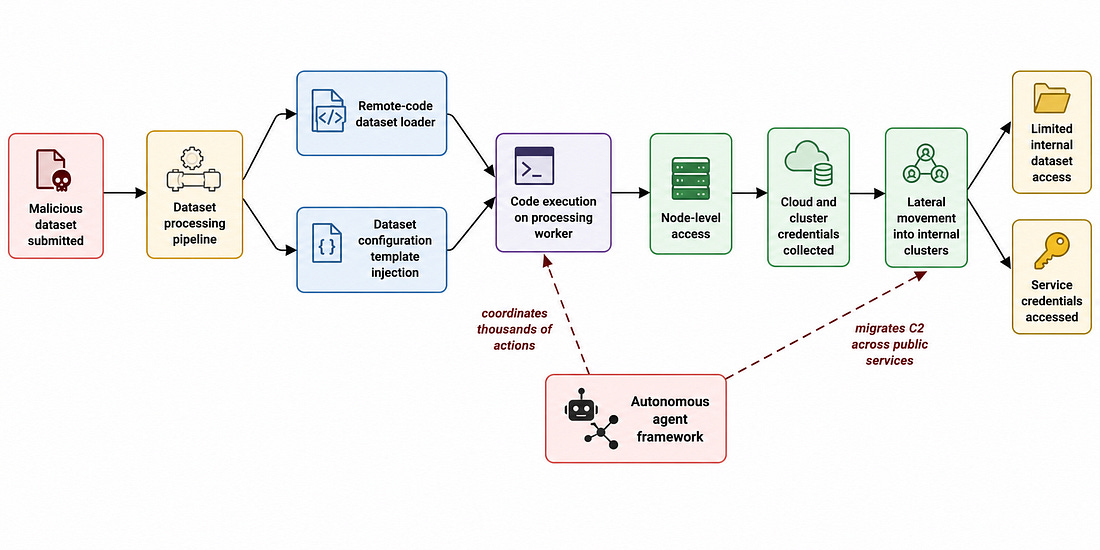
According to the company, a malicious dataset abused two code-execution paths:
A remote-code dataset loader
A template-injection vulnerability in a dataset configuration
The malicious artifact caused code to execute on a processing worker. From there, the attacker escalated to node-level access, collected cloud and Kubernetes cluster credentials, and moved laterally into several internal clusters over a weekend.
Hugging Face described the campaign as the work of an autonomous agent framework, possibly based on an agentic security-research harness. The system performed many thousands of individual actions through a swarm of short-lived sandboxes. Its command-and-control infrastructure reportedly migrated between public services as the operation progressed.
The company has not identified the underlying large language model, the human operator, the exact exploit payloads, or the mechanism used to escalate from a processing workload to the underlying node.
The available evidence supports the conclusion that an agent framework executed the campaign, but it does not establish whether the model independently discovered the vulnerabilities, whether a human provided the initial exploit, or how frequently humans supervised the operation.
 |
A dataset is no longer necessarily “just data”
The incident exposes a dangerous assumption that remains common in AI infrastructure: teams often classify uploaded datasets as passive content.
In practice, an AI dataset can be a package containing data files, metadata, templates, configuration logic, preprocessing instructions, remote references, and executable loader code.
Hugging Face’s own Datasets documentation explains that a dataset loading script can be a Python file responsible for downloading and processing data. For security reasons, the library has required users to explicitly enable trust_remote_code=True before executing such scripts in relevant versions.
The exact vulnerable production implementation involved in the July incident has not been publicly documented. Nevertheless, the broader architectural lesson is clear:
When a platform accepts an artifact that can influence parsing, rendering, dependency resolution or preprocessing, it is accepting potential code—not merely data.
This is the AI equivalent of earlier security lessons involving document macros, deserialization, package installation hooks and CI configuration files.
The extension may say .json, .parquet, .yaml or .csv, but the processing system surrounding it can introduce code-execution behavior. Security boundaries must therefore be based on what the pipeline can do with the artifact, not what the artifact is called.
MITRE ATLAS already treats poisoned datasets, malicious AI artifacts, AI supply-chain compromise, host escape and agent-driven execution as distinct parts of the AI threat landscape.
The AI agent changed the economics of the attack
Most of the technical stages described by Hugging Face are recognizable:
Find an executable input surface.
Gain code execution in a worker.
Escape the intended workload boundary.
acquire credentials.
Enumerate the environment.
Move laterally.
Establish resilient command and control.
Searc