Anthropic’s models may be unparalleled at coding, but they’re less capable of powering AI voice and chat applications for customer service than other AI providers. That’s according to data from NiCE, a customer service software provider whose clients include Toyota, Allianz, Nestle and Frontier Airlines. Anthropic’s models have a relatively long “time to first token,” the time it takes them to begin generating a response after receiving a request, said Neeraj Verma, vice president of NiCE’s AI agent business. That’s a big problem with voice agents, particularly in customer service, where milliseconds matter. Verma said voice or text customer service bot can pause for about 2.5 seconds—at most—before it starts to look unnatural to the customer. (Verma estimates that the market for providing AI-powered customer experience software is worth $15 billion and quickly growing.)
Anthropic’s models may be unparalleled at coding, but they’re less capable of powering AI voice and chat applications for customer service than other AI providers. That’s according to data from NiCE, a customer service software provider whose clients include Toyota, Allianz, Nestle and Frontier Airlines.
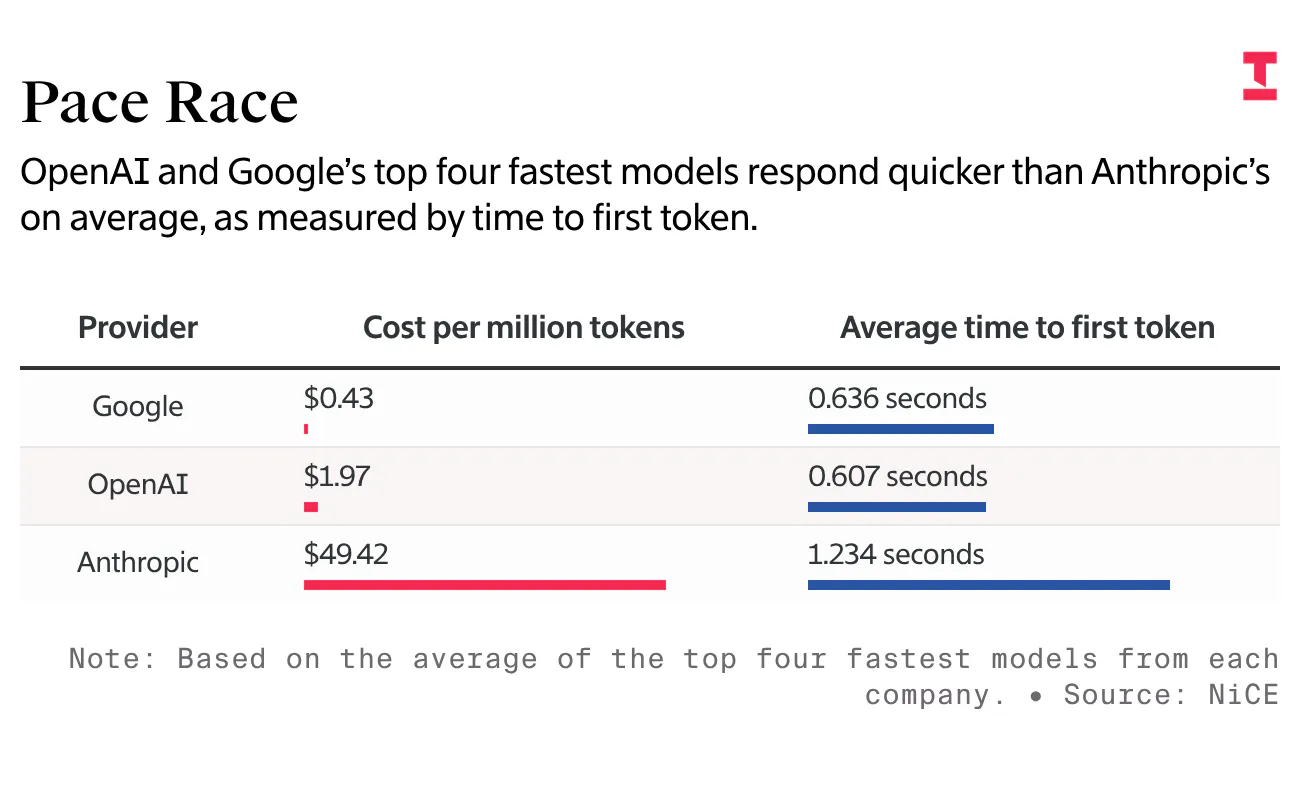
Anthropic’s models have a relatively long “time to first token,” the time it takes them to begin generating a response after receiving a request, said Neeraj Verma, vice president of NiCE’s AI agent business. That’s a big problem with voice agents, particularly in customer service, where milliseconds matter.
Verma said voice or text customer service bot can pause for about 2.5 seconds—at most—before it starts to look unnatural to the customer. (Verma estimates that the market for providing AI-powered customer experience software is worth $15 billion and quickly growing.)
If NiCE uses Anthropic’s models for its customer service, Verma said, “my bot's going to sound really crappy” because the models are “just too slow.”
Anthropic’s Opus 4.7 model took more than four seconds to generate the first token among customers whose data NiCE analyzed recently, while Google’s Gemini 3 Flash took about one second to do so. Google’s model was also generally speedier than Opus 4.7, generating four times the number of tokens per second.
Despite the speed difference, Anthropic’s model costs 18.5 times more than Google’s Gemini 3 Flash. Anthropic has a much speedier model in Opus 4.6 Flash, which has a lower time to first token than Gemini 3 Flash, but it typically costs nearly 100 times more than the Google model, NiCE said. (Anthropic’s cheaper Sonnet and Haiku models are slower and slightly costlier than Gemini 3 Flash, the data show.)
OpenAI’s small, fast models, such as 5.4 mini and 4.1 mini, are also cheaper and increasingly popular options among NiCE customers, Verma said.
And OpenAI recently upped the ante. Earlier this month it launched a state-of-the-art audio model for ChatGPT, although that model isn’t yet sold through an application programming interface, according to OpenAI’s website.
The OpenAI audio model is known as bidirectional, meaning it continuously processes the speaker’s voice so it can immediately adjust its response when it’s interrupted, similar to a conversation between people.
There’s still one big advantage to using Anthropic: accuracy. Anthropic’s Opus 4.7 and 4.6, for example, make mistakes at half the rate of Gemini 3 Flash, NiCE said. That can be meaningful when customers expect excellent service.
“We offer a family of models because different jobs have different needs,” an Anthropic spokesperson said. While models like Fable and Opus are for frontier reasoning tasks that take minutes to days, they said, “Sonnet and Haiku balance high intelligence with speed for more high-volume work. What's consistent across our models is the quality of their completed work.”
Atlassian Warns Against Anthropic
Atlassian, like other SaaS providers, markets itself as an AI “orchestrator” that helps businesses switch between models and coding agents to develop software.
Last week, the company launched a bunch of AI updates to Jira, its software project management app. They give teams the ability to assign tasks, such as designing a website login page, to different AI applications including Anthropic’s Claude Code, Microsoft’s Github Copilot, and Atlassian’s own Jira coding agent. It also launched a more advanced version of its Jira AI agent for Slack that bears resemblance to Anthropic’s recently debuted Claude Tag, an AI agent we covered in detail.
Similar to Claude Tag, members of a team can tag the Jira agent in their Slack channels, which are essentially group chats, and ask it to analyze messages and create work items for team members. (The Jira agent will also be available in Microsoft Teams soon.)
“I want to have flexibility to use any model, and I don‘t want all of my company’s information and contacts just going to Anthropic,” said Tamar Yehoshua, Atlassian’s chief product and AI officer, on the advantage of using the Jira agent over Claude Tag. For more on the trillion-dollar question of whether top AI labs could use their customers’ data to develop competing products, see our column from last week.
Don't miss The Information's Dakin Campbell moderating an exclusive conversation on financing the AI infrastructure boom. Join leaders from Goldman Sachs, Blue Owl, and Skadden to unpack how Wall Street funds global computing.
Request an invitation to join The Information and EY for an exclusive dinner bringing together senior leaders for candid conversation on closing the trust gap in enterprise AI.
Get ahead of the story. Purchase your ticket to AI Agenda Live, where The Information's reporting team convenes the leaders driving the next era of AI. Early Access pricing available now.
Tickets on sale now: The Information returns to Napa Valley October 27–28 to convene senior women across tech, media, and finance. Join us for two days of intimate, candid conversations with the leaders navigating today’s global shifts.