
|



Writing Useful Logs For Production. This Workshop Shows How. (Sponsored)
 |
An incident hits and you pull up the logs, only to find string based console output that tells you something broke but not why. That’s the problem with unstructured logging: it eats your quota and still leaves you guessing.
This hands-on workshop fixes that. You’ll learn what’s actually worth logging (state transitions, request boundaries, external call failures, auth decisions), how to structure logs as real data instead of text dumps, and how to add attributes that connect them to traces and errors. Plus, how to tune signal to noise, so noise stops drowning out what matters.
Roblox is built for scale. In August 2025, the platform reached a peak of 45 million concurrent users. Few game engines can support that kind of demand.
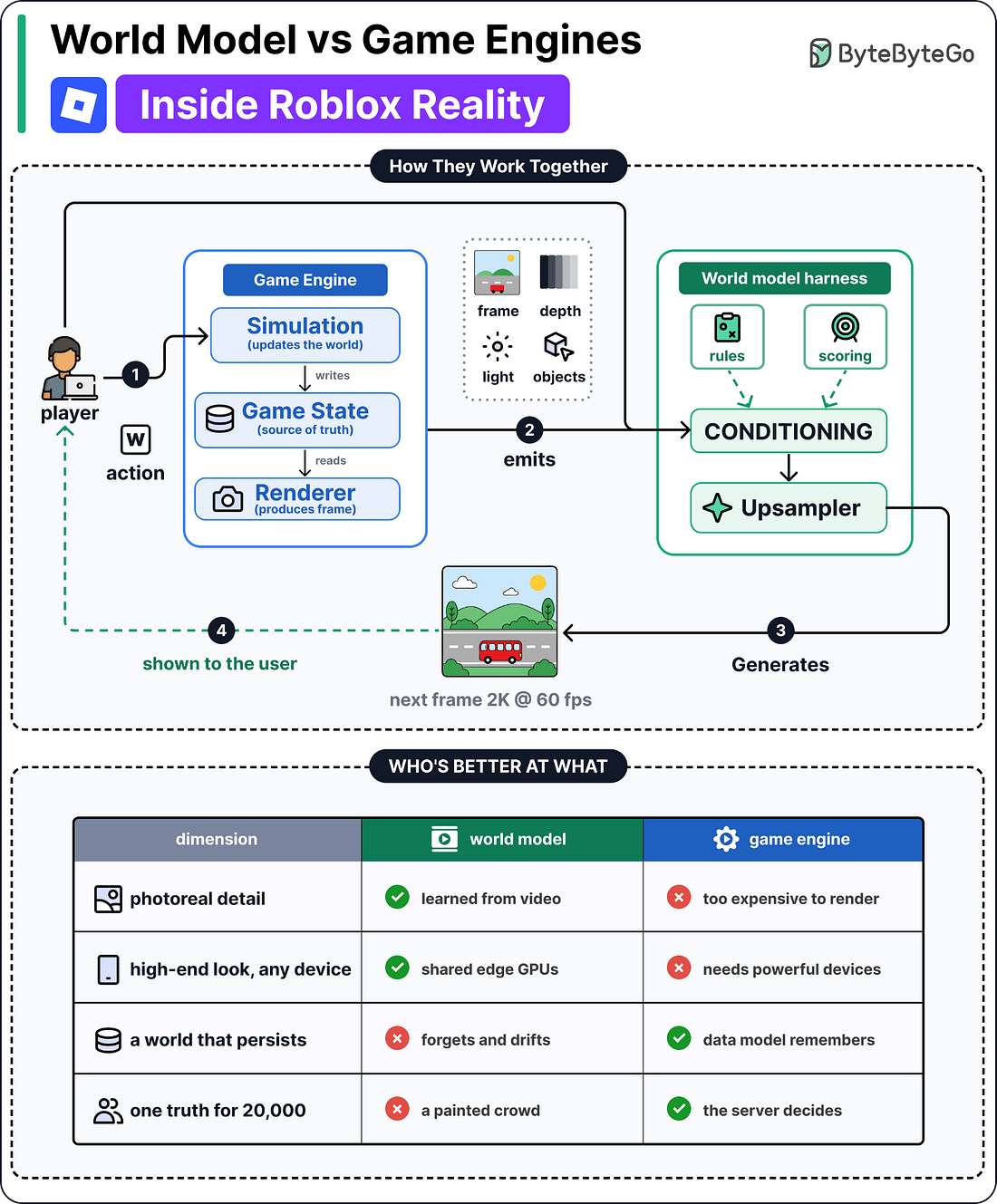
But Roblox itself isn’t the one making most of those games. It gives creators the tools to build them, then focuses on the infrastructure beneath them. Now, Roblox is exploring how a video world model can work alongside its game engine to make those experiences photorealistic without compromising scale or multiplayer performance.
This hybrid approach offers valuable lessons for engineers building real-time systems at scale. To explore those lessons, we sat down with Anupam Singh, senior vice president of engineering at Roblox, to hear from him about the world model that Roblox is using to make its multiplayer games look photorealistic, the key insights that have come from taking that approach, and the next big thing that the Roblox team is focusing on. We thank Anupam for sharing with us.
In this article, you will learn:
What a game actually requires, and why visuals are only part of it.
How combining a world model with a game engine can make games more realistic.
How Roblox is using a hybrid architecture to divide the work between the engine and the world model and keep the world consistent for everyone playing.
The four open problems (latency, consistency, multiplayer, and creator control) and the specific techniques Roblox is using on each.
What Roblox is focused on next, and why it could make photorealistic games far cheaper to build.
 |
What makes a game a game
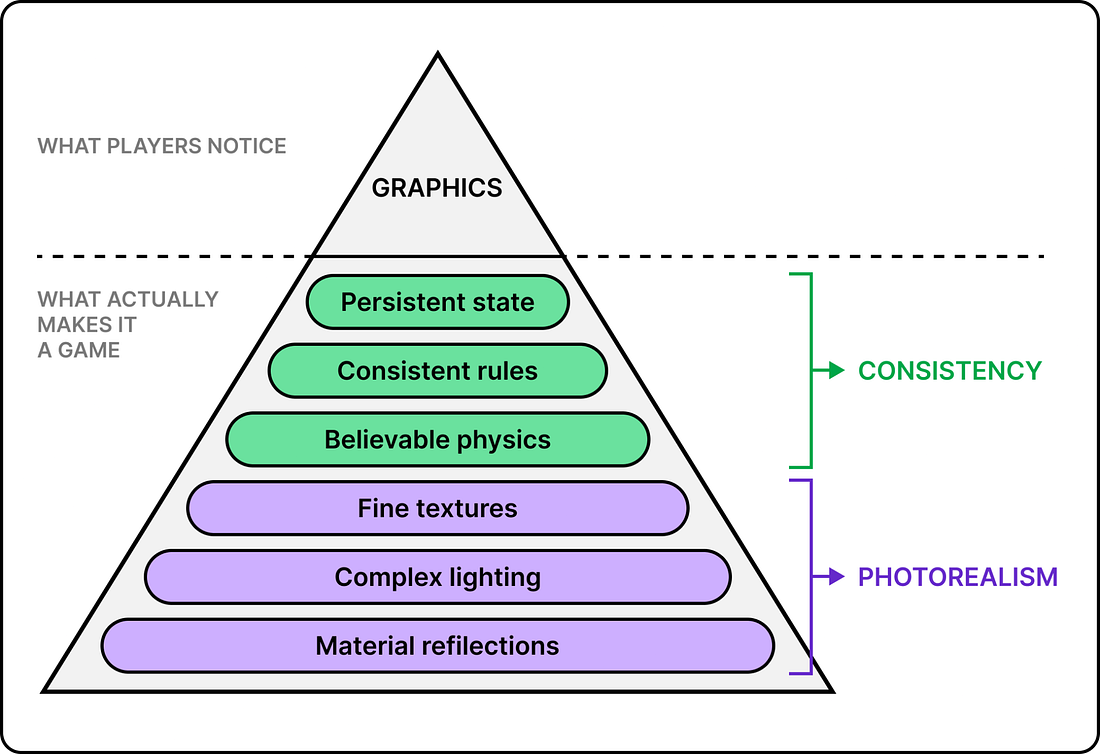
When people praise a game, they usually point at the graphics. Graphics are the easiest part to notice and often the smallest part of the engineering. What actually makes a game a game is a set of systems players never see. These systems serve one of two purposes: keeping the world consistent for everyone playing, and rendering it on screen.
 |
1. Keeping the world consistent
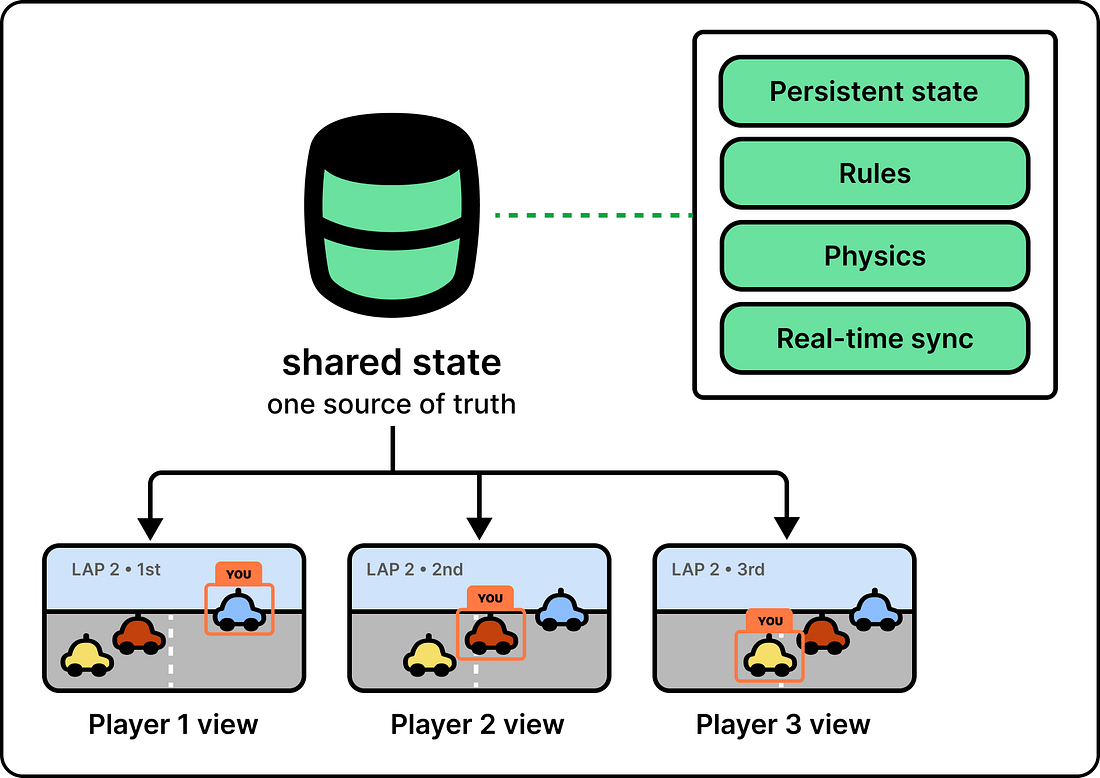
Keeping a world consistent takes several systems working together. The foundation is the persistent state, a running memory of where everything is and what has happened, so the world is still there when you come back to it. Then come the rules, the logic that has to resolve the same way for everyone, so the game stays fair. Physics has to be believable, so objects move, collide, and fall the way players expect. Since most games are played with other people, all of it has to stay in sync in real time, so thousands of players share one consistent world rather than thousands of slightly different ones. On top of that, the world has to react the instant a player acts. Together, this is what turns moving images into something you can actually play.
A racing game makes this concrete. The track, the scores, the penalties, how each car handles, and where every other car is all need to be exact. Every player needs to see the same thing at the same moment. If even one of these is off, players notice right away.
 |
2. Making the game look real
The second purpose, making the world look real, is a newer demand. The real world has a lot of fine detail that is hard to produce. Grass moving in the wind, dust behind a car, smoke off a fire, light shifting across a surface. Players now expect that level of realism.