In the Fed’s July Beige Book, which provides insights about economic conditions across the 12 Federal Reserve Districts, the Boston Fed highlighted that bars in Greater Boston saw "a marked uptick in beer sales, which they attributed to the World Cup.” As Sam Adams’ parent company Boston Beer said, Scotland soccer fans drank four times as much Boston Lager as its Boston Taproom usually sells.
The S&P 500, Nasdaq 100, and Russell all posted daily and weekly losses on Friday. Energy was the only sector to close in the green on Friday as oil prices rose. |
|
|
|
Is Moonshot’s Kimi K3 the next DeepSeek moment? Or is it something far different? |
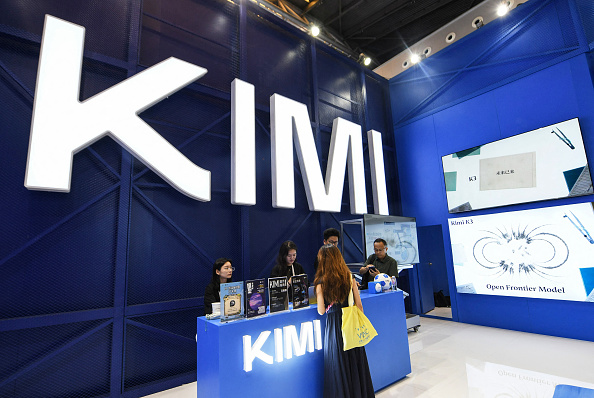
Moonshot AI released a new AI model called Kimi K3 that it will make fully open source before the end of the month. Kimi K3 is a 2.8 trillion-parameter behemoth that has instantly jumped to the upper heights of the LLM rankings that had previously been controlled by just Anthropic and OpenAI. |
- It brings to mind another moment when the pace of Chinese innovation stunned American investors and is a sign that China’s efforts to catch up to American systems are indeed working.
- Anthropic’s head of national security policy said that the US lead over China’s labs is now down to just six to nine months.
-
Shortly after the model reveal, Chinese leader Xi Jinping gave what amounted to a full-throated endorsement of open-source AI models that can compete with American offerings on price and was interpreted as a critique of the US’s approach to largely proprietary models.
-
As of Friday, Kimi K3 was already ranked No. 9 on LLM Arena.
|
DeepSeek’s reveal a year and a half ago rattled markets because it demonstrated that you could train a darn good AI model without massive investment in sophisticated, cutting-edge chips, prompting a selloff centered around Nvidia, the company that makes and sells those chips. That panic subsided once the economics of AI became a little bit more clear, and the idea that you’d need those spiffy chips for the day-to-day inference. So, what now?
|
|
|
|
China’s competing vision for the AI race is one that could very well work out great for American technology companies and the customers they sell to. The main advantage of Kimi K3 is price; it’s going for $3 per million tokens input and $15 per million tokens output, vastly cheaper than the $5 input/$25 output most Claude models are charging, and well under the $10/$50 pricing for Fable. Nothing is stopping American companies from having their daily-driver AI models be the vastly cheaper Chinese models running on American chips in American data centers. That’s one thesis for why we haven’t seen a DeepSeek-style panic.
That said, it does shake up the race, particularly for the likes of OpenAI, Anthropic, and SpaceX, the AI labs that directly compete with these models. China has spent the past several decades taking over industries by producing things at huge volumes and cheap unit costs to kill pricier competitors. You don’t need a supercomputer to infer what the playbook is here. |
Stories we’re obsessed with |
-
World Cup showdown: Nike vs. Adidas: Even before kickoff yesterday, Adidas had clinched the decisive marketing win over Nike, with Spain and Argentina both wearing Adidas kits. During the first week of the World Cup, Adidas saw a 16% year-on-year jump in foot traffic to its stores. Since the World Cup started, Adidas shares have risen about 5%, whereas Nike is essentially flat, as its teams, including Brazil and France, failed to reach the final.
-
How great is the great wealth transfer? While baby boomers stand to pass trillions of dollars to their heirs, estimates of exactly how many trillions are up for debate, with reports ranging from $36 trillion to an amount three times that much. As baby boomers live longer and spend their wealth more than previous generations (including upsizing their homes as they age, accounting for 42% of home buyers, the largest share of any generation), it’s unclear how much of the $93 trillion of baby boomers’ wealth will get passed along.
|
|
|
|
Comparing AAPL to oranges |
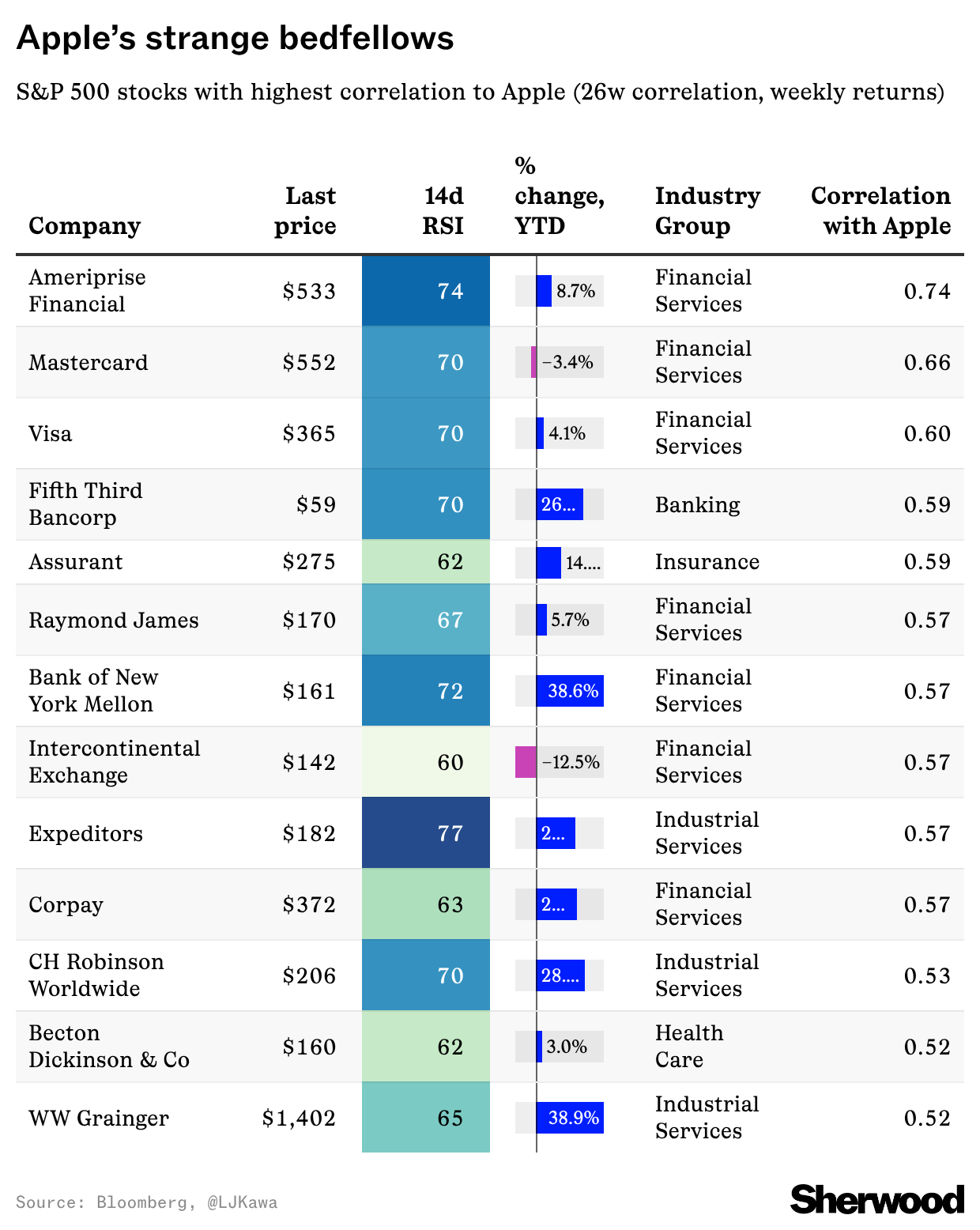
As a stock, Apple has kept some remarkably strange bedfellows this year. Most members of the Magnificent Seven — tech giants, even if they’re not all in the technology sector — tend to be strongly correlated with… other tech companies in the S&P 500. Looking at the 26-week correlation of weekly percent changes: |
Meanwhile, the list of Apple’s closest cousins this year is dominated by… financials, with some industrials thrown in there too: |
|
|
|
|