
|
The Charity Account the IRS Actually Wants You to Open
Donor-advised funds let you deduct five years of giving in one tax year — and dodge capital gains on the way in.
|
| |||||||||||||||


Quick question: if you give to charity every year, when’s the last time you actually got a tax deduction for it?
For most people, the answer is ‘never since 2017.’ That’s the year the standard deduction roughly doubled. For 2026, a married couple gets a standard deduction of $31,500 before they bother with anything else. Unless your itemized deductions — mortgage interest, state taxes, charitable giving — beat that number, your donations give you zero tax benefit. You give the money. The IRS gives you nothing back. Most Americans now fall into this category.
There’s a strategy that fixes this in one move. It’s called a donor-advised fund (DAF), and it’s one of the most under-used wealth tools in the entire tax code.
What a donor-advised fund actually is
A DAF is a charitable investment account. You open one at Fidelity Charitable, Schwab Charitable, or Vanguard Charitable. There’s no minimum to open at Fidelity or Schwab — Vanguard requires $25,000.
Once it’s open, three things happen:
You deposit cash, stock, crypto, or other assets. The moment they land in the DAF, you get a full charitable deduction for the fair market value.
The money inside the DAF gets invested — usually in low-cost index funds — and grows tax-free.
Whenever you want, you direct grants from the DAF to any IRS-qualified charity. Could be next week, could be in 20 years.
The IRS gives you the deduction the moment the money goes in. The charity gets it whenever you decide. The two events are decoupled.
Why this changes the math
Two giant tax wins, stacked.
Win #1: Bunching. Instead of giving $10,000 a year for three years — which never beats the standard deduction — you ‘bunch’ three years of giving into one. Deposit $30,000 to the DAF in Year 1, take a $30,000 deduction, then make $10,000 grants to your favorite charities in each of the next three years. Take the standard deduction in Years 2 and 3.
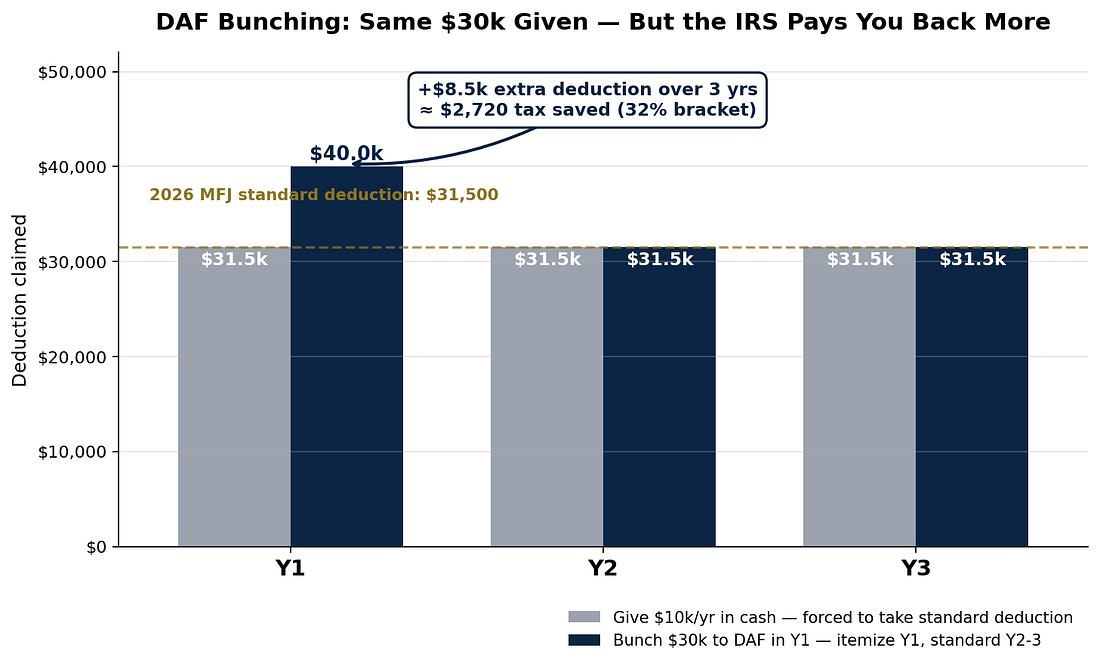 |
Same total dollars to charity. But you actually itemized in Year 1 instead of leaving the deduction on the table. For a married couple in the 32% bracket, that single move is worth roughly $2,700 in tax savings.
Win #2: The appreciated stock loophole
Here’s where the math really shifts. Don’t fund your DAF with cash. Fund it with appreciated stock you’ve held for more than a year.
Say you bought $5,000 of an index fund in 2018 that’s now worth $15,000. If you sell it, you owe long-term capital gains tax on the $10,000 gain — at 15% or 20%, plus 3.8% NIIT for high earners. That’s roughly $1,500 to $2,400 in tax.
If you donate that stock directly to a DAF instead, two things happen:
You get a charitable deduction for the full $15,000 fair market value.
You skip the capital gains tax entirely. The DAF sells the stock inside the account, with zero tax.
You got a full deduction on the gain you never paid tax on. That’s not a loophole the IRS forgot to close. That’s a loophole the IRS wrote into the law on purpose, to incentivize charitable giving with appreciated assets.
Where the 2026 rules get tricky
New for 2026: The One Big Beautiful Bill Act introduced a 0.5% AGI floor on charitable deductions for itemizers. Translation: only the portion of your giving ABOVE 0.5% of your adjusted gross income is deductible. On a $300,000 AGI, that’s a $1,500 threshold before the first dollar deducts.
This actually makes DAF bunching more valuable, not less. Concentrating gifts in a single year easily clears the AGI floor; spreading the same dollars over three years can miss it every time. The new rule punishes the steady-trickle giver and rewards the strategic bunching donor.
Action this week: Identify any appreciated long-term investment in a taxable account you’d otherwise have to sell (and pay capital gains on) at some point. If you give to charity at all, open a DAF at Fidelity Charitable or Schwab Charitable — zero minimum, no annual fee on small accounts. Transfer the appreciated shares directly. The brokerage handles the paperwork in 1-2 weeks.
The catch nobody mentions
Once money is in a DAF, it cannot come back. It’s a legally irrevocable gift the moment you fund it. You direct WHERE it goes to charity, but you can never use it for yourself.
So only fund it with money you’d otherwise give to charity anyway. Don’t lock up your retirement money in a DAF for the tax break.
Also: DAFs have small annual administrative fees (usually 0.6% at Fidelity, declining for larger balances) plus the underlying fund expense ratios. Cheap, but not zero.
The one-line version
A donor-advised fund lets you get a deduction for years of future giving in a single tax year, dodge capital gains on appreciated assets, and grow your charitable dollars tax-free in the meantime. Used correctly, it’s the most efficient way to give money in America.
Sources
Fidelity Charitable — How DAFs work — https://www.fidelitycharitable.org/guidance/philanthropy/what-is-a-donor-advised-fund.html
Schwab Charitable — Account fees and minimums — https://www.schwabcharitable.org/features/fees-and-minimums
Charles Schwab — Tax-smart charitable giving tips for 2026 — https://www.schwab.com/learn/story/12-tax-smart-charitable-giving-tips
Boulay Group — Donating appreciated stock (2026 OBBBA rules) — https://boulaygroup.com/donating-appreciated-stock-a-double-tax-break-for-charitable-giving-capital-gains-savings/
UncleKam — Bunching charitable deductions 2026 strategy — https://unclekam.com/tax-strategy-blog/bunching-charitable-deductions-2026-strategy-guide/
Disclaimer
Affluent Notes is for educational and entertainment purposes only. Nothing in this newsletter is financial, tax, legal, or investment advice. The numbers, charts, and strategies discussed are illustrative; your situation, tax bracket, plan rules, and risk tolerance are different. Past performance does not guarantee future results. Talk to a licensed CPA, CFP, or attorney before acting on anything you read here. The author may hold positions in securities or accounts mentioned.
Affluent Notes is free today. But if you enjoyed this post, you can tell Affluent Notes that their writing is valuable by pledging a future subscription. You won't be charged unless they enable payments.