
|
 |
Thanks for signing up to be a free subscriber! This post in public so it’s free to access by all. If you want to, please heart-react this post, which improves its visibility to the platform, so this newsletter can continue to thrive and grow.
Women Built the World #9 - Eunice Newton Foote
She's the first physicist to discover the greenhouse effect, decades before the rest of the scientists figured it out.
|

| |||||||||||||||


Welcome to my Women Built the World series of articles, that I started in order to debunk one of the manosphere’s most recent falsehoods that these influencers promote in order to demean and silence women - that everything you can see around us in terms of material comfort and infrastructure was built by men. Leaving aside that this sham of an argument conveniently ignores the fact that women were forbidden to go to school or have jobs until relatively recently and that many male achievements were misappropriated from women, even taking this at face value, it doesn’t hold up: there are plenty of remarkable women that changed the world.
When women in the comments point out the many achievements of women, they get silenced because the achievements quoted are not STEM or infrastructure-leaning enough. So, welcome to Women Who Built the World. For a year, I will be presenting a deep dive of 2-3 remarkable women per month, in the month of their birthdays, without whose innovations the world would be significantly less comfortable in the most material sense. In order to not miss a post, don’t forget to hit that subscribe button :). Thank you!
P.S: I’m running a new survey on waiting in relationships and I’d love your input. You can fill it in here. Thank you!
Few scientific discoveries have had a stranger fate than the one made by Eunice Newton Foote.
Imagine correctly identifying a phenomenon that would eventually become one of the most consequential scientific concepts in human history. Imagine publishing your findings, presenting the evidence, and reaching the right conclusion decades before the scientific community fully understood its significance.
And then imagine being almost entirely erased from the story.
That is more or less what happened to Eunice Newton Foote, one of the greatest physicists of our time, who discovered the greenhouse effect.
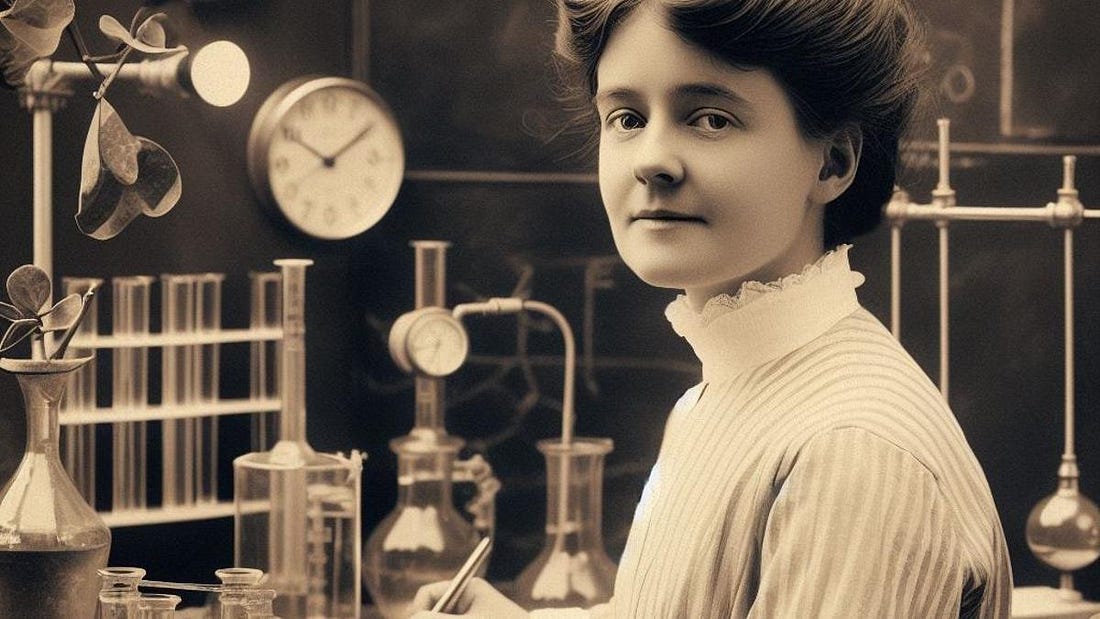 |
Born on this day in July 17, 1819, Foote conducted experiments in the 1850s that led her to an extraordinary insight: certain gases trap heat more effectively than others. Among them was carbon dioxide.
Today, that statement barely qualifies as news. Schoolchildren learn versions of it, while climate scientists build sophisticated models around it. Governments, industries, and entire economies wrestle with its implications, today more than ever.
But in 1856, it was still a remarkable discovery. Foote’s experiment was elegantly simple. She placed different gases in glass cylinders and exposed them to sunlight, measuring how much they heated up. Carbon dioxide consistently retained more heat than ordinary air. From these observations, she drew a conclusion that was astonishingly prescient.
An atmosphere containing more carbon dioxide, she suggested, would produce a warmer planet. Yup, exactly. Read that sentence again.
In the middle of the nineteenth century, before automobiles, before commercial aviation, before modern climate science existed as a discipline, Foote identified one of the fundamental mechanisms governing Earth’s temperature. That should have made her a household name. It didn’t, because she didn’t have the right sex organ.
The discovery is often associated with later researchers, particularly John Tyndall, whose work on the heat-trapping properties of gases predictably became more widely known and influential, because his name was John rather than Jane if you know what I mean. Tyndall’s contributions were substantial and scientifically important. But Foote’s earlier work disappeared from much of the historical record for generations.
The pattern is familiar by now: when women make significant scientific observations that prove correct, history suffers from a strange amnesia and remembers someone else. What makes Foote’s story especially frustrating is that her experiment wasn’t merely a curiosity. It touched on one of the most important scientific questions humanity would eventually face.
Because this isn’t really a story about climate change, it’s a story about understanding the atmosphere. This understanding is one of the key insights that allows modern civilization to function. Here are just a few things that wouldn’t be possible without atmospheric science:
Weather forecasting
Agriculture
Aviation
Environmental protection
Climate modeling
Every attempt to understand how Earth’s systems interact ultimately relies on the realization that the atmosphere is not just an empty space surrounding the planet. It is an active, dynamic system with measurable physical properties. Foote helped demonstrate exactly that.
One of the reasons her work feels so modern is that she approached nature as a system rather than a collection of isolated facts. Many nineteenth-century scientists still operated within intellectual traditions that emphasized description, but Eunice Newton Foote wanted mechanisms: Why does the planet maintain its temperature? Why do different gases behave differently? What physical processes are involved?
Those are modern scientific questions, and she pursued them with remarkably limited resources.
Foote was not employed by a major research institution. She did not possess the kind of laboratory infrastructure that many male scientists of the era could access. She conducted her work largely from outside the professional scientific establishment. The fact that she arrived at such an important insight under those circumstances makes the achievement even more impressive.
The atmosphere continued obeying the laws she observed regardless of whether her name appeared in textbooks, and carbon dioxide continued trapping heat. The science remained true, but the credit she was owed vanished.
Only in recent decades has her work begun receiving broader recognition. Historians revisiting nineteenth-century science discovered that the origins of climate science were more complicated than many standard narratives suggested. Eunice Newton Foote’s paper emerged from the archives as a reminder that scientific history often looks very different when people bother to examine it carefully.
Much of the scientific infrastructure supporting modern life works the same way. The most important systems are often the least visible. They disappear into the background until something goes wrong or someone reminds us they are there.
Foote’s contribution belongs to the latter category. She helped humanity understand one of the systems that makes life on Earth possible. Not through grand theories or philosophical speculation, but through observation, experimentation, and evidence. The kind of work that advances science even when science isn’t payin