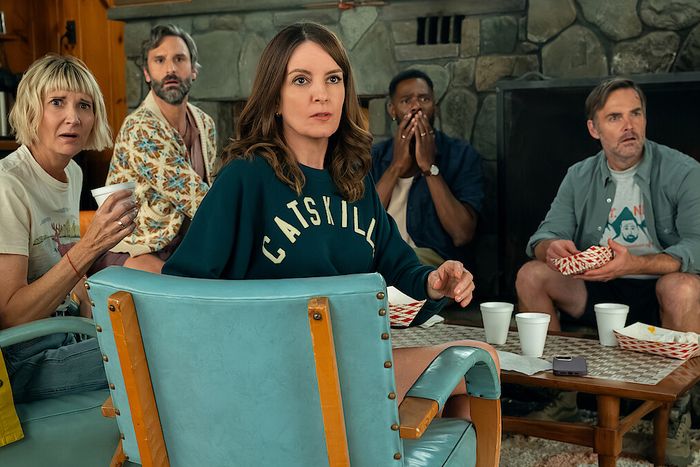
Welcome back to Buffering, where we’re already mourning the looming end of the 2026 World Cup. As has been reported on widely, the quadrennial international event has been a monster ratings hit in the U.S for Fox and Telemundo. In today’s newsletter, we’ve got fresh intel on how the combination of the World Cup and Love Island — call it Copa de Amor — has also been a massive boon to Peacock. But our main story is about Netflix, which reports its second quarter earnings today. There’s been a ton of chatter lately about its supposed second-season ratings problem as well as a series of move it’s taken to boost engagement. But how deep are its problems? Read on for my report.
|
|
|
|
Subscribe now to get unlimited access to everything New York, including subscriber-only newsletters, exclusive perks, the New York app, and more. |
|
|
|
In this edition: David Ellison, Rob Bonta, Ted Sarandos, Greg Peters, Bela Bajaria, Christopher Nolan, Thomas Kail, and Dwayne “The Rock” Johnson’s Maui bodysuit…
|
|
|
|
➽ Peacock’s June Was a Gooooooool
|
Between the return of Love Island and the start of the FIFA World Cup, Peacock was pretty much guaranteed to have a strong June — and now we know just how strong. Thanks to the combination of the two very disparate programming tentpoles, the 6-year-old NBCUniversal platform racked up its most-watched month ever, as measured by millions of hours streamed, Buffering has learned. While Peacock isn’t saying exactly how many viewers its programming reached, overall engagement with the platform managed to beat the record set just a few months ago in February, when it streamed both the Super Bowl and the Olympics, historically two of TV’s biggest (and most expensive) events.
While Love Island and Telemundo’s Spanish-language coverage of the World Cup by themselves might not be as big overall draws as those February tentpoles, they collectively occupied more hours of Peacock’s June lineup: Love Island streamed a new episode six nights a week throughout the entire month of June, while multiple World Cup matches streamed in Spanish almost every day as well. Another sign audiences were committed to Peacock’s June events: Mobile viewing also set a record in June and surged 75 percent ahead of normal usage, no doubt powered in part by fútbol fans looking to get their fix during the workday. And while Peacock isn’t revealing its own internal viewership numbers for Love Island just yet, Nielsen data offers a hint of just how big it was this season: During the first two weeks of June, the show generated more than 2.3 billion minutes of viewing for Peacock, not counting mobile or tablet viewership (which Nielsen doesn’t include in its weekly reports). That’s up 50 percent vs. 2025 numbers — good enough to make Love Island the No. 1 show in streaming for two consecutive weeks. —Joe Adalian
|
|
|
|
➽ Everyone’s Trying to Fight David Ellison
|
California, New York, and 10 other states agree: This Paramount Skydance–Warner Bros. Discovery merger should not pass. California AG Rob Bonta led a dozen state attorneys to file suit this week in an attempt to block the David Ellison–led company’s $110 billion acquisition of WBD. The next day, the WGA filed its own lawsuit and a Paramount shareholder also filed a derivative suit accusing Paramount insiders of “profiting through breaches of their fiduciary duties.” Could all these challenges delay the merger? If it’s not closed by Sept. 30, Ellison and co. will owe a ticking fee to Warners shareholders of about $6.9 million per day, or $650 million a quarter. —Savannah Salazar
|
|
|
|
When Netflix reported its first-quarter earnings back in April, the company’s profits turned out to be higher than Wall Street analysts had projected — and yet the next day, its stock price dropped by nearly 10 percent. Investors shrugged off the good news because, in that same report, the streaming giant also said it expected its growth would slow down in the second quarter and, even with a new price hike, didn’t expect overall revenues for 2026 to increase. Turns out Netflix had good reason to be pessimistic about its short-term outlook: As the data analyst and blogger known as Entertainment Strategy Guy first noted in late June, when it comes to ratings for new and returning titles, “Netflix is absolutely having a dismal second three months of 2026.”
Part of the problem has been a sophomore-season slump that’s plagued a number of shows such as A Good Girl’s Guide to Murder, Running Point, and The Four Seasons, worsening a trend that veteran Netflix tracker Kasey Moore has reported on for at least two years now and that has recently gotten renewed attention through articles in The Guardian and Bloomberg. But Netflix’s woes right now aren’t just about viewers abandoning established shows. “What everybody is reacting to right now is that they haven’t had a breakout hit in a while and that silence is deafening,” one industry veteran who’s studied the numbers for decades told me this week.
New titles that had franchise potential — such as The Boroughs, an adventure thriller from the Duffer brothers, or late 2025 entry The Abandons, from Sons of Anarchy creator Kurt Sutter — ended up disappointing and were canceled after a single season. On the unscripted side, high-profile bets like a live reboot of Star Search and the music competition Building the Band ended up being one-and-done. And while Netflix racked up its usual big Emmy-nomination tally last week, competitors HBO Max and Apple TV dominated the second-quarter awards-season discourse with only three Netflix titles — all from 2025 — getting nominated across the three main outstanding scripted series categories (comedy, drama, and limited).
The combination of mediocre viewership and lack of buzz is disappointing on its own, and it can also have a trickle-down effect. “When not a lot is breaking through, it gets very quiet on a platform overall,” our industry vet says. Translation: Without big blockbusters or discourse-driving series to lure audiences, it’s that much harder to funnel viewers to returning shows or less flashy newcomers. It seems no coincidence that one of Netflix’s few legit smashes in 2026, January’s His & Hers, dropped between the final season of Stranger Things and the new chapter of Bridgerton.
The big caveat, of course, is that most other streamers would love to have Netflix’s current headaches. The Four Seasons may have lost a huge chunk of its viewership between seasons one and two, but its Nielsen-reported numbers in the U.S. made it a top-ten staple for multiple weeks in May and June with a larger audience than most streaming comedies. (That’s one reason Netflix has already ordered a third season, as it has of Running Point.) Plus, even if Netflix has had a paucity of blockbusters, it’s still had a nice run of medium-size hits, such as the two Harlan Coben limited series it has released in 2026 or last week’s modest-but-respectable launch of Little House on the Prairie. The streamer also keeps audiences coming back through live sports, comedy events, and a regular cadence of successful original movies (including animated smash Swapped and last year’s now-iconic KPop Demon Hunters). “I don’t think there’s tons of evidence that there’s a serious crisis for Netflix,” says an exec who works at a rival entertainment conglomerate. “They have a pretty winning strategy in general.”
|
|
|
|
But when you’re by far the biggest subscription streamer on the planet, even a few sniffles can seem like pneumonia. Netflix’s decade-plus run of TV dominance means Wall Street and others judge it on an unforgiving curve, and when issues crop up — like this last stretch of mediocre ratings — folks are going to take notice. We saw this a few years ago coming out of the pandemic, when a few bad quarters for Netflix prompted the so-called “great streaming correction.” Netflix responded by making several big changes in a short period of time, including accepting advertising and cracking down on passwords. Within a year or so, folks were writing about its miraculous comeback.
This time, there are once again signs Netflix is moving to address problems, real or perceived. Last week, The Wall Street Journal said the streamer was considering adding live channels, either ones it curates itself or through deals like the one it has in France with broadcaster TF1, whose programming lineup is now simulcast by Netflix in that country. The Journal also said Netflix might be willing to sell subscriptions to competing streamers, much the way that Peacock now lets users add on Starz and that Apple and Amazon have bundled services for years. In addition, Netflix for the past 18 months or so has been adding more podcast and creator content, seeking to curb some of YouTube’s growing advantage in overall time spent on platform. Some of these deals have proven very successful: Ms. Rachel, for instance, is a regular presence in the Netflix and Nielsen top-ten lists.
Netflix has also made a couple of high-profile exec changes in the past year. Last summer, longtime scripted boss Peter Friedlander exited (he has since landed at Amazon MGM Studios), and earlier this year, U.S. unscripted programming chief Jeff Gaspin announced his departure. While spun as voluntary resignations, these sorts of shuffles typically indicate top brass — in this case, Netflix content chief Bela Bajaria — is looking to shake up its slates or thinks that fresh eyes are needed to guide programming.
Which brings us to something else that may be contributing to Netflix’s current issues: quality. While the service has a lot of shows that get consumed, it hasn’t done as good of a job lately launching long-running, beloved franchises that hold on to audiences á la Stranger Things and Bridgerton or even more modestly successful veterans such as Virgin River and Emily in Paris. As a result, it’s not surprising when so many second seasons end up with so-so ratings. “Most Netflix shows are not great,” says our exec at a rival platform. “So when these not-great shows go away for a year and a half or two and then come back, nobody cares. Nobody’s built a lasting relationship with them, and so they move on.” Somewhat surprisingly, this exec doesn’t actually think this is a big deal, at least not in the eyes of Netflix execs. “I’m intrigued that people are paying attention now to what has been true about Netflix for a long time,” he says. “And they seem to be doing just fine. I think this is all an annoying distraction to the people over there.”
Another senior TV executive who has followed Netflix since its began making originals agrees the platform is in no danger of losing its grasp on No. 1 anytime soon and that some of the narrative about its allegedly disappointing performance of late is part of “the natural evolution from upstart to incumbent, where Wall Street starts to realize you are not an exponential growth machine any longer and the pressure is on to find new avenues of growth.” And yet based on some of its recent actions, this exec also believes Netflix’s leadership may be more concerned than it’s been letting on. “Shortform! Podcasts! Buy a studio! This feels like an overreaction that could end up hurting them,” he says.
Of course, when Netflix underwent some turbulence a few years ago, the company also made a lot of bold moves in response, such as the aforementioned addition of an advertising tier, and those actions ultimately calmed investors’ nerves. It’s possible big swings could work again. Co-CEOs Ted Sarandos and Greg Peters will likely address Netflix’s ratings and engagement woes when the company announces second-quarter earnings today, and perhaps they’ll say something that will quickly change the current negative narrative around the company. The senior TV exec, however, is not so sure. “This is a group that’s running out of levers,” he says. “I know their business is fundamentally strong. Netflix is not going anywhere. But whereas what they did a few years ago felt like an even-handed experiment, this feels a little frantic. This feels like a panic.”
|
|
|
|
Christopher Nolan, Matt Damon, and Zendaya on the set of The Odyssey. Photo: Melinda Sue Gordon/Universal Pictures |
How exactly do you retell a story that’s been told a thousand times before? In adapting Homer’s Odyssey, Christopher Nolan was fully cognizant of what he calls “the Ur-text problem”: when a tale is so ubiquitous and influential that modern audiences find the original tired or derivative. The epic poem dates back to the seventh or eighth century B.C. and has informed and has influenced world culture for nearly three millennia. When it came to studio blockbusters, however, Nolan felt a curious absence: “The genre of Greek mythology doesn’t really exist in movies,” he says.
That’s not to say people haven’t tried. “Hollywood made all these incredible movies about the classical period of antiquity, but it was left to geniuses like Ray Harryhausen to visualize the more mythical aspects,” Nolan says, referring to the stop-motion pioneer behind the enchanting yet undeniably goofy Jason and the Argonauts (1963) and Clash of the Titans (1981). “For a long time, it wasn’t technically viable to make this kind of film and give as much weight and validity to a fantastical story as you did to a non-fantastical story,” Nolan says. He cites Peter Jackson’s Lord of the Rings movies as examples of the fantasy genre finding a footing in the world of ambitious blockbusters. “The technology had to evolve,” as Nolan puts it. “What I saw with The Odyssey is a gap that hadn’t been filled….”
|
|
|
|
|