
|
The AI boom is getting bigger, but investors are starting to ask who actually wins
For the past few years, the technology industry has treated artificial intelligence as both an inevitability and an emergency.
|

| |||||||||||||||


The ultimate AI tech stack for product-led growth in 2026 (Sponsor)
 |
The best product teams don’t win based on how many tools they use, they win when they use tools that leverage product signals to accelerate user engagement.
Recently, Scott Strand, Knock’s agent-pilled growth lead, shared the AI marketing tech stack he uses to connect product signals, user data, and customer messaging as a one-person marketing team.
For product engagement specifically, the foundation looks like this:
Claude and Cursor to move from idea to execution faster.
PostHog and Hightouch to understand product behavior, run experiments, and activate warehouse and product data across your stack.
Knock to trigger relevant lifecycle messaging across email, in-app, push, chat, and more.
Check out the full post to see all 15 tools in Scott’s AI marketing stack and learn how he uses them together to improve activation, adoption, and retention.
For the past few years, the technology industry has treated artificial intelligence as both an inevitability and an emergency.
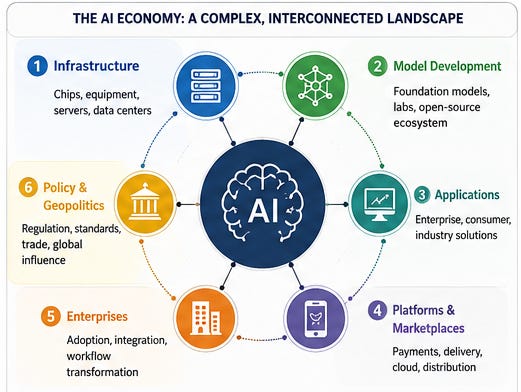
Companies have rushed to acquire chips, build data centers, develop large language models and attach AI features to nearly every product. Governments, meanwhile, have begun treating computing infrastructure as a strategic resource rather than simply another part of the private technology market.
The latest developments suggest that the AI boom is far from slowing down. However, they also reveal a more complicated reality: not every company positioned as an AI beneficiary will benefit equally, and not every dollar invested in the technology will necessarily produce a meaningful return.
The clearest winners are still selling the infrastructure
Among the strongest signals came from TSMC and ASML, two companies positioned near the foundation of the global semiconductor industry.
TSMC reported a sharp increase in quarterly profit and raised its capital-spending plans, while ASML announced plans to expand its production capacity for the machines used to manufacture advanced chips.
These companies are benefiting from a relatively straightforward reality: regardless of which AI model eventually dominates, nearly all serious AI developers need advanced computing infrastructure.
OpenAI, Google, Anthropic, Meta and a growing list of startups may compete on models, products and developer platforms, but their systems ultimately depend on chips manufactured through an extremely concentrated global supply chain.
This makes TSMC and ASML something close to the picks-and-shovels suppliers of the AI gold rush.
 |
The comparison is imperfect, of course. Gold-rush suppliers did not operate inside a geopolitical contest involving export restrictions, national-security policy and semiconductor manufacturing subsidies. Still, the basic idea holds: when companies are uncertain about which application will win, selling the infrastructure required by every competitor can be the safer position.
The scale of current spending also suggests that major AI companies do not expect demand to level off soon. Building more chip capacity is expensive, technically difficult and slow. Companies would not be making such large commitments unless they believed the need for computing power would continue growing.
 |
But strong demand for chips does not automatically mean the broader AI economy is healthy. It may simply mean that companies remain locked in an infrastructure race they cannot afford to abandon.
IBM’s decline shows the other side of AI spending
IBM’s dramatic stock decline offers a useful counterpoint.
The company suggested that customers were prioritizing spending on servers, storage and other AI infrastructure while delaying some software and consulting deals.
In other words, enterprise technology budgets may not be expanding enough to support every part of the AI ecosystem simultaneously. Money directed toward graphics processors, memory, cloud capacity and data-center construction may be money that is no longer available for traditional software contracts or consulting engagements.