Dear Colleague and Friend,
I recorded a short reflection for you today because this idea is one of the easiest sequencing mistakes to miss.
The central idea is simple:
The next move is not always more treatment.
Sometimes the patient does not need a bigger plan. The patient needs a clearer next
step.
▶ Watch / Listen First:
Regulate™ + Resynchronize™ + Signal™ — What if the Patient Needs a Clearer Next Step, Not a Bigger Plan?
If you prefer to read, I’ve included the written reflection below.
In my last message, I introduced State™ and
Readiness™.
Those two steps ask:
What state is this patient in today?
And:
What is this patient ready to receive?
Today, I want to bring together the next three steps in the FMU Nine-Step Sequencing Method™:
- Regulate™
- Resynchronize™
- Signal™
Regulate™ asks:
What must become stable first?
Resynchronize™ asks:
What rhythms need restoration?
Signal™ asks:
What is the minimum effective next move?
These three steps matter because once you realize
a patient may not be ready for deeper intervention, the next question is not:
How much can I do?
The better question is:
What is the clearest, most precise next step that helps this patient move forward without creating more confusion?
That is a different way to think.
And it can be
uncomfortable.
Because when you see a lot of findings, you naturally want to help.
You see the gut issue.
You see the blood sugar issue.
You see the thyroid pattern.
You see the inflammation.
You see the detoxification burden.
You see the nutrient deficiencies.
And you may be right.
But in a low-capacity patient, adding more can sometimes make the case less clear.
More supplements can create more reactions.
More protocols can create more confusion.
More changes can make it harder to know what helped and what made things worse.
The
plan gets bigger.
But the signal gets weaker.
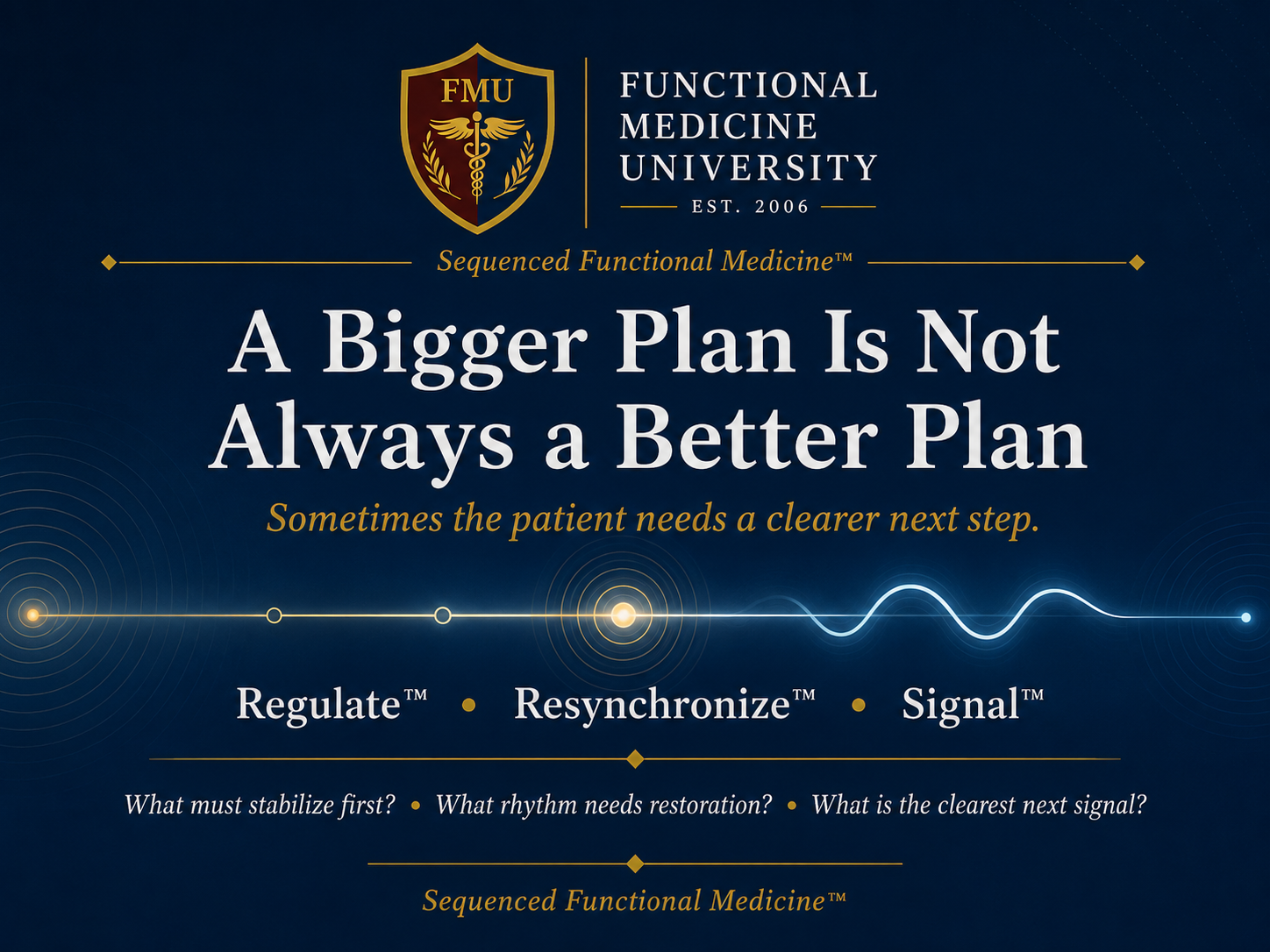
A bigger plan is not always a better plan. Sometimes the patient needs a clearer next step.
That is the pain point.
You may be doing more
work, giving more support, and addressing more real findings — but the case may not be getting clearer.
That is why Regulate™ matters.
Before deeper repair, ask:
What must become stable first?
Sleep?
Blood sugar?
Bowel function?
Pain?
Stress physiology?
Hydration?
The nervous system?
The patient’s sense of safety?
Sometimes the first move is not to
intensify.
Sometimes the first move is to stabilize.
That is also why Resynchronize™ matters.
Complex patients often lose rhythm before they lose more obvious markers.
Sleep-wake rhythm changes.
Meal timing becomes inconsistent.
Recovery rhythm breaks
down.
Movement becomes too much or too little.
The patient no longer has a stable biological rhythm to build on.
So before deeper restoration, you may need to
ask:
What rhythm needs to be restored first?
And then comes Signal™.
This may be one of the
most important steps in the entire sequence.
Signal™ asks:
What is the minimum effective next move?
Not the
biggest move.
Not the most impressive move.
Not every reasonable intervention at once.
The minimum effective next move.
Why?
Because a clear signal teaches you something.
A noisy plan hides the lesson.
If you change five things at once and the patient gets worse, what caused it?
Was it the supplement?
The diet?
The
detox support?
The antimicrobial?
The exercise change?
The timing?
The dose?
The patient’s current state?
You may not know.
But if you choose one thoughtful, low-burden move, the patient’s response becomes much easier to interpret.
That is the power of Signal™.
Think again about Mary.
Mary may eventually need gut work.
She may eventually need metabolic support.
She may eventually need thyroid support.
She may eventually need inflammatory support.
But if she
is exhausted, sleeping poorly, anxious, reactive, crashing after activity, and feeling worse every time something new is added, then the next move may not be another full protocol.
The next move may be:
Regulate what must
stabilize.
Resynchronize the rhythm that is most disrupted.
Choose one minimum effective signal.
That is not doing less because you are
unsure.
That is choosing a clearer next step because you are thinking carefully.
Clearer does not mean weaker.
More precise may be
wiser.
Once you see this, it becomes difficult to go back to practicing as if a more comprehensive plan is always a better plan.
A comprehensive plan can still be poorly sequenced.
A clearer first move can sometimes create more clinical clarity than a larger treatment plan.
That is the shift.
Sequenced Functional
Medicine™ does not ask only:
What else could be wrong?
It asks:
What move will create the clearest
next signal without overloading the patient?
That question can change the case.
It can help you stabilize instead of overstimulate.
Restore rhythm before repair.
Preserve clinical clarity.
Reduce unnecessary reactions.
And choose the next step that gives every later intervention a better opportunity
to work.
Functional Medicine gave us the tools.
Sequenced Functional Medicine™ teaches the clinical order of using them.
Before your next complex patient, ask yourself:
What must become stable first?
What rhythm needs restoration?
What is the
minimum effective next move?
If you cannot answer those questions clearly, the next move may not be a bigger plan.
It may be a clearer signal.