
|
Stop Treating Domain-Driven Design Like a Deployment Blueprint
Domain-Driven Design helps teams define business boundaries and rules, but infrastructure, service decomposition, communication, and reliability still require separate architectural decisions.
|

| |||||||||||||||


The AI notepad for people in back-to-back meetings (Sponsor)
 |
Most AI note-takers just transcribe what was said and send you a summary after the call.
Granola is an AI notepad. And that difference matters.
You start with a clean, simple notepad. You jot down what matters to you and, in the background, Granola transcribes the meeting.
When the meeting ends, Granola uses your notes to generate clearer summaries, action items, and next steps, all from your point of view.
Then comes the powerful part: you can chat with your notes. Use Recipes (pre-made prompts) to write follow-up emails, pull out decisions, prep for your next meeting, or turn conversations into real work in seconds.
Think of it as a super-smart notes app that actually understands your meetings.
Free 1 month with the code SCOOP
Domain-Driven Design is often introduced through diagrams.
There are boxes for Bounded Contexts, arrows for relationships, circles for Aggregates, and events flowing between different parts of the domain. Once these diagrams reach engineering discussions, however, they are frequently interpreted as deployment plans.
A Bounded Context becomes a service.
A Domain Event becomes a message on Kafka.
An Aggregate becomes its own database.
A context relationship becomes an API call.
The result may look technically sophisticated, but an important design step has been skipped.
A domain model describes how a business area should be understood.
A software architecture describes how an implementation should behave under real operational conditions.
Those are related concerns, but they are not interchangeable.
Domain-Driven Design can expose where software boundaries might exist. It cannot decide how many applications to deploy, which components should communicate over a network, or whether the operational cost of distribution is justified.
That difference becomes especially important when teams move from whiteboard models to production systems.
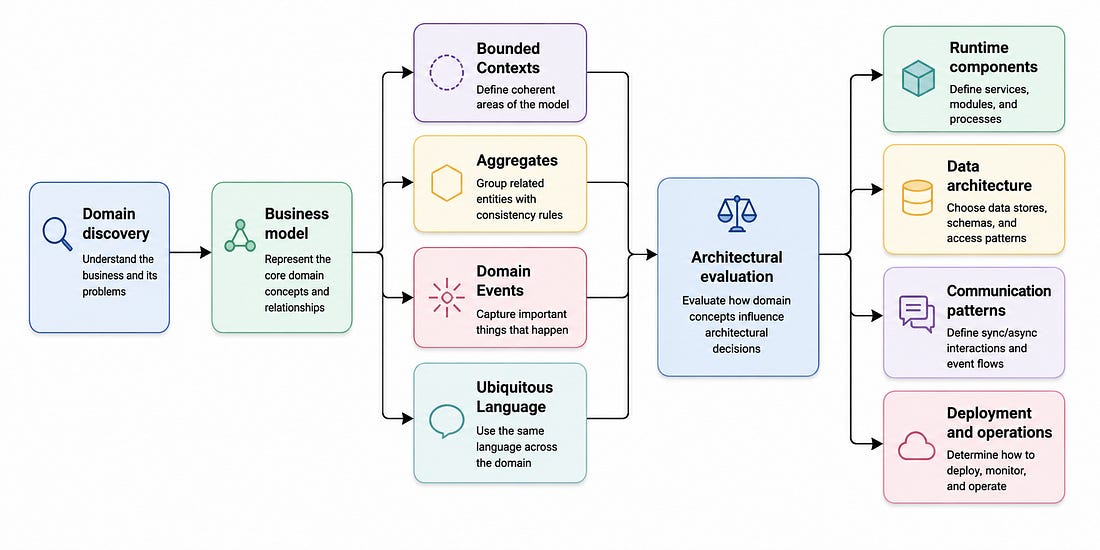 |
The domain model is not the end of architecture. It is one of architecture’s most important inputs.
The Problem With One-to-One Mappings
Many misleading system designs begin with an assumed one-to-one relationship:
One Bounded Context = One Microservice
One Aggregate = One Database
One Domain Event = One Broker Message
One Team = One Service
This is attractive because it makes decomposition appear mechanical. Once the domain workshop is complete, the service architecture seems to emerge automatically.
Real systems rarely work that neatly.
A Bounded Context represents a boundary of meaning. Inside it, terms, rules, and models have a consistent interpretation.
A microservice represents an operational boundary. It can be deployed, scaled, monitored, secured, and changed independently from other runtime components.
Sometimes those two boundaries align. Sometimes they do not.
The fact that two parts of the business use different models does not automatically mean they should communicate across a network. Conversely, one coherent business model may require several independently running components because of scale, latency, security, or workload differences.
The correct relationship is therefore not equality but evaluation.
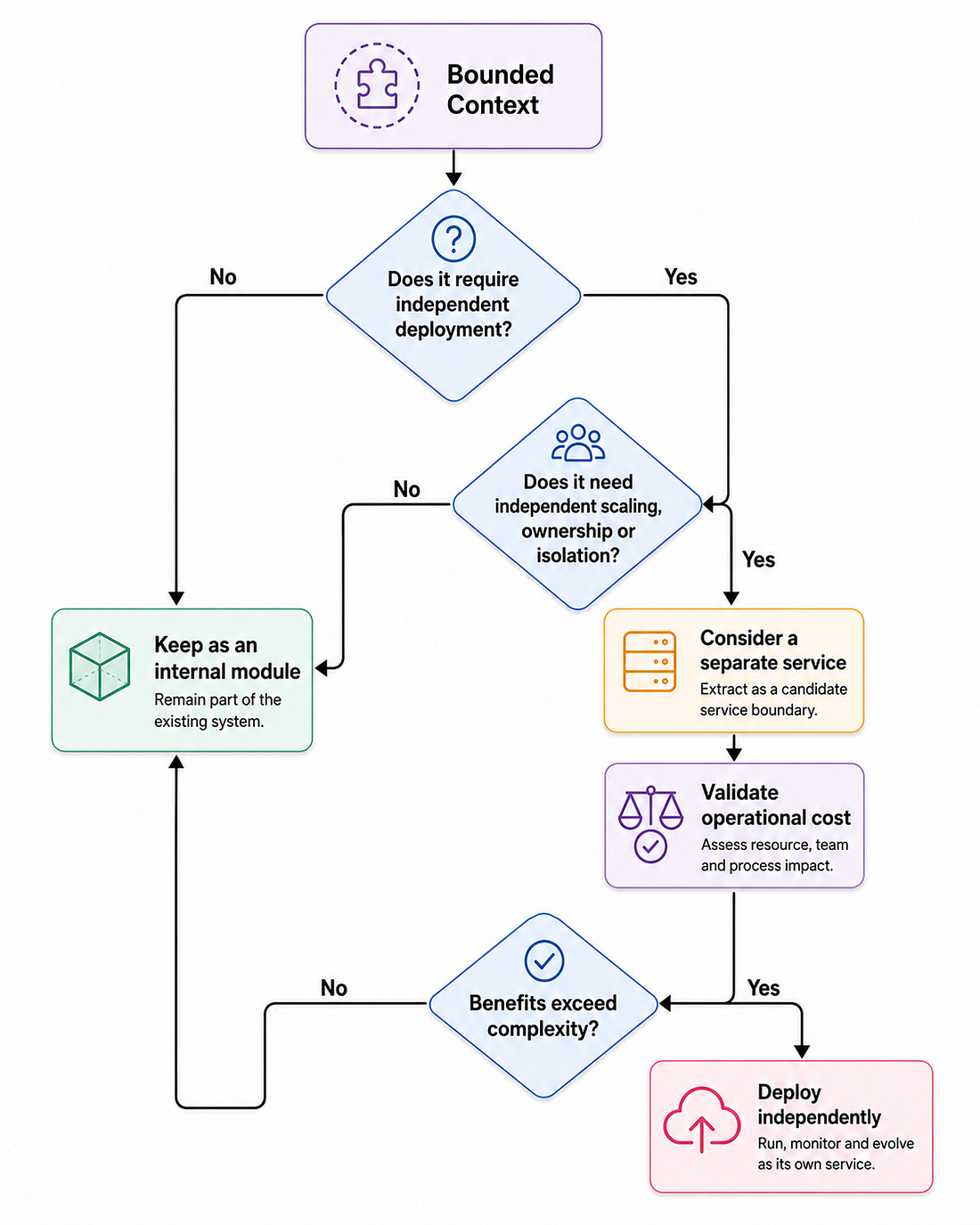 |
This is the architectural work that simplified DDD diagrams often leave out.
A Bounded Context Can Live Inside a Monolith
Consider an insurance platform with the following contexts:
Policy administration
Claims processing
Billing
Customer support
Each context uses differen