If you prefer to read, I’ve included the written reflection below.
In my last message, I introduced Pattern™ — the second step in the FMU Nine-Step Sequencing Method™.
Pattern™ asks:
What patterns are
emerging?
That question helps us stop chasing isolated symptoms and begin seeing what
may be connecting the case.
But once the pattern becomes
clearer, another question immediately follows.
And this next question may be one of the most important questions in complex chronic care:
Is the patient actually in a state where they can receive the intervention I am
considering?
That brings us to the next two steps in the FMU sequence:
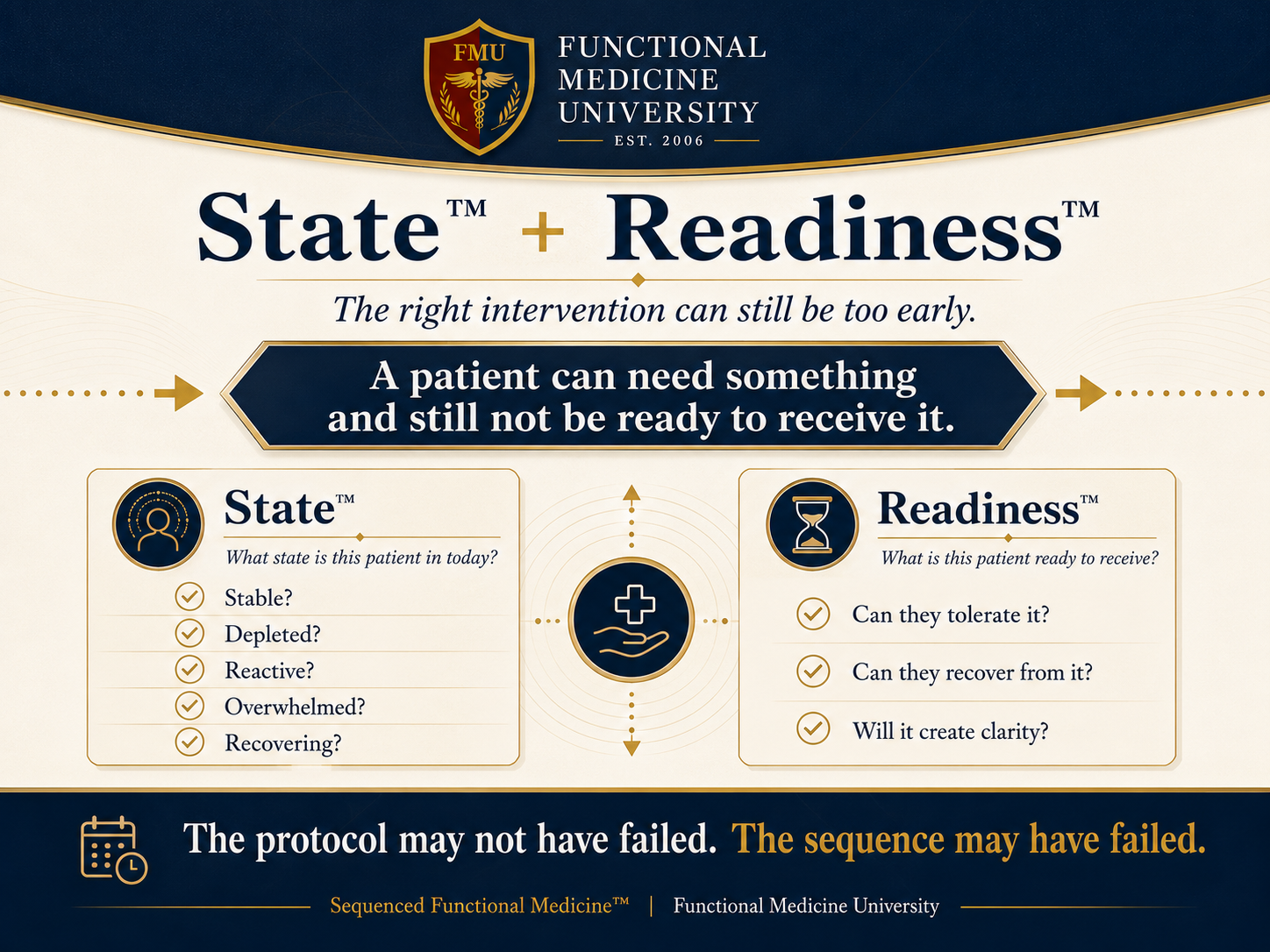
State™ and Readiness™.
State™ asks:
What state is this patient in today?
Readiness™ asks:
What is this patient ready to receive?
These two questions may sound simple.
But they can completely change the first clinical decision.
Because in complex patients, the problem is not always that the clinician chose an unreasonable intervention.
Sometimes the gut protocol made sense.
The
hormone support made sense. The blood sugar support made sense. The detoxification strategy made sense. The lab correction made sense.
But the patient was not in the right
state to tolerate that phase of care yet.
That is the painful part.
A clinician can see the pattern correctly and still move too fast.
A clinician can choose a reasonable intervention and still introduce it too early.
A clinician can be thoughtful, informed, and careful — and still overwhelm the patient’s current capacity.
That is why State™
and Readiness™ matter.
They prevent us from confusing:
what the patient may eventually need
with
what the patient can successfully receive right now.
Think again about Mary.
Mary has fatigue, brain fog, poor sleep, widespread muscle pain, anxiety, bloating after
meals, weight gain, exercise intolerance, early insulin resistance, borderline thyroid function, low vitamin D, and mild inflammatory changes.
Mary is not simply a gut case.
She is not simply a blood sugar case.
She is not simply a thyroid case.
She is not simply an inflammation case.
Those findings may all matter.
But now State™ and Readiness™
ask something more practical:
What condition is Mary’s system in right now?
Is she stable? Is she depleted? Is she reactive? Is she overwhelmed? Is she recovering? Is she tolerating basic changes? Is she able to handle more clinical load?
That is where the case begins to change.
Because if Mary is exhausted, sleeping poorly, reacting to supplements, crashing after activity, anxious, inflamed, and feeling worse every time something new is added, then the first question may not be:
Which protocol fits Mary?
The better question may be:
What state is Mary in — and what is she ready to receive?
That question can prevent a lot of unnecessary setbacks.
This is one of the hidden reasons complex cases become so frustrating.
The clinician sees
something real.
The intervention makes sense.
The plan looks thoughtful.
But the patient gets worse, becomes more reactive,
loses confidence, or stops following through.
Sometimes the protocol was wrong.
Sometimes the dose was wrong.
Sometimes the lab picture was incomplete.
But sometimes the deeper issue is simpler and more uncomfortable:
The patient was not ready for the intervention yet.
Once you see this,
it becomes difficult to go back to practicing as if the right idea is always the right next move.
Because the right idea and the right timing are not always the same.
A patient can need something and still not be ready to receive it.
That is a different way of thinking.
Before you choose the next protocol, ask three readiness questions:
Can this patient tolerate
the intervention?
Can this patient recover from the intervention?
Will this intervention create clarity — or add more confusion?
If the answer is
unclear, the next move may need to be smaller.
Not weaker.
Not less thoughtful.
Smaller because the goal is not maximum treatment.
The goal is the right next signal.
In a low-capacity patient, more action can create less clarity.
More supplements can create more reactions.
More protocols can create more confusion.
More treatment can create more clinical noise.
And the patient may begin to feel that every attempt to help makes them worse.
That is painful for the patient.
And it is painful for the clinician.
But State™ and Readiness™ give us another way to think.
They help us ask:
What does this patient’s current state allow?
What must become more stable before deeper repair?
What is the lowest-burden move that helps the patient move forward without overloading the system?
For the newer clinician, this provides safety.
You do not have to treat every finding immediately.
You do not have to prove your value by doing more.
For the experienced clinician, this provides refinement.
You may already recognize the pattern.
You may already know which protocol could eventually fit.
But the deeper question is whether the patient’s current state supports that move today.
That is not hesitation.
That is clinical judgment.
This is why Sequenced Functional Medicine™ is different.
It does not ask only:
What is wrong?
It asks:
What is the patient ready for now?
That single question can change the case.
It can help you simplify instead of intensify.
Stabilize instead of stimulate.
Build capacity before
deeper restoration.
Delay what is real but not ready.
And choose the first move that gives every later move a better opportunity to work.
That is the FMU
difference.
Functional Medicine gave us the tools.
Sequenced Functional Medicine™ teaches the clinical order of using them.
Before your next complex patient, ask yourself:
What state is this patient in today?
Then ask:
Is this patient truly ready for the intervention I am about to recommend?
If you cannot answer those questions clearly, the next step may not be another protocol.