
|
The Quiet 0.4% Mistake Costing Investors Six Figures
Asset location — which investments live in which account — is the most ignored strategy in personal finance. It shouldn't be.
|

| |||||||||||||||


Quick test: if I gave you $200,000 to invest across a taxable brokerage, a Traditional IRA, and a Roth IRA, where would you put your bonds? Where would you put your S&P 500 index fund? Where would you put your REITs?
If you said ‘doesn’t matter — same return either way,’ you’re about to lose six figures over the next 30 years and not even realize it. There’s a name for this: asset location. It’s one of the few free lunches in personal finance — and almost no retail investor uses it correctly.
Asset allocation vs. asset LOCATION
These sound the same. They are not.
Asset allocation: what you own. 60% stocks, 40% bonds. The classic mix.
Asset location: where you hold it. The same 60/40 portfolio, organized intelligently across taxable, tax-deferred, and tax-free accounts.
Allocation gets all the attention. Location gets ignored. But Vanguard’s research has consistently put the value of proper asset location at roughly 0.20% to 0.75% per year in after-tax returns — for free. Same portfolio, same risk, same gross return. Just better organized.
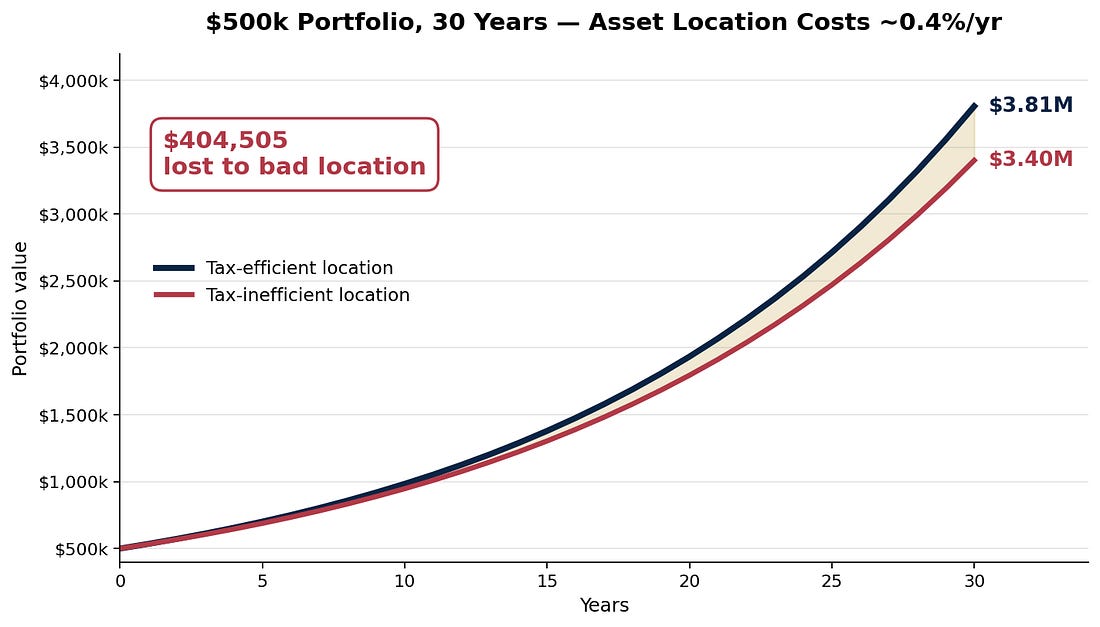 |
Compounded over 30 years, that gap closes in on $600,000 on a $500k starting portfolio. The investments are identical. Only the address changes.
The three buckets and what belongs in each
There are three account types from a tax standpoint.
Taxable brokerage — you pay tax on dividends every year, plus capital gains when you sell.
Tax-deferred (Traditional 401(k), Traditional IRA) — no tax now, ordinary income tax when you withdraw.
Tax-free (Roth IRA, Roth 401(k), HSA) — no tax now, no tax later.
Each investment type is taxed differently. The optimization is matching the right investment to the right bucket.
The actual rule
Put your most tax-inefficient investments in your most tax-protected accounts. Put your most tax-efficient investments in your least protected ones.
That sounds backwards. It isn’t. Here’s how it plays out in practice:
Bonds and REITs in Traditional IRA / 401(k). They throw off ordinary-income interest and non-qualified dividends every year. Inside a tax-deferred account, that income compounds untouched.
High-growth investments in Roth IRA / HSA. The growth is going to be massive over decades — and in a Roth or HSA, it’s tax-free forever. Put your highest-expected-return investments there.
Index funds (S&P 500, Total Market) in your taxable brokerage. They’re already tax-efficient — qualified dividends, low turnover, long-term capital gains rates. They barely create a tax bill. Don’t waste protected space on them.
“Wait, that means stocks in taxable? Doesn’t that get expensive?”
It feels that way. It isn’t. Total stock market index funds typically distribute about 1.5% in qualified dividends a year. At a 15% qualified dividend rate, that’s 0.23% in annual tax drag. Compare that to a high-yield bond fund kicking off 5% in ordinary interest taxed at 32% — that’s 1.6% in tax drag. Six to seven times worse.
Bonds in taxable is the most common asset-location mistake. People don’t notice because every year the tax bill is small. Compounded over decades, it isn’t.
Action this week: Log into every investment account you own. List the holdings, and the account type next to each one. Look for bonds or REITs sitting in taxable accounts — those are the highest-ROI moves to fix. If you have a Roth IRA holding short-term Treasuries while your taxable account holds VTI, you have it backwards. Reorganize next time you rebalance.
Two important caveats
First, never trigger a big capital gains tax bill just to relocate. If you have a $50,000 gain on a fund in taxable, leave it. The tax cost of the move kills the benefit. Asset location is a strategy you implement going forward, especially with new contributions and rebalancing.
Second, this only matters if you have meaningful balances across multiple account types. If 95% of your money is in your 401(k), asset location doesn’t change much for you yet. Once you have a real taxable brokerage and a Roth IRA running, the math starts to matter.
The one-line version
Asset allocation decides what you own. Asset location decides how much of it the IRS takes. Most investors get the first one right and the second one totally backwards — and pay six figures over a lifetime for it.
Sources
Vanguard — Asset location for taxable investors (research paper) — https://corporate.vanguard.com/content/dam/corp/research/pdf/asset-location-for-taxable-investors.pdf
Morningstar — Asset location best practices — https://www.morningstar.com/articles/1059247/asset-location-where-to-hold-investments-for-tax-efficiency
Fidelity — Asset location strategy — https://www.fidelity.com/learning-center/personal-finance/asset-location
Bogleheads wiki — Tax-efficient fund placement — https://www.bogleheads.org/wiki/Tax-efficient_fund_placement
Kitces — Asset location prioritization framework — https://www.kitces.com/blog/asset-location-strategy-prioritizing-tax-efficient-investments-by-account-type/
Disclaimer
Affluent Notes is for educational and entertainment purposes only. Nothing in this newsletter is financial, tax, legal, or investment advice. The numbers, charts, and strategies discussed are illustrative; your situation, tax bracket, plan rules, and risk tolerance are different. Past performance does not guarantee future results. Talk to a licensed CPA, CFP, or attorney before acting on anything you read here. The author may hold positions in securities or accounts mentioned.
Affluent Notes is free today. But if you enjoyed this post, you can tell Affluent Notes that their writing is valuable by pledging a future subscription. You won't be charged unless they enable payments.
|
