
Nokia SR Linux EVPN and Data Center Interconnect Sample Questions:
NEW QUESTION # 44
Which of the following statements about the configuration of a distributed Layer 2 EVPN in a Nokia SR Linux is FALSE?
- A. The route-targets are manually configured when the leaf routers are in different autonomous systems.
- B. Only one VXLAN-interface can be associated to the Layer 2 EVPN.
- C. Each PE participating in the Layer 2 EVPN must be configured with the same EVPN instance ID (EVI).
- D. The route distinguisher is auto-generated using the autonomous system number and EVI.
Answer: C
Explanation:
Comprehensive and Detailed 150 to 250 words of Explanation From [SR Linux EVPN and Data Center Interconnect/Course Guide/topics]:
A distributed Layer 2 EVPN in SR Linux is implemented using MAC-VRF network instances, EVPN control-plane signaling, and VXLAN data-plane encapsulation. A common mistake is assuming that every PE must use the same EVI value for the same L2 service. In SR Linux, the important operational requirement is that the correct EVPN routes are imported and exported using matching route-target policy, not necessarily that every PE has the same locally configured EVI. Therefore, option A is false. The route distinguisher can be automatically generated using local values such as the autonomous system number and EVI, giving each PE's EVPN routes uniqueness in MP-BGP. A MAC-VRF is associated with VXLAN encapsulation for its data-plane service mapping, and route targets may need to be manually configured when leaf routers are in different autonomous systems because automatic derivation may not produce matching import/export policy across AS boundaries. The key separation is this: the RD gives uniqueness, the route target controls service membership, and the EVI is a local service identifier rather than a universal mandatory match in all designs. Reference: SR Linux distributed L2 EVPN configuration, EVI, RD auto-generation, route-target policy.
NEW QUESTION # 45
Which of the following statements about a L3 EVPN network using symmetric routing is FALSE?
- A. A routed-VXLAN interface is required on a per IP-VRF basis.
- B. Each participating PE must support the use of EVPN route-type 5.
- C. Each MAC-VRF used in the L3 EVPN network must exist on each PE.
- D. Ingress and egress PEs perform MAC and IP forwarding.
Answer: C
Explanation:
Comprehensive and Detailed 150 to 250 words of Explanation From [SR Linux EVPN and Data Center Interconnect/Course Guide/topics]:
Symmetric L3 EVPN routing uses an IP-VRF-based overlay model in which both ingress and egress PEs participate in routed forwarding. The ingress PE receives the frame from the local MAC-VRF, routes it into the IP-VRF, and sends it across the VXLAN routed interface. The egress PE receives the routed overlay packet, performs the corresponding IP-VRF lookup, and then forwards it into the locally attached destination MAC-VRF. Because the routed overlay is built per IP-VRF, a routed-VXLAN interface is required for that IP-VRF. EVPN route type 5 support is also required because RT-5 carries IP prefix reachability across the EVPN control plane. The false statement is option D. Symmetric routing specifically removes the requirement for every MAC-VRF to exist on every PE. A PE only needs the MAC-VRFs for locally attached subnets, plus the shared IP-VRF and routed overlay state. This is the major scaling advantage of symmetric routing compared with designs that require broad MAC-VRF instantiation across the fabric. Reference: symmetric L3 EVPN routing, routed VXLAN interface, RT-5 prefix reachability, MAC-VRF scaling.
NEW QUESTION # 46
Consider the exhibit.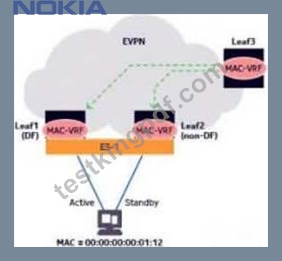
Which of the following statements about the configuration and operation of this setup is FALSE?
- A. The host will be required to be configured with a LAG.
- B. All traffic to and from the host will flow through Leaf1.
- C. The ports that connect to the host are associated to ES-1.
- D. The Ethernet segment ES-1 is configured as single active.
Answer: A
Explanation:
Comprehensive and Detailed 150 to 250 words of Explanation From [SR Linux EVPN and Data Center Interconnect/Course Guide/topics]:
This setup represents single-active Layer 2 EVPN multi-homing. In single-active mode, the Ethernet Segment is configured so that only one PE acts as the active forwarding node for a given service, while the other remains standby. The ports connecting to the host are associated with ES-1 so the EVPN control plane can perform Ethernet Segment discovery, DF election, and standby behavior. If Leaf1 is the active/DF node for the service, all traffic to and from the host flows through Leaf1 until a failure or DF transition occurs. Option D is false because a host LAG is not required for this single-active topology. A LAG is typically required for all-active L2 multi-homing, where the host must treat multiple physical links toward different leaf routers as one logical bundle. In single-active operation, the host can be connected through separate physical links or active/standby access behavior without requiring LACP bundling. The EVPN PEs enforce the active path selection through DF and ES state rather than relying on host-side LAG hashing. Reference: single-active EVPN multi-homing, Ethernet Segment port association, DF-controlled active forwarding.
NEW QUESTION # 47
Which of the following four symmetric routing options does NOT require the use of an EVPN route-type 2?
- A. Prefix routing interface-ful unnumbered
- B. Prefix routing interface-ful numbered
- C. Prefix routing interface-less
- D. Host routing
Answer: B
Explanation:
Comprehensive and Detailed 150 to 250 words of Explanation From [SR Linux EVPN and Data Center Interconnect/Course Guide/topics]:
EVPN route type 2 carries MAC/IP advertisement information. It is central to host-based routing and to designs where the fabric must distribute host MAC-to-IP bindings for integrated routing and bridging. In host routing, RT-2 is required because individual host reachability is signaled through MAC/IP advertisements. In interface-less prefix routing, RT-2 is still needed because the system relies on host or gateway MAC/IP information associated with the IRB and distributed gateway behavior. Interface-ful unnumbered designs may also require RT-2-style information to resolve next-hop or adjacency behavior because the routed interface does not use a conventional numbered next-hop model. Prefix routing with interface-ful numbered operation is different. In that model, the routed interface has explicit IP addressing and prefix reachability can be carried with L3 prefix routes without requiring EVPN RT-2 host MAC/IP advertisement as a dependency. Therefore, the symmetric routing option that does not require EVPN route type 2 is prefix routing interface-ful numbered. Reference: symmetric L3 EVPN routing models, RT-2 MAC/IP advertisements, prefix routing behavior.
NEW QUESTION # 48
... >> https://www.testkingpdf.com/4A0-D03-testking-pdf-torrent.html
Disclaimer: You are receiving this email (sent to nie@niepodam.pl) because you subscribed to or used learning materials related to 4A0-D03 on our company's website testkingpdf.com.

|