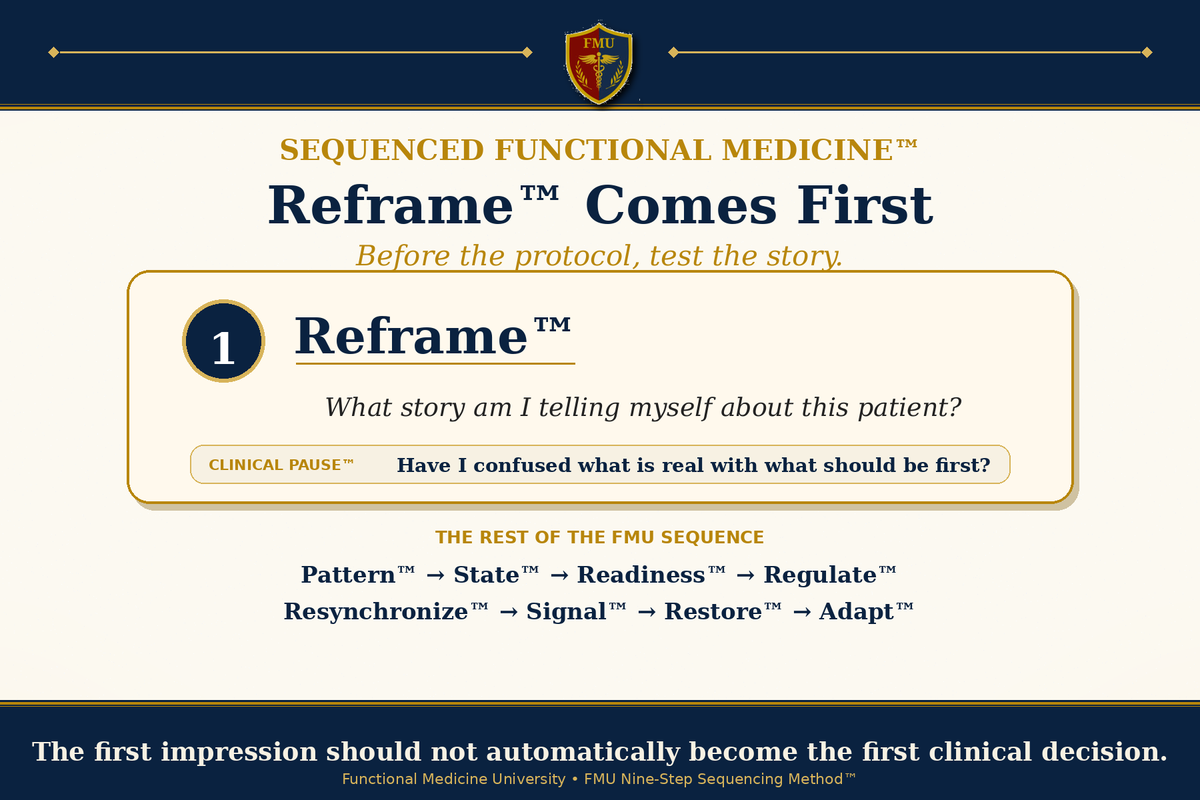
Reframe™ exposes the moment a real finding can become the wrong first move.
Dear Colleague and Friend,
Yesterday, I introduced the FMU Nine-Step Sequencing Method™ — the clinical order FMU uses before choosing the first protocol, lab, supplement, or intervention.
Today, I want to begin unpacking the first step:
Reframe™.
The question behind Reframe™ is simple:
What story am I telling myself about this patient?
That question may sound simple, but it represents a very different way of practicing Functional Medicine.
The first
chapter of Functional Medicine taught us to see more — more labs, more systems, more protocols, more root causes, and more clinical possibilities.
And all of that matters.
But the next chapter requires something different:
learning how to organize what we see before we act.
That is the territory FMU is naming as Sequenced Functional Medicine™ — not another protocol, not another specialty, and not another clinical lane, but the clinical decision architecture that helps determine what should happen first, what should wait, and what should
change as the patient responds.
The first story we tell ourselves often determines what we notice, what we test, what we explain, what we treat, what we delay, and what we may overlook.
Think back to Mary’s case.
Mary is exhausted. She has brain fog, poor sleep, widespread muscle pain, anxiety, bloating after meals, weight gain, exercise intolerance, and several abnormal lab findings.
A gut-focused clinician may hear bloating and think, “This is a gut case.” A metabolic clinician may see early insulin resistance. A thyroid-focused clinician may focus on borderline thyroid function. A hormone-focused clinician may see a 48-year-old woman in midlife and begin there.
None of those first impressions are necessarily wrong.
But here is where Reframe™ matters:
The first impression should not automatically become the first clinical decision.
Once we name the case too quickly, the rest of our thinking may quietly begin to follow that story.
If I call Mary a gut case, I start asking gut questions. If I call Mary a hormone case, I start asking hormone questions. If I call Mary a lab case,
I start asking how to correct the markers.
This is the consequence of information without clinical order: the clinician sees more, the patient receives more, but the case does not necessarily become clearer.
Here is the uncomfortable part: once that first story takes over, a real finding can become too powerful too soon.
The gut issue becomes the whole case. The lab marker becomes the target. The hormone picture becomes the plan.
And the clinician may be doing something reasonable — but still beginning in the wrong place.
That is the frustration many clinicians feel with complex patients. They are not careless. They are not uninformed. They may be seeing something real.
But the case can still stall because the first story was too narrow.
That is painful because many clinicians have spent years learning more Functional Medicine, ordering better labs, studying more protocols, and trying harder for their patients.
Yet more information does not always make the first decision clearer.
But what if Mary then tells us she has already tried multiple supplements, several diets, a gut protocol, and hormone support — and each time she begins something new, she feels worse?
Now the story changes.
Maybe the gut protocol was not foolish. Maybe the hormone support was not unreasonable. Maybe the lab correction was not irrelevant.
But if Mary gets worse every time someone adds another intervention, the deeper problem may not be that no one has found enough things to treat.
The deeper problem may be that no one has changed the sequence..
The question is no longer simply:
Which protocol fits Mary?
The better question becomes:
What is preventing Mary from responding well to otherwise reasonable interventions?
That is Reframe™ in plain English.
It is not abandoning your clinical instincts, ignoring your experience, or pretending your first impression has no value.
It is testing
your first impression before it governs the case.
For the newer Functional Medicine clinician, Reframe™ protects you from drowning in too many possible starting points. It gives you permission to pause before every symptom, lab, and protocol begins shouting for attention.
For the experienced clinician, Reframe™ may be even more important.
Your clinical instincts were earned through years of practice, and they are valuable.
But experience can also create a preferred story — a gut story, a hormone
story, a lab story, a detox story, or a metabolic story.
That story may have helped many patients. But in complex cases, even good instincts deserve structure.
The question is not whether your clinical lens has value. The question is whether that
lens has quietly begun to govern too many of your first clinical decisions.
This is why the FMU sequence begins with Reframe™ — before Pattern™, State™, Readiness™, Regulate™, Restore™, or the protocol itself.
Because if the
first story is too narrow, the entire sequence can begin in the wrong direction.
This is why Reframe™ matters.
Without Reframe™, clinicians may keep adding more information, more testing, and more
interventions — while the case itself does not become clearer.
With Reframe™, the clinician begins differently. The case slows down.
The first story is tested. The patient is seen more fully. The next decision becomes more
intentional.
Reframe™ does not guarantee outcomes. No clinical step can do that.
But it is designed to reduce premature protocol selection, limit avoidable treatment burden, improve patient understanding, and help the clinician make clearer decisions
before the case becomes overloaded.
Once you see this, it becomes difficult to go back to practicing as if more information alone is enough.
The question changes from “What else can I find?” to
“What story am I telling myself — and is that story leading me to the right first decision?”
That is the beginning of Sequenced Functional Medicine™.
Before your next complex patient, ask yourself:
What did I call this case in the first five minutes?
Then ask:
Did that story help me see the whole patient — or
did it pull me too quickly into the clinical lane I know best?