
|
The Roth IRA Loophole Built for People Who Make Too Much to Use One
It's called the Backdoor Roth. It's legal, fully sanctioned by the IRS, and there's one trap that wrecks it.
|

| |||||||||||||||


Quick question: do you make more than $168,000 single, or $252,000 married? If yes, the IRS has officially decided you make too much money to contribute to a Roth IRA. The 2026 phaseout kicks in at $153k single and $242k joint, and shuts the door completely at $168k and $252k.
This is one of those rules that sounds like it punishes high earners — and it does, on paper. In practice, Congress left a side door wide open. It’s called the Backdoor Roth IRA. The IRS officially blessed it in 2018. Every major brokerage will help you do it. And almost nobody who’s eligible actually does.
How the backdoor actually works
There are exactly two steps. That’s it.
Step 1: Contribute up to $7,500 ($8,600 if you’re 50+) to a Traditional IRA as a nondeductible contribution. There’s no income limit on this — anyone with earned income can do it.
Step 2: Convert that Traditional IRA balance to a Roth IRA. Since the money was already taxed (you didn’t deduct it on Step 1), the conversion is tax-free.
Done. You now have $7,500 in your Roth IRA. Tax-free growth, tax-free withdrawals in retirement, no required minimum distributions, fully inheritable. Exactly what a regular Roth IRA gives you — except you walked in through a door the IRS technically locked.
Now for the trap most people walk into
There’s a single rule that ruins the strategy if you ignore it: the IRS pro-rata rule. Here’s the gist.
When you do a Roth conversion, the IRS doesn’t let you cherry-pick which dollars you’re converting. It looks at the total balance across ALL of your Traditional, SEP, and SIMPLE IRAs and treats them as one pool. The conversion is then taxed proportionally — based on the ratio of pre-tax money to after-tax money in that pool.
So if you have a $50,000 pre-tax IRA from an old 401(k) rollover, and you contribute $7,500 nondeductible and try to convert it, here’s what actually happens:
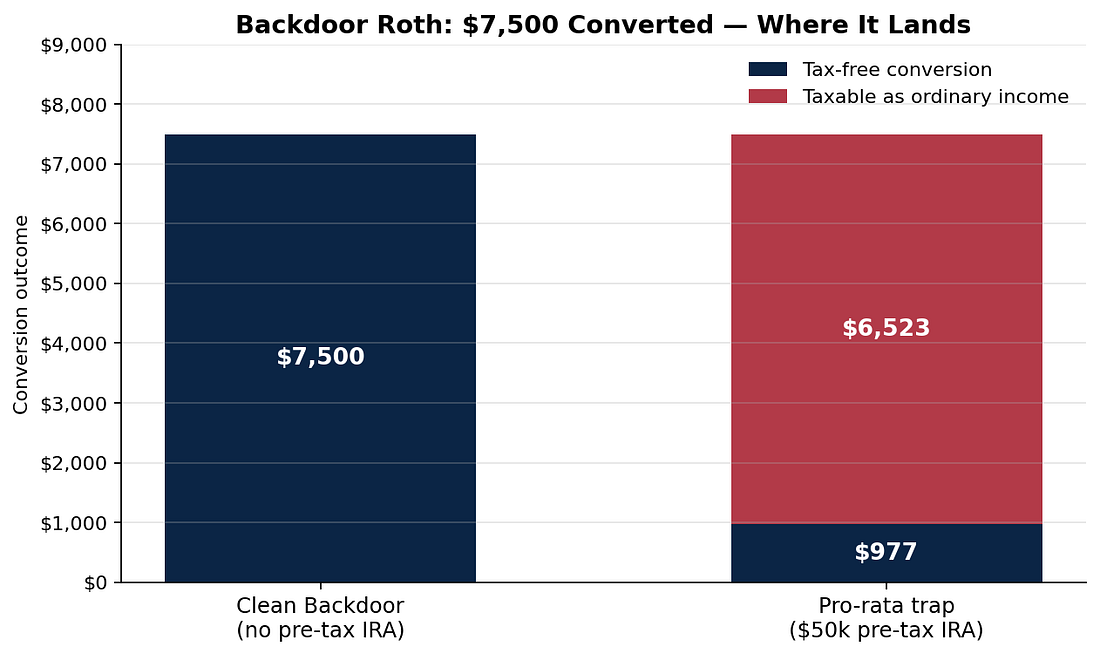 |
Only 13% of your conversion is tax-free. The other 87% — about $6,500 — gets taxed as ordinary income, in your top marginal bracket. For someone in the 32% bracket, that’s a $2,088 surprise tax bill on a strategy that was supposed to be free.
How to legally clear the pro-rata problem
Three options, in order of how clean they are.
Roll your existing pre-tax IRA balances INTO your current 401(k). 401(k)s aren’t counted in the pro-rata math. If your employer’s plan accepts incoming rollovers (most do), this empties out your IRA pool to zero, leaving the backdoor wide open.
If you have self-employment income, open a Solo 401(k) and roll your pre-tax IRA balances there instead. Same result.
Bite the bullet and convert the entire pre-tax balance to Roth in one year. You’ll owe tax on the conversion, but going forward, the pool is clean.
The first option is the most common and the most underused. People with old 401(k) rollovers in IRAs are sitting on the pro-rata trap and don’t know it. Reverse the rollover, then run the backdoor.
Action this week: Check your IRAs. Add up the balance across every Traditional, SEP, and SIMPLE IRA in your name. If it’s zero, you can run a clean Backdoor Roth this year — log into Fidelity or Vanguard, contribute $7,500 to a Traditional IRA as nondeductible, then convert to Roth on the same screen. Should take 10 minutes. If your balance isn’t zero, call your 401(k) provider and ask if they accept incoming IRA rollovers.
Don’t forget the paperwork
Every year you do a backdoor, you have to file IRS Form 8606. This is the form that tells the IRS you made a nondeductible contribution — meaning that money was already taxed and shouldn’t be taxed again on conversion. Without Form 8606, the IRS assumes the contribution was pre-tax, and you’ll be double-taxed on the same dollars.
TurboTax handles it automatically if you check the right boxes. If you have an accountant, mention ‘Form 8606 for a Backdoor Roth’ specifically — most CPAs know it, but a few will miss it.
Why this matters more than people think
Over a 30-year career, $7,500 a year compounded at 7% inside a Roth grows to about $750,000 — all of it tax-free in retirement. Most high earners are paying 32-37% on every dollar they pull from their Traditional 401(k) when they retire. Roth withdrawals are 0%. That arithmetic only gets sweeter as tax rates rise.
If you can do this and you’re not, you’re voluntarily handing the IRS a check you don’t have to write.
The one-line version
If you make too much for a Roth IRA, you don’t have to skip it — you have to take a slightly longer route to the same place. Just clean up your IRA pool first, or the pro-rata rule will charge you for the privilege.
Sources
Vanguard — 2026 Roth IRA income limits — https://investor.vanguard.com/investor-resources-education/iras/roth-ira-income-limits
Fidelity — Backdoor Roth IRA explainer — https://www.fidelity.com/learning-center/personal-finance/backdoor-roth-ira
IRS — Form 8606 (Nondeductible IRAs) — https://www.irs.gov/forms-pubs/about-form-8606
Schwab — Pro-rata rule for IRA conversions — https://www.schwab.com/learn/story/roth-ira-conversion-pro-rata-rule
CNBC — IRS unveils 2026 Roth IRA income limits — https://www.cnbc.com/2025/11/13/roth-ira-income-limits-2026.html
Disclaimer
Affluent Notes is for educational and entertainment purposes only. Nothing in this newsletter is financial, tax, legal, or investment advice. The numbers, charts, and strategies discussed are illustrative; your situation, tax bracket, plan rules, and risk tolerance are different. Past performance does not guarantee future results. Talk to a licensed CPA, CFP, or attorney before acting on anything you read here. The author may hold positions in securities or accounts mentioned.
Affluent Notes is free today. But if you enjoyed this post, you can tell Affluent Notes that their writing is valuable by pledging a future subscription. You won't be charged unless they enable payments.
|
