
|



In the age of AI, proving you are a human has become increasingly hard.
The defenses websites have relied on for years are failing in predictable ways, and the failure shows up most visibly in moments like the one below.
A popular retailer drops a thousand pairs of a limited-edition shoe at noon. Within thirty seconds, the inventory is gone. The buyers turn out to be automated agents working for resellers. The real people who wanted the shoes get nothing.
The retailer almost certainly tried the standard defenses: rate limits by IP, CAPTCHA, phone verification, device fingerprinting. Each of them helps for a while and then stops working. The reason they all fail in the same way is worth pausing on.
Every one of those defenses relies on a proxy for what the retailer actually wants to verify. An IP address is a proxy for a different network. A phone number is a proxy for a different person. A device fingerprint is a proxy for a different device. Each proxy fails the moment adversaries learn to acquire many of them cheaply, and adversaries always do. Phone numbers can be bought in bulk. Fingerprints can be randomized. IPs can be rotated through residential proxy networks. None of these strategies binds the verification to a real, unique person.
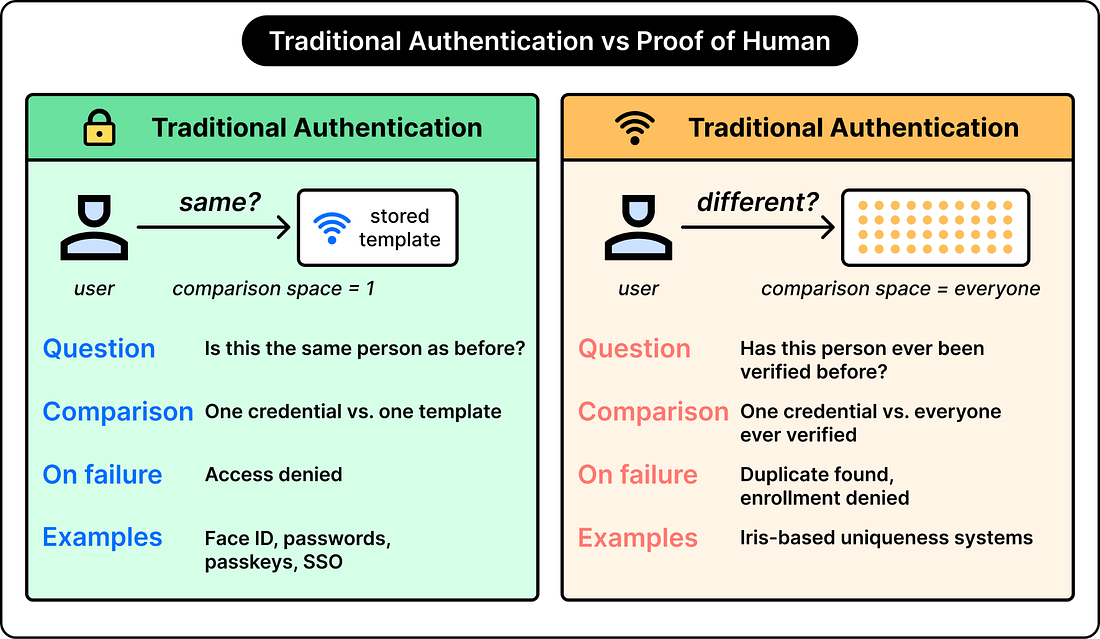
Authentication systems do not solve this either. Single sign-on, face unlock, passkeys, OAuth tokens, all of them compare an incoming credential against a stored template and return yes or no. None of them answers the question that actually matters here: has this user already been verified somewhere else in the world?
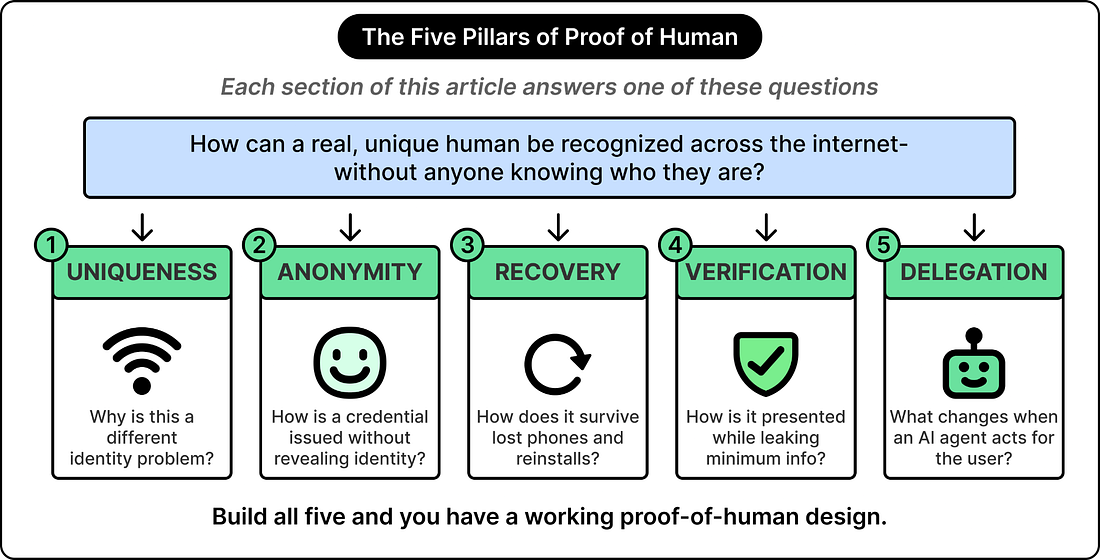
The central question: How do you let a real, unique human be recognized across the internet, without ever knowing who they are?
For this article we spoke with the team behind World, including Tiago Sada and Lily Gordon at Tools for Humanity, on how they try to solve this problem.
 |
Five Pillars of a Proof-of-Human System
A working answer to the central question requires five distinct ingredients. We will look at each one in turn.
Uniqueness. Why is this a different identity problem than the ones we usually solve?
Anonymity. How can a credential be issued without anyone knowing the identity of the user?
Recovery. How does the system survive lost phones and reinstalled apps?
Verification. How does the holder present the credential without revealing more than necessary?
Delegation. What changes when the holder is an AI agent acting on a person’s behalf?
 |
Pillar 1: Uniqueness
To see why uniqueness is structurally different from authentication, start with a system everyone already trusts: Face ID on a phone.
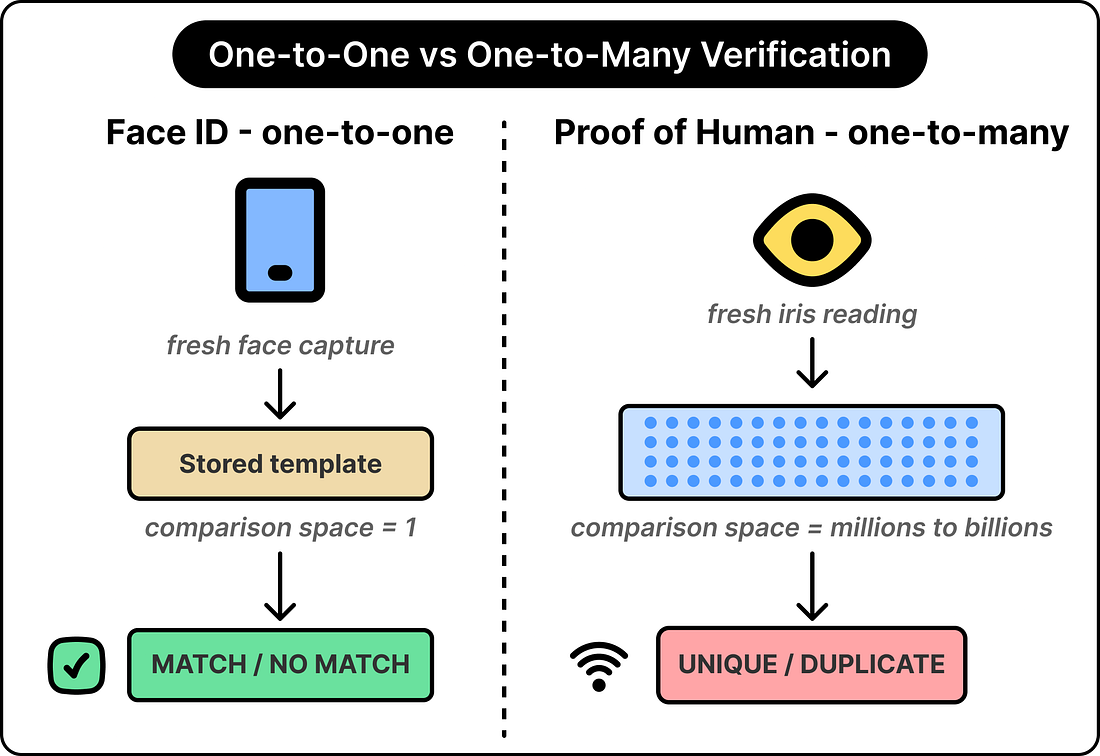
When the user sets up the phone, the camera captures a single facial template and stores it locally. From then on, every unlock attempt produces a fresh capture, which the phone compares against the stored template. The comparison space is exactly one. If the fresh capture matches the template within some tolerance, the phone unlocks. If not, the phone refuses. The system handles other faces by failing the match.
This is a one-to-one matching problem. The math is simple because the comparison is small. Even with a per-comparison error rate of one in a million, the phone unlocks reliably for its owner and refuses essentially every other face.
However, the example with the retailer wants a different guarantee. They want to verify, at checkout, that the buyer is different from every other person who has already bought those special edition shoes. The comparison is no longer against one template, but against the entire population of past buyers. If the system is meant to work at internet scale, the population is potentially every person on the planet.
This is a one-to-many matching problem, and the diagram below shows this comparison in the context of World ID. As you can notice, the math can get much more complex when the comparison space grows.
 |
The probability of a false match scales roughly with the size of the comparison space. A per-comparison error rate of one in a million sounds excellent, but checked against a billion candidates, it produces roughly a thousand false matches per query. To make one-to-many uniqueness viable at a billion-person scale, the per-comparison error rate has to be on the order of one in a hundred billion or better. That requirement rules out most consumer-grade biometric methods straight away.
This type of system that answers the one-to-many question is what the World ID calls the proof of human. At present, there is no widely deployed equivalent of this category. We have a great deal of authentication infrastructure and very little uniqueness infrastructure.
Pillar 2: Anonymity
Once the goal is uniqueness at an internet scale, an apparent paradox emerges.
Checking whether someone is the same as anyone else usually requires recognizing them. If a system cannot identify a person, how can it tell whether it has seen that person before?
The answer takes multiple steps.
Step 1: Find a biometric signal that scales
Most consumer biometrics fall short. For example, fingerprints have decent entropy but can be captured from surfaces. Face geometry varies less than people assume. The iris pattern of the human eye, by contrast, turns out to be one of the few biometric features with the entropy needed for billion-scale comparisons. Two unrelated humans have essentially no chance of producing matching iris patterns, even after accounting for camera noise and aging.
However, reading the iris reliably is the next challenge, and this is where hardware matters.
A standard phone camera can be replaced with a device that injects images directly into the camera pipeline, defeating any face check done in software. A printed iris image can fool an infrared camera that lacks depth detection. To get a reading that resists these attacks, the capture has to happen on hardware that controls the entire signal path from sensor to processing.
Tools for Humanity handles this using a purpose-built device called the Orb. The Orb uses multispectral imaging across infrared and visible wavelengths, runs several neural network