
|
Claude’s Future May Run on Custom Chips
Frontier AI labs are moving beyond models into silicon, cloud capacity, memory, packaging, and inference economics.
|

| |||||||||||||||


Free Claude Code Course with Lydia Hallie, Anthropic (Sponsor)
 |
We partnered with Anthropic to make our Claude Code course free for everyone. No subscription, no trial. Just dive in.
It’s taught by Lydia Hallie, who’s been an instructor with us for years and now works on the Claude Code team at Anthropic. When she taught Claude Code live, it broke every platform record we have with over 10,000 people tuning in.
Lydia has a knack for visualizing how tools work under the hood, which is exactly the mental model you need to stop guessing with AI and start directing it.
Anthropic is reportedly in early-stage talks with Samsung Electronics to manufacture a custom AI chip. No final manufacturing agreement has been announced, and Anthropic is still reportedly defining what the processor should do, how powerful it should be, and how it would fit into a server. The company has also not decided whether the chip would be aimed mainly at training models or inference, meaning running Claude at scale after deployment.
This is not yet a taped-out chip. It is not proof that Anthropic is replacing Nvidia, Amazon, or Google. But it does suggest that AI race is moving from model quality alone to full-stack infrastructure control: model architecture, serving software, custom accelerators, memory, packaging, cloud capacity, and power availability.
Anthropic already runs Claude across a diversified compute stack. The company says it trains and runs Claude on AWS Trainium, Google TPUs, and Nvidia GPUs, while Amazon remains its primary cloud provider and training partner. In April 2026, Anthropic signed a new Amazon agreement securing up to 5 gigawatts of capacity for training and deploying Claude, while committing more than $100 billion over ten years to AWS technologies. It also expanded its Google and Broadcom partnership for multiple gigawatts of next-generation TPU capacity starting in 2027.
So why would Anthropic even explore its own chip?
Because at Claude’s scale, every cent per token matters.
AI Labs Are Becoming Infrastructure Companies
In April 2026, the company said Claude demand had accelerated sharply, with run-rate revenue surpassing $30 billion, up from about $9 billion at the end of 2025. It also said the number of business customers spending more than $1 million annually had doubled to over 1,000 in less than two months. That kind of growth creates pressure on GPUs, data centers, power supply, networking, and inference capacity.
This is the same pattern seen across OpenAI, Google, Amazon, Meta, Microsoft, Tesla, and xAI: frontier AI is no longer just a software business. It is a capital-intensive infrastructure business.
A custom chip gives Anthropic another lever. It could tune silicon around Claude’s actual workloads instead of relying only on general-purpose GPUs or cloud partner chips. That does not mean replacing Nvidia overnight. It means reducing dependency, improving cost efficiency, and gaining more control over the serving stack.
Why Samsung?
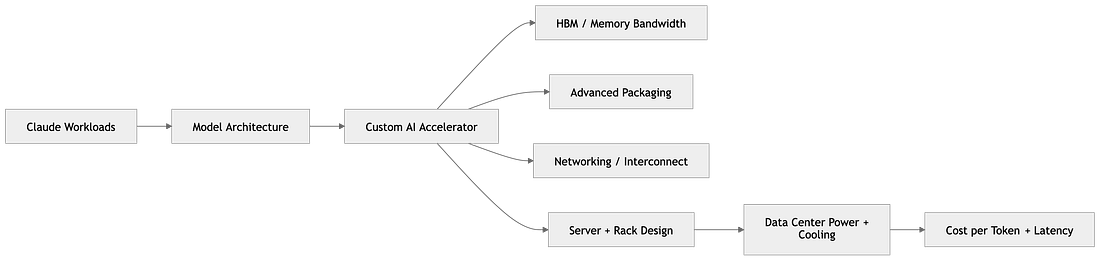
Samsung is not just a memory company. It is one of the few companies that can offer a combination of logic chip manufacturing, high-bandwidth memory, and advanced packaging. That combination matters because modern AI accelerators are not just about the compute die. They depend heavily on HBM, chiplets, interconnects, packaging, thermals, and board-level integration.
Samsung says its SF2 2nm process is a second-generation gate-all-around technology node for mobile, HPC, AI, and automotive workloads, and that it entered stable volume production from late 2025. Samsung also argues that advanced packaging is becoming central to AI/HPC performance because compute and memory must be placed closer together to improve bandwidth, latency, energy efficiency, and scalability.
That is why Samsung is an interesting partner for Anthropic. A Claude-specific accelerator would not just need transistor density.
 |
The foundry angle is also strategic for Samsung. Anthropic’s Series H announcement named Micron, Samsung, and SK hynix as strategic infrastructure partners whose technologies support memory, storage, and logic chips. Among those three, Samsung is the one with a major foundry business capable of manufacturing logic chips, making it the most natural manufacturing candidate if Anthropic moves forward with custom silicon.
Training Chip or Inference Chip?
This is the most important technical question.
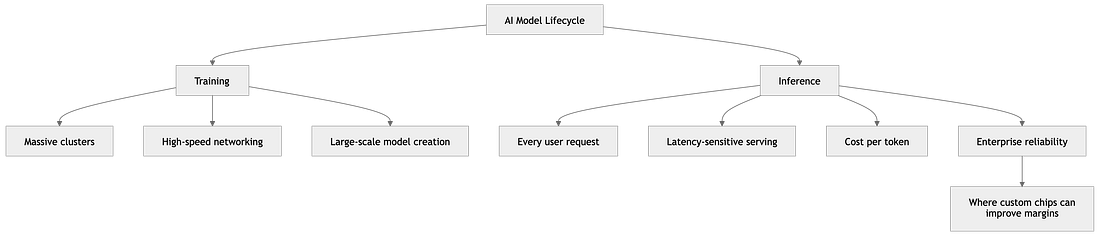
A training chip is used to build large models from massive datasets. It needs huge compute density, fast memory, networking across thousands or tens of thousands of accelerators, and tight software support.
An inference chip is used to run the model after training. It serves user requests, generates tokens, powers coding agents, handles enterprise workflows, and supports consumer usage.
For Anthropic, an inference chip may be the more likely near-term target, although the reporting says no final decision has been made. Why? Because inference is where AI companies can face enormous recurring costs once adoption scales. Training is expensive, but it happens in bursts. Inference happens every second, for every user, API call, coding session, agent workflow, and enterprise integration.
 |