| | In today’s edition: The Daily Wire’s IPO play, and why Hollywood shouldn’t fear AI.͏ ͏ ͏ ͏ ͏ ͏ |
| |  Cannes Cannes | Hollywood | Nashville |
 | Media |  |
| |
|
 - Daily Wire’s IPO
- Mixed Signals
- Don’t fear AI
- Listening habits
|
|
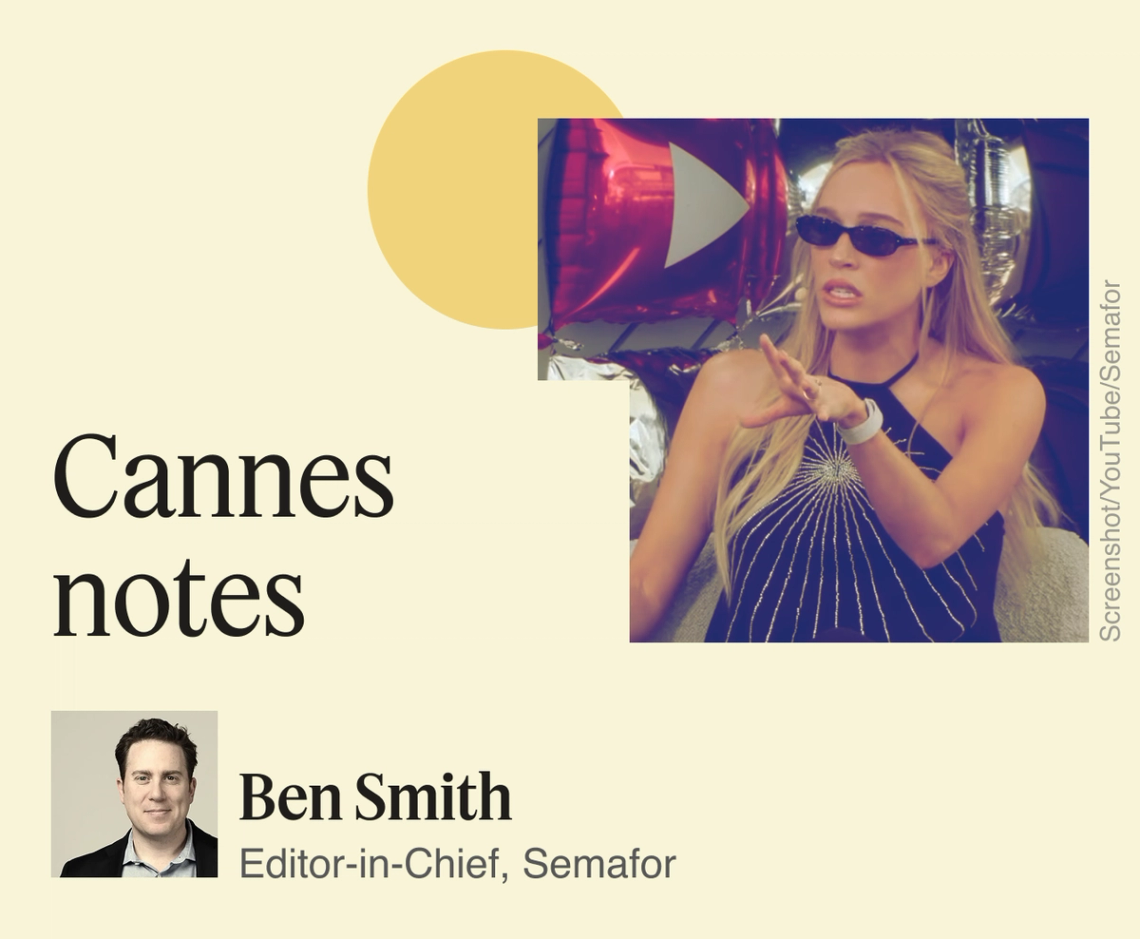 The great Hollywood chronicler Matt Belloni unfavorably compared the Cannes Lions ad fest on the Riviera last week — a “soulless corporate boondoggle” — with the fading, grand Cannes film festival earlier in the summer. Some self-hating marketers may have been stung by Belloni’s jibe, but the mood Max Tani and I found there was mostly the supreme confidence of a growing, $1.3 trillion global industry in boom times. The “creator economy,” not so new, has solidified into a massive, deeply-integrated business. As the Belloni of the ad industry, Brian Morrissey, put it: “Cannes represents a tangible reminder of the reordering of the media landscape that has largely swallowed media. YouTube is far more powerful than any Hollywood studio or broadcaster.” We interviewed one of that new industry’s biggest stars, Alex Cooper, for Mixed Signals, and I put Belloni’s view on the other Cannes to her. “I could have gone to that festival with my husband, but I’m here,” she replied, after talking about the ad dollars flowing into her original productions, and the rate at which people are consuming films on YouTube. “That’s not where the future is anymore — you’re just going to get left behind.” Also today: The Daily Wire’s IPO play, and why Hollywood shouldn’t fear AI. |
|
 Ben Shapiro. Cheney Orr/Reuters. Ben Shapiro. Cheney Orr/Reuters.Conservative media outlet Daily Wire is raising money with an eye toward an IPO, as Max scooped. Its pitch, in the deck and at the Cannes Lions advertising festival: If you want to influence MAGA, you have to advertise where MAGA is. The Wire has been struggling to maintain cultural traction with an increasingly populist right-wing base, and it lost $50 million on a scripted medieval series called The Pendragon Cycle. But it’s still a profitable business, and the $750 million pitch to investors, viewed by Semafor, touts a conservative, “quality” audience that is attracting blue-chip advertisers: Oracle, Paramount, Meta, Netflix, and Chevron. All have big business in front of the White House — merger approvals, data centers, oil concessions, avoiding President Donald Trump’s missives about CNN — and may see conservative media ad spending as a way to press their case. More broadly, the concerns that CMOs had about appearing next to conservative content in the wake of the Jan. 6 riots have all but disappeared; brands are back in force on X, too. (There’s a reason Jamie Dimon went on Maria Bartiromo’s Fox show last year to send Trump a tariff warning: It works.) |
|
Alex Cooper on ‘Mixed Signals’ |
 From launching Call Her Daddy in 2018 to becoming one of the most successful podcasters in the world, Alex Cooper has built a highly influential media brand — and now she’s expanding into the creative agency space. On this week’s episode of Mixed Signals, Unwell co-founder Alex Cooper joins Max and Ben live from Cannes Lions to talk about growing her media business beyond podcasting, how her creative agency ended up going toe-to-toe with Call Her Daddy in revenue, and why she’s more interested in the marketing than most talent in her field. Plus, what she’s learned from her interview with Michelle Obama.
|
|
View: Hollywood, don’t fear AI |
| |  | Reed Albergotti |
| |
 Arafat Barbakh/Reuters Arafat Barbakh/ReutersHollywood shouldn’t worry too much about generative AI that can build images, videos, and songs from a single text prompt. While film executives may not like to say it out loud, AI is already being used to bring down costs and increase the speed of adding visual effects to movies. That means AI can help more artists make more movies, rather than replace artists or their art. In the classic computer-generated movies we’re used to, like the ones in the Marvel cinematic universe, a massive amount of labor and processing power is spent on each scene and asset. Human actors perform in front of screens. The images and physics of the imagined world around them are added in later. With generative AI, the heavy lifting is done during the pre-training process. Once the model is built, it can be used to take a scene constructed by artists and tweak it, making the physics look realistic — not by modeling the physics, but by guessing at them based on absorbing an incredibly large dataset of real-world footage. This process is “breaking down silos between the actor, the director, the producer, and then on the soundstage, they also have solution architects and data scientists that are working with them in real time,” Samira Bakhtiar, Amazon Web Services’ general manager of media and entertainment, said in an interview. If a film uses these “real-time hybrid” techniques to bring down costs, that’s more like a faster, better generation of the CGI viewers know and love. Based on my conversations at Cannes Lions, the best creatives in the business will end up using this transformer architecture in some way. And, with a crisis of ballooning budgets in the film industry, this change couldn’t come at a better time. |
|
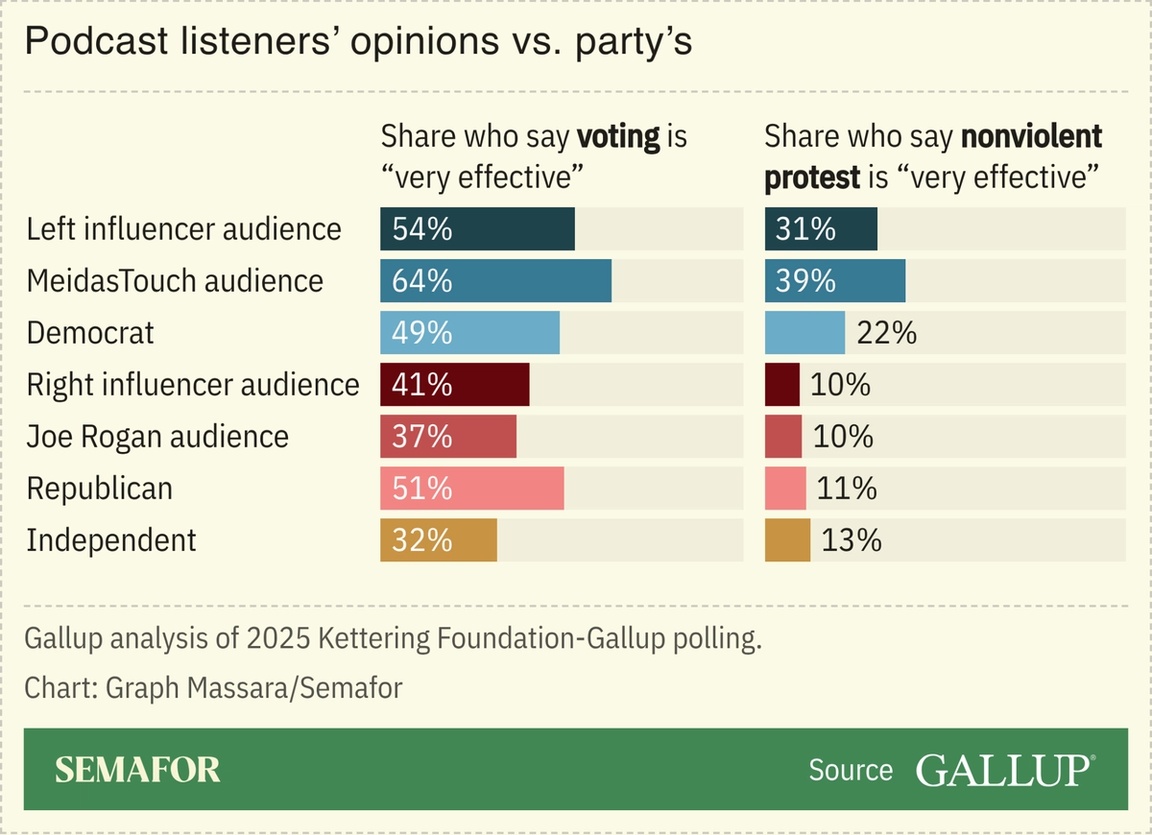 What separates Hasan Piker Democrats or Joe Rogan Republicans from their respective political parties? A new Gallup analysis of 2025 polling data suggests avid listeners of top political podcasts and influencers on both the left and the right hold somewhat more small-D democratic views of government participation. Asked whether citizens who hold “radical views” should be allowed to engage in nonviolent protest, 71% of respondents who listened to what Gallup characterized as left-wing podcasts (Piker, MeidasTouch, Heather Cox Richardson, etc.) and 40% of those who listened to right-wing podcasts (Rogan, Megyn Kelly, Glenn Beck, etc.) strongly agreed, compared with 49% of Democrats overall and 28% of Republicans. Both the left-wing and right-wing podcast groups were also less optimistic that US political leaders will be held to account for wrongdoing than non-podcast-listening Democrats and Republicans, respectively. — Graph Massara |
|
 If you like Semafor, you should take a look at Numlock News. Numlock is a daily newsletter that pops out fascinating numbers buried in the news. Each issue is full of great stories that you’re missing out on, including under the radar science and culture news as well as amazing data journalism that’s drowned out by the loud stuff. Sign up for Numlock and you’ll enjoy catching up on the world each morning — it’s free to read and subscriber-supported. Check it out today. |
|
WSJ: Emily Glazer, Annie Linskey, and Jessica Toonkel detail the bonds, financial and personal, between Oracle’s Larry Ellison and Trump. Bloomberg: Russian agents are going to great lengths to “control the sources of information that underpin search engines and large language models,” Stephanie Baker and Priyanjana Bengani report. FT: Meta is increasingly replacing the humans who review content and ads with AI to offset spending (on AI), Hannah Murphy and Cristina Criddle write. Link in Bio: Rachel Karten writes that the best part of Cannes Lions is the “basement” where attendees can explore the actual ad campaigns from winners and finalists. A Media Operator: Christiana Sciaudone checks in with the man once known as The Washington Post’s TikTok guy on his expanding and profitable media empire. |
|
- In an interview last week, Yahoo CEO Jim Lanzone doubled down on his stance that AI companies need to take a more publisher-friendly attitude. He told Semafor that he thought it was a “huge miss” that first-generation large language models used citations instead of blue links back to publishers. He told Semafor that Yahoo designed Scout, its agent, to highlight the traditional blue links. “We think we need to keep a healthy internet, and it’s the right thing to do, and we think it’s extremely useful for users to be able to check their sources or click through to investigate further,” he said.
- Someone made an extremely comprehensive dashboard tracking Bill Simmons’ mentions of various people on his podcast.
- FIFA required US stadiums to cover their sponsors’ logos, but brands like Levi’s are turning the coverups into a marketing opportunity.
- The anti-misinformation company NewsGuard released an AI fact-checker trained on news reporting.
- Blogger Om Malik died at 59.
|
|
|


