
|
The 4.26% Government Account Almost Nobody Talks About
I-Bonds quietly outpace your high-yield savings — and the IRS doesn't touch the interest until you cash out.
|

| |||||||||||||||


Want to hear the most boring six-figure question in personal finance? Why is your emergency fund still sitting in a savings account paying 0.4%?
The average U.S. savings account is paying 0.61% as of June 2026. The average high-yield savings account is paying 1.58%. Meanwhile, the U.S. Treasury has an account that’s currently paying 4.26%, doesn’t charge a single fee, and you can open it in about 15 minutes on a clunky website that looks like it’s from 1998. Almost no one uses it.
It’s called a Series I Savings Bond. I-Bond, for short. And in a year where the S&P 500 is volatile and 30-year mortgages are still ugly, it’s the single safest way to outpace inflation with cash you don’t want at risk.
So what actually is an I-Bond?
It’s a savings bond issued by the U.S. Treasury, designed specifically to keep up with inflation. The interest rate has two pieces, recalculated every six months:
•A fixed rate — set when you buy and locked for the 30-year life of the bond. The current fixed rate (May 2026 - October 2026) is 0.90%.
•An inflation rate — adjusted every six months based on CPI. The current inflation portion is 3.34%.
Add them together and the composite rate from May 1 to October 31, 2026 is 4.26%. That’s the rate the Treasury is paying you, right now, on brand-new cash. Zero fees. Backed by the U.S. government. And the interest grows tax-deferred for up to 30 years.
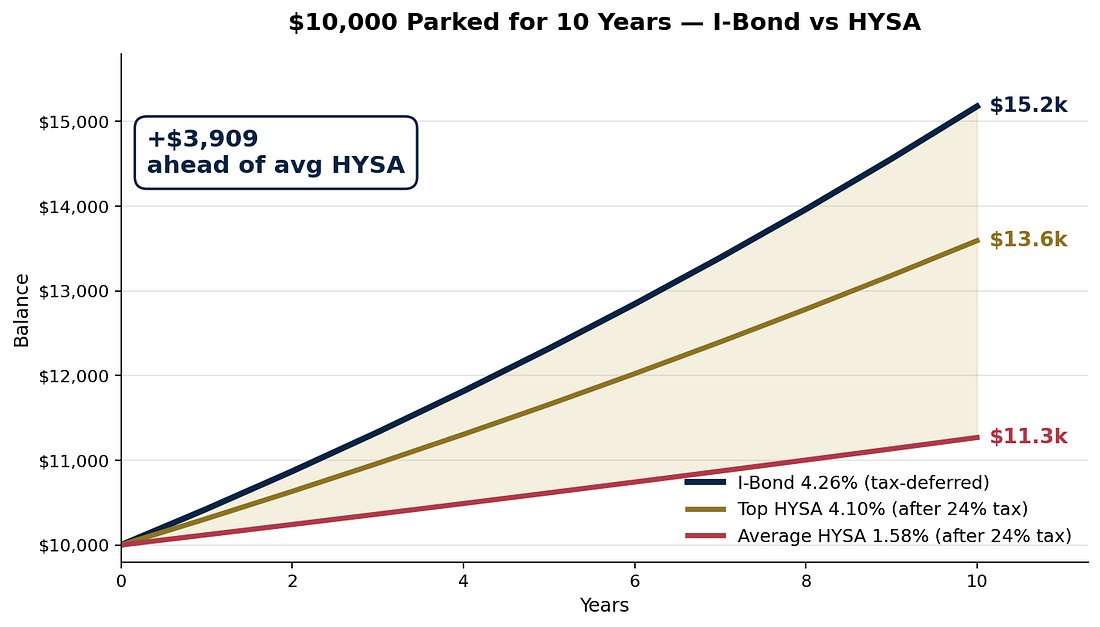 |
That gold band is the difference between earning interest the government taxes every year and earning it inside an account that lets it compound untouched. Same $10,000. Same decade.
Why most people miss this
Three reasons.
First, you can’t buy I-Bonds at Fidelity, Vanguard, or Schwab. You have to use TreasuryDirect — the government’s website. And TreasuryDirect looks like it was built by someone who lost a bet with the IRS in 1999. Most people open the page, see the interface, and assume something so ugly couldn’t possibly be worth the time.
Second, there’s a $10,000 per-person, per-calendar-year purchase limit. So nobody who manages money for a living talks about them — there’s no commission to be earned on a $10k Treasury purchase, and the cap is too small to move the needle for wealthy clients. The financial industry doesn’t sell I-Bonds, so the financial industry doesn’t write about I-Bonds.
Third, there’s a one-year lockup. You cannot touch the money for the first 12 months. From months 13 through 60, you can cash out but you forfeit the last three months of interest. After five years, full liquidity. So this isn’t checking-account money. It’s the cash you don’t actually need this year.
The tax angle most people miss
Interest on I-Bonds is exempt from state and local income tax — federal only. If you live in California, New York, or any state with income tax, that’s already a quiet edge over a regular high-yield savings account.
Better still, you can choose to defer federal tax on the interest until you cash the bond out. Buy in 2026, cash out in 2056, and you pay tax once — in the year you finally redeem. That’s 30 years of compounding inside what’s effectively a tax shelter for cash.
And if you use the proceeds to pay for qualified higher education expenses, the interest can be federally tax-free entirely (subject to income limits).
When I-Bonds aren’t the right call
If you need the money in the next 12 months — don’t. It’s locked.
If your emergency fund isn’t fully funded — build that in a regular high-yield savings first. I-Bonds are layer two of your cash stack, not layer one.
If inflation drops sharply — the inflation component resets every six months. A 4.26% rate today could be 2% next May. The fixed-rate portion is yours forever, but the inflation portion floats.
The one-line version
I-Bonds are the most underused account in retail personal finance — government-backed, inflation-protected, tax-deferred, and currently paying more than almost every high-yield savings account in the country. The interface is terrible. The math is excellent.
Sources
TreasuryDirect — Current I-Bond rates (May 2026) — https://www.treasurydirect.gov/savings-bonds/i-bonds/i-bonds-interest-rates/
Treasury press release — 4.26% composite rate — https://www.treasurydirect.gov/news/2026/release-05-01-rates/
Experian — Average savings account rates (June 2026) — https://www.experian.com/blogs/ask-experian/average-savings-account-rates/
Bankrate — Best high-yield savings (June 2026) — https://www.bankrate.com/banking/savings/best-high-yield-interests-savings-accounts/
IRS — Education tax exclusion for U.S. savings bonds — https://www.irs.gov/forms-pubs/about-form-8815
Disclaimer
Affluent Notes is for educational and entertainment purposes only. Nothing in this newsletter is financial, tax, legal, or investment advice. The numbers, charts, and strategies discussed are illustrative; your situation, tax bracket, plan rules, and risk tolerance are different. Past performance does not guarantee future results. Talk to a licensed CPA, CFP, or attorney before acting on anything you read here. The author may hold positions in securities or accounts mentioned.
Affluent Notes is free today. But if you enjoyed this post, you can tell Affluent Notes that their writing is valuable by pledging a future subscription. You won't be charged unless they enable payments.
|