
|



WorkOS launches auth.md - an open protocol for agent registration (Sponsored)
 |
Sign-up forms were built for humans in browsers, so how do AI agents programmatically register with services?
Enter auth.md. By exposing a single, machine-readable Markdown file at your service root, AI agents can dynamically discover your OAuth Protected Resource Metadata, parse required scopes, and authenticate seamlessly.
With native support in WorkOS AuthKit, you can now implement this protocol out of the box, giving AI tools a standardized, secure way to log into your application.
Everyone is building agents. Most of them will fail at scale. Not because the technology doesn’t work, but because teams don’t know what happens after the demo.
That’s the lesson from Salesforce, which has over 20,000 enterprise customers running Agentforce in production. Their support agent alone has handled over three million conversations.
We sat down with John Kucera, Salesforce’s CPO of Agentforce, to learn what separates agents that deliver real business value from those that stall after a good demo.
What is Salesforce?
Salesforce is the enterprise software leader, and its Agentic Enterprise Architecture defines how AI agents are built and deployed across business operations.
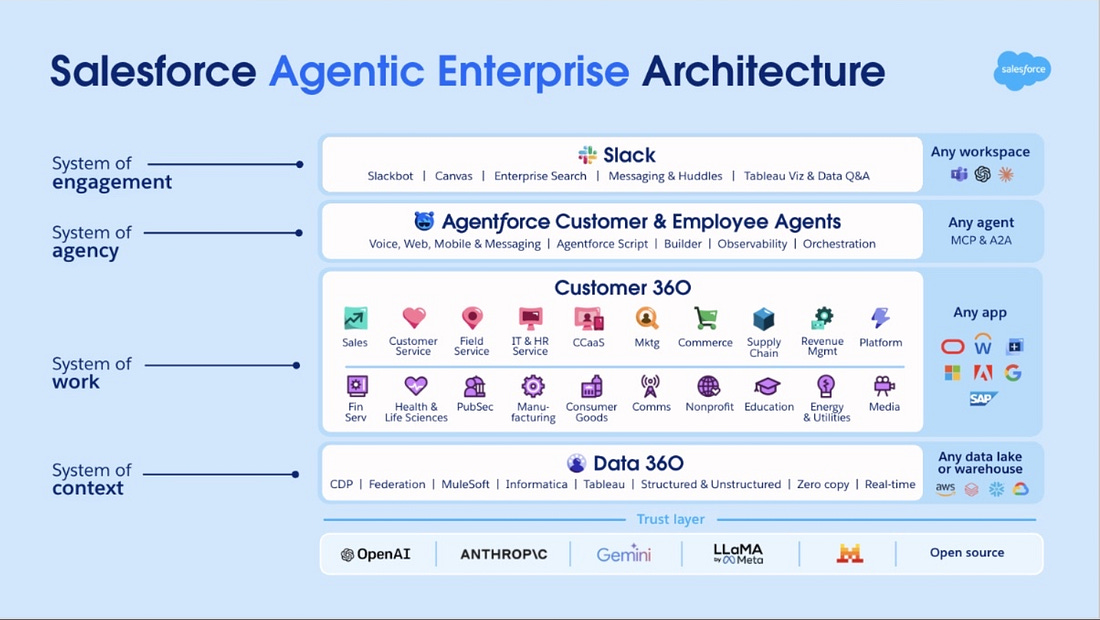 |
The Agentic Enterprise Architecture has four layers. At the top is the engagement layer, where users interact with agents through their everyday tools like Slack, chat, or messaging apps. Below that is the agent layer, where the AI reasoning and decision-making happens. This is where agents are built, monitored, and orchestrated.
Below the agent layer is the system of work, which incorporates the apps trusted by, and tailored for, your department and your industry. These are the business applications where real work gets done, like resolving a support case, processing a return, or updating a sales pipeline. Lastly, the context layer provides agents with the data and metadata they need to ground their actions in real context, ensuring decisions are informed by the specific business operations.
A trust layer spans the entire stack, supporting multiple LLM providers and enforcing the guardrails we cover later in this article.
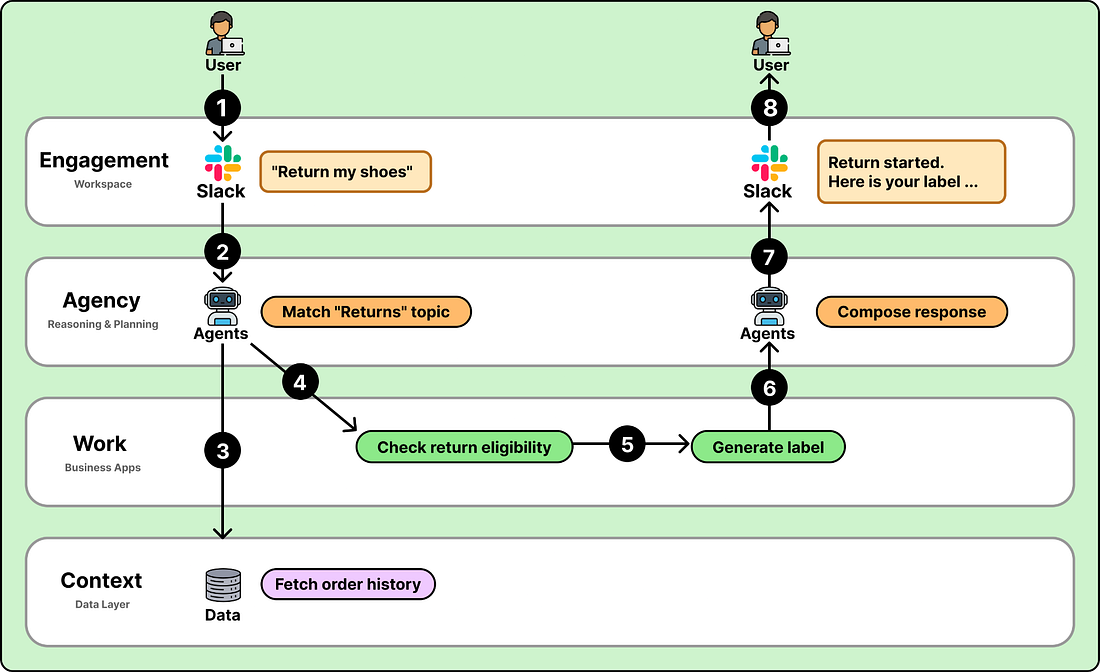 |
Together, these layers let customers go from idea to working agent without building the infrastructure from scratch. Agentforce provides the reasoning, the data access, the business applications, and the trust controls as a connected platform. But having the right architecture is only part of the story. Once 20,000 customers started deploying agents on this platform, Salesforce discovered something that reshaped how they think about the entire product: the hardest part isn’t building the agent. It’s what happens after you ship it.
What is Agentforce?
Agentforce is Salesforce’s platform for building and deploying AI agents in the enterprise. Rather than a single model or chatbot, it’s a layered architecture designed to embed agentic AI across Salesforce’s entire ecosystem like sales, commerce, and services.
Agentforce elevates every experience by bringing together humans, applications, AI agents, and data. Now any company can safely deploy agents that work for their customers, suppliers, and employees 24/7. Teams can manage the complete agent development lifecycle with a robust set of tools to build, test, deploy, manage, and orchestrate AI agents at scale.
Why Most Enterprise Agents Fail
Agents built on LLMs are flexible by design. They can interpret a wide range of inputs and decide what to do in real time. But that flexibility comes with a tradeoff. Because LLMs are non-deterministic, the same question can produce different steps each time. Across Salesforce’s deployments, this was one of the most common challenges: keeping agent behavior consistent and reliable, especially in high-stakes workflows.
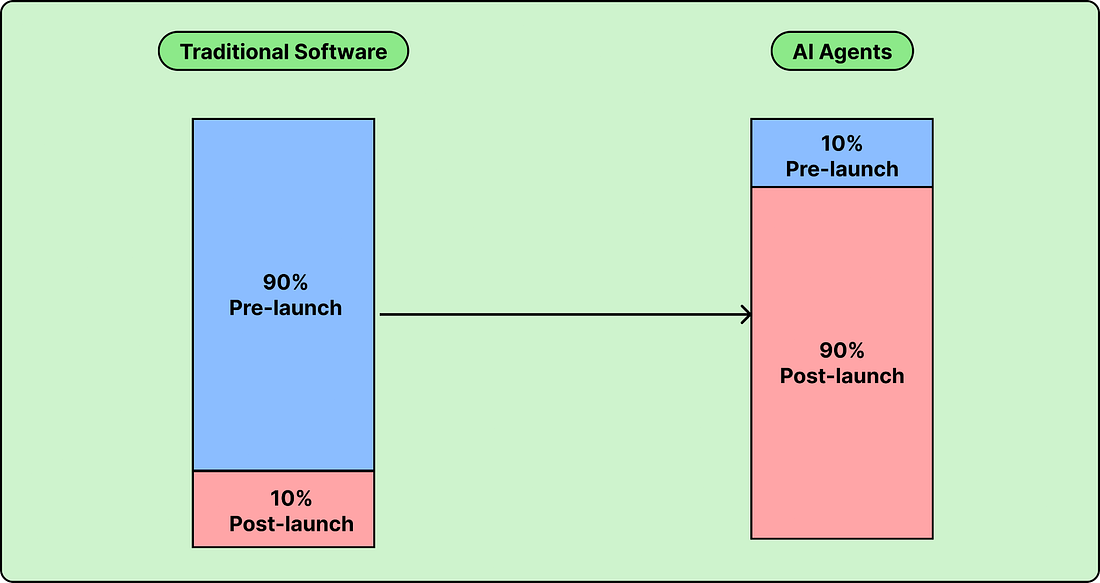
The reason this is so hard comes down to how AI agents differ from traditional software. In traditional software, the effort distribution looks roughly like this:
 |