
|
The $219,000 Mistake Hiding in Your "Permanent" Life Insurance Policy
Whole life is sold as protection plus investment. The math says it's mostly commission.
|

| |||||||||||||||


Want a question that ends a lot of dinner conversations? Ask the person across from you what their life insurance agent’s commission is on a whole life policy. They almost certainly don’t know. The agent never said.
Here’s the answer: industry data puts first-year commissions on whole life often at 70% to 110% of the first-year premium. That’s not a fee. That’s effectively the entire first year of your premium going straight into your salesperson’s pocket. And nobody calls that out, because the salesperson is the one selling it.
This is one of those topics where the gap between what’s pitched and what the math actually says is enormous.
Term vs. whole life, in plain English
There are two flavors of life insurance. They’re so different they shouldn’t share a name.
Term life — pure insurance. Pays out if you die during the term (10, 20, 30 years). If you don’t die, you get nothing. Like car insurance — you don’t get a refund for not crashing.
Whole life — insurance plus a savings component. Coverage lasts forever, premiums are 10 to 20x higher, and a portion of the premium builds “cash value” you can borrow against.
Whole life is sold as the smart, sophisticated choice — protection plus investment, in one package. The math is rarely as flattering as the pitch.
Want to see the math? Here it is.
Take a healthy 30-year-old who needs $500,000 of coverage. According to Policygenius, a 20-year term policy runs about $25/month. The equivalent whole life policy: roughly $440/month. That’s a $415/month gap.
So let’s run the head-to-head. Buy the term ($25/mo). Take the $415/mo difference and invest it in a low-cost index fund returning 7%. Compare that to the cash value of the whole life policy, which the industry’s own illustrations typically credit at 3% IRR over 30 years.
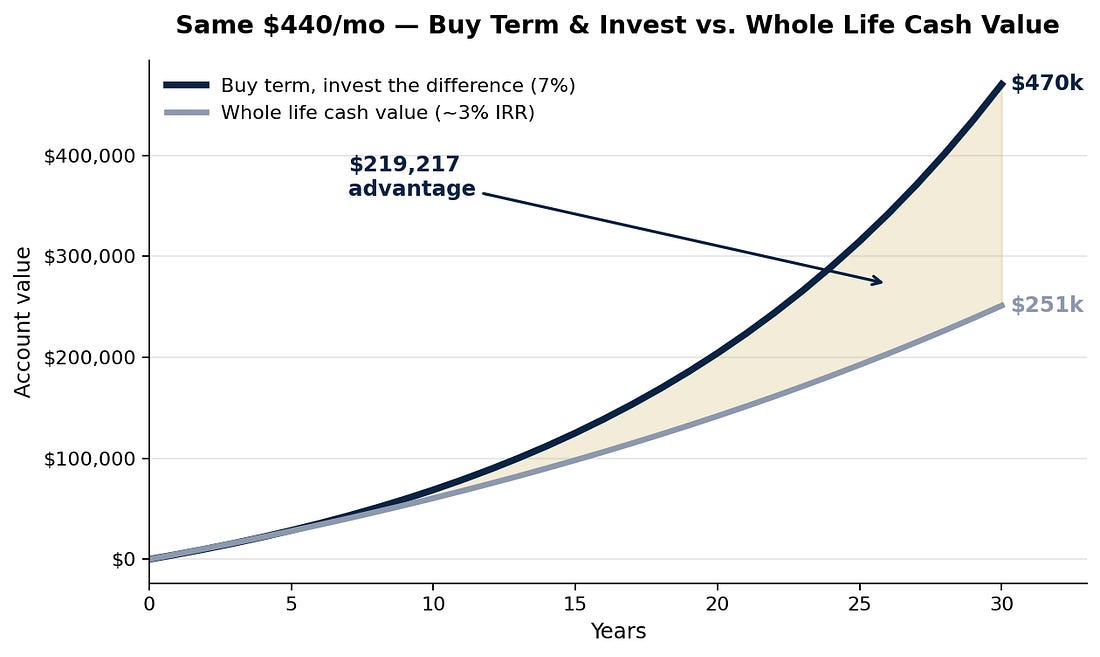 |
Same monthly outlay. After 30 years, the buy-term-and-invest version is worth roughly $219,000 more than the whole life cash value. And the term-buyer kept their full $500,000 death benefit the whole time.
“But whole life is permanent — it can’t lapse”
That sounds important. It mostly isn’t, for most people. The reason is simple: most people don’t actually need permanent coverage. You buy life insurance to protect dependents. By age 65 or 70, your kids are grown, your mortgage is gone, and your retirement savings are doing the heavy lifting. The need for insurance disappears.
Whole life is sold as a forever-need. The need is almost never forever.
Where does whole life genuinely make sense?
Three narrow situations:
Estate tax planning for ultra-high-net-worth families (above $13M+ singles, $27M+ couples in 2026).
Funding a buy-sell agreement for a closely held business.
Permanent dependents — for example, a special-needs child who will need care for life.
If you’re not in one of those buckets, the math almost always favors term.
Action this week: Pull out your life insurance policy. Find the cash value and the annual premium. Run a 30-year future-value calculation on the difference between term ($20-30/mo for $500k) and your current premium, at 7%. If the gap is meaningful, talk to a fee-only advisor — not a commissioned agent — about whether a 1035 exchange or surrender makes sense.
The one-line version
Whole life isn’t a scam. It’s a product designed to maximize commission, sold as if it were designed to maximize your wealth. Those are different things, and the math doesn’t lie.
Sources
Sams List — Life insurance commission breakdown — https://samslist.co/blog/how-life-insurance-commissions-work
NerdWallet — Life insurance agent commissions, 2026 — https://www.nerdwallet.com/insurance/life/learn/life-insurance-agent-commissions
Policygenius — Term vs whole life cost comparison — https://www.policygenius.com/life-insurance/term-vs-whole-life-insurance/
Monegenix — Whole life lifetime cost analysis — https://www.monegenix.com/cost-of-whole-life-insurance-vs-term-insurance/
Stacked Life — Whole life IRR analysis — https://stackedlife.com/post/the-math-on-whole-life-insurance-returns
Disclaimer
Affluent Notes is for educational and entertainment purposes only. Nothing in this newsletter is financial, tax, legal, or investment advice. The numbers, charts, and strategies discussed are illustrative; your situation, tax bracket, plan rules, and risk tolerance are different. Past performance does not guarantee future results. Talk to a licensed CPA, CFP, or attorney before acting on anything you read here. The author may hold positions in securities or accounts mentioned.
Affluent Notes is free today. But if you enjoyed this post, you can tell Affluent Notes that their writing is valuable by pledging a future subscription. You won't be charged unless they enable payments.
|
