Thanks for reading The Briefing, our nightly column where we break down the day’s news. If you like what you see, I encourage you to subscribe to our reporting here.
Greetings!
Elon Musk and Sam Altman don’t often see eye to eye, as they made clear in their recent legal dispute. But when it comes to making outlandish projections about future growth, the two men seem to share a common philosophy.
As we reported earlier on Thursday, SpaceX’s lead bank on its upcoming IPO, Goldman Sachs, has told investors it expects SpaceX’s revenue to hit $474 billion by 2030, from $18.7 billion last year. That’s even more ambitious than OpenAI’s projection—which we reported in February—that its revenue will grow to $284 billion by 2030 from $13 billion in 2025. Both companies also expect to burn massive amounts of cash in the same period, although SpaceX outdoes OpenAI on that count as well.
Neither of these sets of projections is particularly believable, of course. Sure, OpenAI might become a major player in digital advertising—a key part of its growth story—but it has presented little that would support the long-range forecasts it has put forward. SpaceX’s projections are no better. Our story today, by my colleague Cory Weinberg, says two-thirds of the projected 2030 revenue would come from AI, which implies SpaceX thinks it will be bigger than OpenAI by then.
And yet right now, SpaceX’s AI unit is nowhere. Its revenue last year of $3.2 billion was mostly from ads generated by X, the business formerly known as Twitter, which doesn’t count as AI (the discourse on X could be better described as a lack of intelligence, artificial or otherwise). OpenAI, for all its travails, at least has real AI revenue, amounting to $5.7 billion in the first quarter. Moreover, constant employee turnover has turned xAI upside down, and the status of its model development is unclear. Musk has leased out much of its computing infrastructure to rivals such as Anthropic.
We get that the credibility of these projections isn’t important to the Musk fans who are likely to support SpaceX’s stock offering, which is expected to go to market next week. But it is worth noting Musk’s dismal history of meeting projections. In 2022, for instance, he told investors he expected to lift Twitter’s revenue to $26.4 billion in 2028, up from $5 billion in 2021, according to this New York Times account.
How’s he doing? X’s ad business has dropped by half. (SpaceX’s IPO prospectus shows the AI segment’s revenue was $2.6 billion in 2024, “substantially all” of it from X.) Musk combined X into xAI, and the resulting AI unit is also generating revenue from selling subscriptions to its Grok AI chatbot and renting out computing capacity. Those X numbers are no longer relevant, but they are a reminder of the value of long-term revenue projections.
Nadella’s Rebuke
Talk about a career blunder. Microsoft CEO Satya Nadella on Thursday sent out a memo to roughly 50 of the company’s top engineers working on AI products, rebuking an internal memo from another company executive that suggested a goal to “make people addicted” to its new AI agent product, Scout.
“This is absolutely a non goal! If anything we are doing the exact opposite. We want to make sure AI empowers and adds real value to human endeavor and broad economic growth! We should make our teams clear about this,” Nadella said in his memo, a copy of which was reviewed by The Information.
In his message, Nadella attached a link to a report by 404 Media about the original memo, which Corporate Vice President Omar Shahine had sent to a small number of employees. In that memo, Shahine outlined a plan to develop Scout in “three phases from addictive app to agentic platform.” (Microsoft spokesperson Frank Shaw reiterated in a statement that Scout is for “helping people accomplish tasks more effectively—not encouraging dependency.”)
“Not sure what this document is or who is writing and leaking this nonsense! They may want to go work elsewhere,” Nadella said in Thursday’s staff message.—Aaron Holmes
In Other News
• Two members of Congress released a sweeping discussion draft for an AI regulatory framework on Thursday, proposing a bipartisan federal approach ahead of November’s midterm elections (more here).
• Pinterest said it would spend $4 billion on Amazon Web Services infrastructure through 2031, the largest infrastructure commitment in the company’s history. As part of the deal, Pinterest will use AWS’ Trainium chips for AI workloads and expand its use of Amazon’s central processing unit, Graviton.
• Airbnb chief executive Brian Chesky is in early stage talks to fund a new AI lab, according to a person with knowledge of the discussions. The lab will aim to develop models with a possible design focus, according to a Bloomberg report.
• Cybersecurity and data recovery firm Rubrik reported 39% higher revenue of $387 million for the April quarter, far exceeding what it had projected.
• S&P Dow Jones Indices said Thursday it had decided not to change its rules to make it easier and faster for SpaceX to quickly join the S&P 500 and other indices after it goes public.
Today on The Information’s TITV
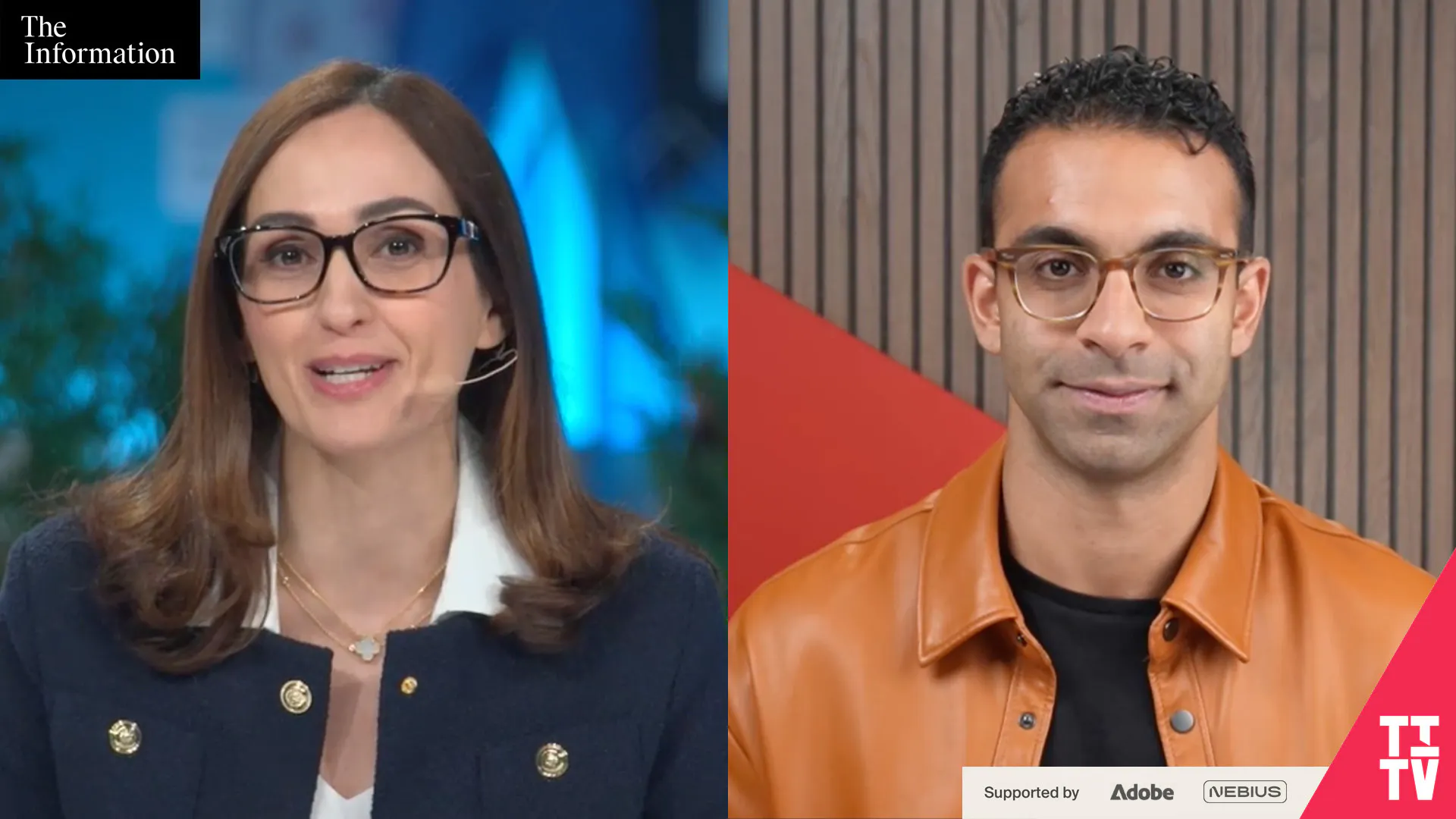
Check out today’s episode of TITV in which we speak with Snowflake’s chief data and AI officer about the company’s competitive positioning.
Recommended Newsletter
Start your day with Applied AI, the newsletter from The Information that uncovers how leading businesses are leveraging AI to automate tasks across the board. Subscribe now for free to get it delivered straight to your inbox twice a week.
Join The Information's SpaceX reporting team as they explore the landmark IPO's implications — from Starlink funding xAI's ambitions and Musk's investor pitch, to index funds and retail demand reshaping the tech industry.
Tickets are on sale now for The Information’s AI Agenda Live in San Francisco. Join top AI leaders for conversations on the future of AI, and secure early bird pricing while it lasts!
Save the Date: The Information returns to Napa Valley October 27-28 to convene senior women across tech, media, and finance. The event will feature two days of intimate, candid conversations with the leaders navigating today’s global shifts.